
Genoese-style homemade focaccia: a quick recipe with Grandma’s secret
Have you ever taken a focaccia out of the oven that looked inviting but after just thirty minutes turned as hard as a shoe sole?
It’s a very common problem: often lack of humidity or a rushed rising makes the dough “dry” and unpleasant.
Many think you need endless hours of waiting or some professional mixer, but the truth is the secret to long-lasting softness lies in a small chemical balance between fats and liquids.
To solve this problem once and for all, I dusted off an old notebook of my grandmother’s notes.
Among the yellowed pages I found what she called her “foolproof recipe.” At first I was skeptical: there was one ingredient, butter melted in the milk, that I’d never seen in a traditional focaccia.
Yet I had to change my mind. This trick not only makes the dough silky and very easy to work by hand, but it creates an internal structure so soft it melts in your mouth.
If you’re looking for the taste of memory combined with a fast method anyone can do, you’re in the right place.
Simple ingredients within everyone’s reach like Manitoba flour, dehydrated brewer’s yeast (such as Mastro Fornaio), milk, oil, salt and a little honey plus a secret ingredient, very easy preparation even by hand and a quick rise—finally a FOCACCIA anyone can make!
Quick and Foolproof Focaccia: 5-step method
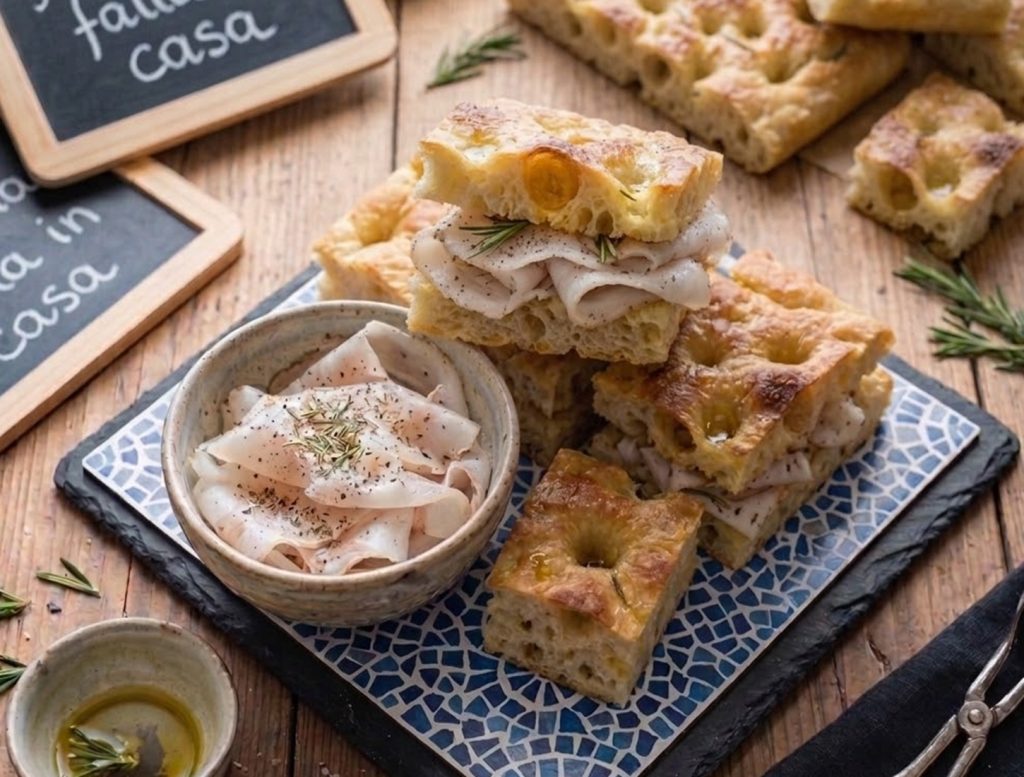
- Difficulty: Very easy
- Cost: Very economical
- Rest time: 2 Hours 30 Minutes
- Preparation time: 15 Minutes
- Cooking time: 15 Minutes
- Portions: rectangular baking sheet 12 x 16 in
- Cooking methods: Oven
- Cuisine: Italian
Ingredients Homemade Focaccia
- Manitoba flour (about 3 3/4 cups (450 g))
- 00 flour (about 1/3 cup (50 g))
- Dry brewer's yeast (1 sachet (e.g. Mastro Fornaio))
- Whole milk (about 1 1/4 cups (300 ml))
- Butter (about 1 1/2 tablespoons (20 g))
- Salt (2 teaspoons)
- Extra virgin olive oil (4 tablespoons)
- Honey (1 tablespoon)
- 30 ml Extra virgin olive oil (about 2 tablespoons (30 ml))
- Coarse salt (for sprinkling at the end)
- 30 ml water (about 2 tablespoons (30 ml))
Tools
- Bowl
- Spoon
- Pastry board
- Baking tray
- Plastic wrap
- Small bowl
- Brush
How to prepare focaccia at home
To prepare the focaccia, first take the milk and add the butter. Warm it slightly (in the microwave or on the stove) until the butter is completely melted. Attention: the milk must be lukewarm, it must not boil, otherwise it will kill the yeast.
In a large bowl, combine the flours, the yeast, the honey, the oil and the milk-and-butter mixture. Start working the ingredients with a spoon until you get a homogeneous consistency. Transfer the dough to the pastry board, add the salt and work by hand for about 5 minutes. You will obtain a smooth, silky dough.
Place the dough in a bowl, make a cross cut on the surface and cover with plastic wrap. Let rise for 2 hours (until doubled). After this time, take the baking tray (I used a rectangular 12 x 16 in one) greased with oil and gently stretch the dough with your hands, without re-kneading it. Let it rest in the tray for another 30 minutes.
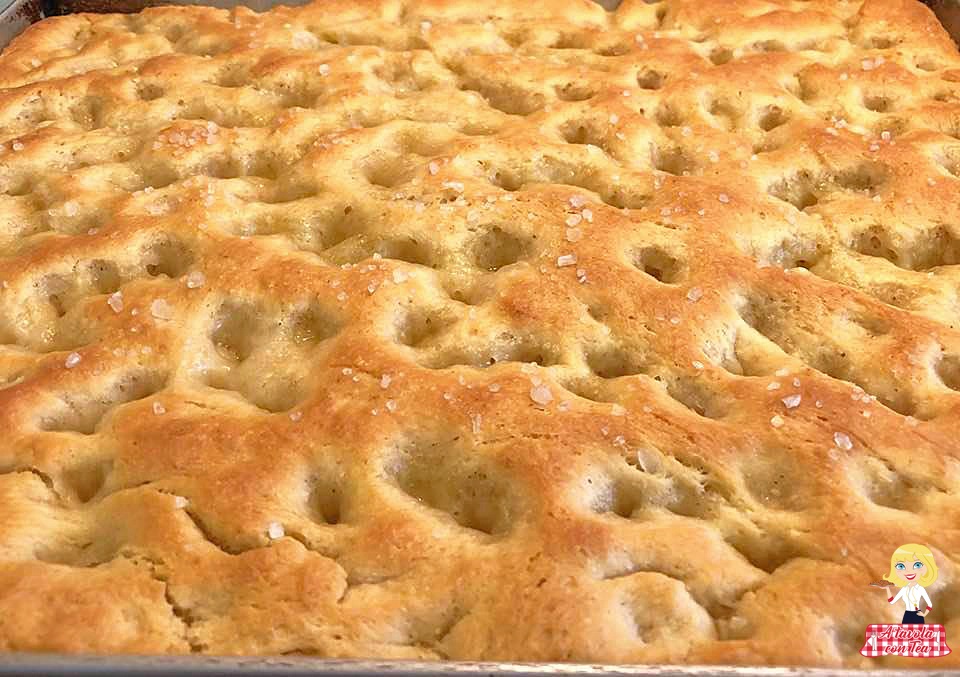
Prepare the brine by mixing the water and oil. Create the classic dimples on the surface by pressing with your fingertips, then spread the brine and the coarse salt.
TIP: For perfect results (my grandmother’s second trick) place a tray with water on the lowest rack of the oven. This will help better rising and baking of the focaccia. Bake in a conventional (non-fan) oven at 482°F for 15-18 minutes.
Substitutions and Versions
Lactose-free: Replace the butter with a good-quality vegetable margarine and the whole milk with water or unsweetened soy milk. The softness will be slightly different, but still very good.
Without honey: If you don’t have honey, you can use a tablespoon of sugar (still to activate the yeast).
STORAGE
I recommend consuming the focaccia the same day so it doesn’t lose its fragrance and crispness. If you have leftovers you can safely store them in the freezer and take portions out as needed; in that case divide it into portions beforehand.
TIPS
When you start kneading on the work surface I suggest adding flour to the pastry board only if necessary and in small amounts, otherwise the focaccia will lose softness.
Lightly oil your hands before stretching the dough in the tray.
The advantage of using dehydrated brewer’s yeast like Mastro Fornaio is that it does not need to be dissolved or reactivated in water; you add it directly to the flour together with a tablespoon of honey or two teaspoons of sugar.
OTHER FOCACCIAS
If you want to try making the classic GENOESE FOCACCIA the recipe is here https://blog.giallozafferano.it/atavolacontea/ricetta-focaccia-genovese-fatta-in-casa/
A TAVOLA CON TEA ON SOCIAL
FACEBOOK https://www.facebook.com/aTavolaconTea/
INSTAGRAM https://www.instagram.com/atavolacontea_/?hl=it
Why did my focaccia turn out hard or dry?
The main causes are: a) Too much flour: Do not add excess flour while working on the pastry board. b) Lack of humidity: Make sure you used the tray of water trick on the bottom of the oven, which is essential to prevent the surface from drying out and to keep it soft.
How important is the “secret” ingredient (butter in the milk)?
Using butter in the dough is the key element that, together with the milk, gives a prolonged softness and tenderness, distinguishing it from a basic focaccia. It is strongly recommended not to omit it for the “foolproof” result.
My focaccia didn’t rise, what went wrong?
Rising fails if: a) The yeast is inactive. Make sure the yeast is fresh (or, if dry, still within its date). b) The temperature is wrong. Check that the milk is only lukewarm, not hot, otherwise it kills the yeast.
Can I use fresh baker’s yeast?
Yes, you can replace the sachet of dry yeast with 12 g (half a cake) of fresh baker’s yeast, dissolving it in a little lukewarm water taken from the total amount.
Can I prepare the dough the night before?
Certainly! After doing the folds, place the covered bowl in the fridge overnight. The next morning, proceed to stretch and do the second rise in the tray as in the recipe.
What is the purpose of the water on the bottom of the oven?
It’s the trick to prevent the dough from drying out. The steam keeps the surface elastic, allowing the focaccia to rise more and remain soft.
