
How to make Vitello Tonnato at home easily and quickly (without mayonnaise or using hard-boiled eggs)
The secret to tender Vitello Tonnato and a chef-level sauce
Vitello tonnato is one of the great classics of Italian cuisine, but let’s be honest: disappointment is often around the corner. How many times have you bitten into a gray, chewy slice of meat that’s almost impossible to chew, or found a tuna sauce on your plate that’s too runny, sliding off instead of coating the meat?
It’s a problem that affects many cooking enthusiasts, often caused by the wrong cut of meat or cooking that is too aggressive and stresses the muscle fibers.
In this definitive guide, I want to reveal how to turn a potentially mediocre dish into a triumph of flavors and textures. The secret starts with choosing the Magatello or Girello, but the real magic happens in the cooling: the meat must rest in its broth to remain juicy and pink just right.
Not to mention the sauce: forget those heavy industrial versions. I will teach you how to perfectly balance capers, anchovies and tuna to obtain a silky cream that doesn’t cover the flavor of the veal but enhances it.
Whether you’re preparing the starter for Sunday lunch or an elegant buffet, these small tips will make your guests ask for the recipe before they’ve finished the first bite. Let’s get to work and finally solve the dilemma of tough meat!
- Difficulty: Easy
- Cost: Medium
- Preparation time: 20 Minutes
- Cooking time: 50 Minutes
- Portions: 4-6 servings
- Cooking methods: Stovetop
- Cuisine: Italian
- Energy 525.40 (Kcal)
- Carbohydrates 4.00 (g) of which sugars 0.33 (g)
- Proteins 39.60 (g)
- Fat 34.56 (g) of which saturated 10.23 (g)of which unsaturated 13.19 (g)
- Fibers 1.13 (g)
- Sodium 1,250.03 (mg)
Indicative values for a portion of 150 g processed in an automated way starting from the nutritional information available on the CREA* and FoodData Central** databases. It is not food and / or nutritional advice.
* CREATES Food and Nutrition Research Center: https://www.crea.gov.it/alimenti-e-nutrizione https://www.alimentinutrizione.it ** U.S. Department of Agriculture, Agricultural Research Service. FoodData Central, 2019. https://fdc.nal.usda.gov
INGREDIENTS SIMPLE VITELLO TONNATO
- 1 lb 12 oz lbs Veal (magatello or girello (eye of round))
- 1 cup Dry white wine
- 4 1/4 cups Water
- 3 tbsp Extra-virgin olive oil
- 1 stalk Celery stalk
- 1 Carrot
- 1 Yellow onion
- 1 clove Garlic clove
- leaves Bay leaves
- 1 pinch Salt
- to taste Black peppercorns
- 5.6 oz Tuna in oil
- 3 Hard-boiled eggs
- 3 tbsp Capers (packed in salt), rinsed
- 2 fillets Anchovy fillets (salted), rinsed
- 1/3 cup Cooked vegetables (boiled from the meat broth)
- to taste Salt
- 1 ladle Meat broth (from the cooking of the meat)
How to make Vitello Tonnato at home easily and quickly (without mayonnaise or with hard-boiled eggs)
Start by preparing the aromatic “bed” for the meat. Wash the celery and trim the ends, then cut it into large pieces. Peel the yellow onion and quarter it. Wash and peel the carrot, remove the ends and cut it into pieces. Clean the garlic clove, leaving it whole so it can be removed easily.
Take a large pot (big enough to hold the meat) and place the piece of magatello (or girello) in it. Add the prepared vegetables, the bay leaves, the cloves and the black peppercorns. Pour in the dry white wine and the water until the meat is completely covered. Finally add the salt and the extra-virgin olive oil. Bring to medium heat until the broth comes to a boil. As soon as it boils, lower the heat to minimum, cover with a lid and let cook for about 45-50 minutes (allow about 30 minutes for every 1.1 lb (500 g) of meat).
Once cooked, immediately remove the piece of meat from the broth with a slotted spoon and let it cool completely at room temperature (this is crucial to be able to slice it well). In the meantime, strain the broth removing all the spices (bay, pepper, cloves). Take about one third of the total broth and pour it into a small saucepan. Put it over high heat and let it reduce for about ten minutes, until it has concentrated.
While the meat and broth cool, cook the hard-boiled eggs (about 9 minutes from boiling). Peel them and cut into quarters. Take about 1/3 cup (80 g) of the cooked vegetables from the broth (the ones you didn’t discard), drain the tuna in oil, and desalinate the capers and the anchovies. Put the eggs, tuna, capers, anchovies and vegetables in the jar of a blender or food processor. Add one ladle of the reduced broth and blend until you obtain a smooth, homogeneous cream. If the sauce is too thick, gradually add more reduced broth. Taste and adjust salt if necessary.
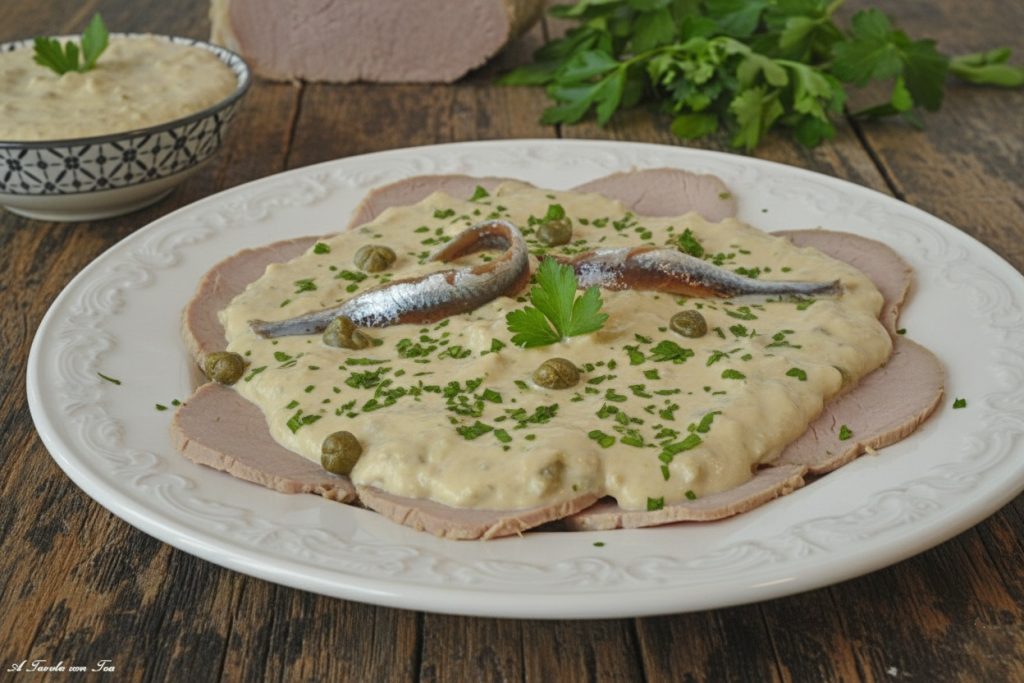
Once the meat is completely cold, slice it into very thin slices with a very sharp, smooth-bladed knife (or with a slicer). Arrange the slices on a serving platter, pour the tuna sauce generously over the center or on one side and garnish with some whole capers for a finishing touch. Serve your Vitello Tonnato well chilled.
If you’re short on time but don’t want to give up the tenderness of your magatello or girello for Vitello Tonnato, the pressure cooker is your best ally. For a piece of meat of about 1 lb 12 oz (800 g), the cooking time is drastically reduced to only 20-25 minutes from the whistle (or from reaching full pressure), compared to 45-50 minutes for traditional cooking. Simply place the meat and vegetables as per the recipe in the pressure cooker, add water, wine and aromatics up to the maximum level indicated (or at least until the meat is covered), close the lid and bring to pressure over high heat. Once cooked, turn off the heat, let the steam release completely and remove the meat. This method not only halves the time, but also helps keep the meat more juicy and the broth more concentrated — perfect for your super creamy tuna sauce!
If you’re short on time but still want rich flavor, you can prepare a quick tuna sauce with mayonnaise, skipping the egg and oil step entirely. Simply combine in the jar of an immersion blender: good-quality mayonnaise (as the base of the sauce); drained tuna in oil; desalinated capers; anchovy fillets (if you didn’t use them when cooking the meat); a splash of the cooking juices (if available) or a little water to thin and make the sauce smoother.
Blend everything for a few seconds, until smooth. Taste and, if necessary, adjust salt or add a pinch of lemon juice for a brighter note. The sauce is ready to cover the veal slices!
Cut of meat for Vitello Tonnato
For a Vitello Tonnato worthy of the Piedmontese tradition, the choice of cut is not a detail but the foundation of success. The best piece is without doubt the Magatello (also called Girello). This cut, taken from the rear part of the veal thigh, is ideal for several reasons: it has an elongated and regular shape that makes slicing easier, it is extremely lean and has very few streaks of fat, which keeps it compact during and after cooking in broth. Its firm texture and delicate flavor absorb the aromas of the broth without becoming chewy. If you can’t find the magatello, a great alternative is the Fesa di Vitello (top round), making sure it is well tied so it keeps its shape during poaching. Avoid cuts that are too rich in fat or tendons, which would make slicing difficult and compromise the elegance of the finished dish.
Storing Vitello Tonnato
Vitello Tonnato is a dish that lends itself wonderfully to being prepared in advance — in fact it improves after a few hours of rest. Once assembled, it can be stored in the refrigerator for up to 3-4 days. I recommend placing the slices of meat arranged on a plate and covered with the tuna sauce in an airtight container. If you prepared the sauce separately, you can store it in a sealed jar for the same time. Remember that it’s essential that the tuna and eggs used in the sauce are fresh at the time of preparation. For best enjoyment, remove it from the fridge about ten minutes before serving.
Notes on Key Ingredients
To achieve an excellent result, the quality of the ingredients really makes a difference:
Tuna in Oil: Choose high-quality tuna. Even though it’s packed in oil, draining it well is essential. A tuna in glass jars, perhaps ‘ventresca’ or ‘yellowfin’, will give the sauce a richer flavor and smoother texture.
Capers and Anchovies: They are the salty, savory heart of the sauce. Make sure to desalinate them carefully under running water to avoid an overly salty or overpowering final sauce.
Reduced Broth: Don’t underestimate the importance of this ingredient! It replaces the oil and, partly, mayonnaise. The concentrated broth will bind the sauce naturally, making it full-bodied but light. If you didn’t have time to reduce it, use the cooking broth as is, but sparingly.
Alternatives and Variations
Although tied to tradition, Vitello Tonnato offers some tasty variations:
Quick Vitello Tonnato (with mayonnaise): If you’re in a hurry and accept a modern version, you can replace the hard-boiled eggs, the broth vegetables and part of the reduced broth with 3/4 cup of mayonnaise (homemade or good quality). Mix the mayonnaise with the tuna, capers and anchovies, adding very little broth to adjust the density.
Vitello Tonnato with Taggiasca Olives: For a Ligurian touch, add 1/4 cup of pitted Taggiasca olives to the sauce when blending. Their fruity, delicate flavor pairs well with the tuna.
Variation with Different Cuts: If you can’t find magatello, you can use turkey breast or pork loin. Cooking times will be similar, but the taste will be slightly different.
How do I slice the meat into very thin slices?
The secret is temperature and equipment. The meat must be completely cold, just taken from the refrigerator, to keep it firm. Use a very sharp, smooth-bladed knife or, for a professional result, a slicer. Always cut perpendicular to the meat fibers.
Can I make the sauce without mayonnaise?
Absolutely yes — in fact, the traditional recipe does not include mayonnaise. The creaminess comes from the hard-boiled eggs and the emulsion with the tuna and reduced broth. If your sauce is too thin, try adding another half hard-boiled egg or a tablespoon of the boiled vegetables.
The meat didn’t cook through — what went wrong?
You probably miscalculated time or the temperature was too high or too low. Remember the basic rule: about 30 minutes for every 1.1 lb (500 g) of meat, starting from when the broth boils and then keeping the flame at minimum. If you use a pressure cooker, the time is halved (about 20-25 minutes from the whistle). In any case, use a kitchen thermometer: the internal temperature at the core of the meat should reach 158-167°F (70-75°C).
How do you make the traditional tuna sauce without mayonnaise?
The traditional sauce is obtained by emulsifying tuna, hard-boiled eggs, capers and anchovies with the oil and the reduced cooking broth of the meat, which gives creaminess and flavor without weighing it down.
What is the ideal internal cooking temperature for Vitello Tonnato?
Veal should reach an internal temperature between 158°F and 167°F to be perfectly cooked and remain tender.
Can you use Fesa or Sottofesa instead of Magatello?
Yes — as an alternative to magatello (girello) you can use fesa di vitello or sottofesa. They are lean cuts that keep their shape during poaching and are suitable for thin slicing.
What is the best cut of meat for vitello tonnato?
The cut of choice is undoubtedly the girello (also called magatello), a very lean part of the veal thigh with no nerves. Alternatively, you can use the fesa, which is equally tender but slightly wider. The important thing is that it is a high-quality piece of meat, because the success of the dish depends almost entirely on the texture of the slice.
How can you slice the meat so thin without a slicer?
The fundamental trick is cooling. Never try to slice the meat while it’s still warm: it will shred. Let it cool completely in its broth, then wrap it tightly in cling film and refrigerate for at least 4-5 hours (or overnight). Once very cold and firm, use a very sharp smooth-bladed knife and make decisive cuts to obtain paper-thin slices.
Can I prepare the tuna sauce without mayonnaise?
Absolutely yes! The “old-fashioned” recipe calls for a base of hard-boiled egg yolks blended with tuna, capers, anchovies and a bit of the meat cooking broth to adjust the density. This version is more intense and flavorful than the mayonnaise one, and is perfect for those seeking a more traditional taste and a slightly rustic but velvety texture.
What are the ingredients for tuna sauce with mayonnaise?
The basic ingredients are few: tuna, mayonnaise, capers and anchovies. One of the simplest and light-tasting variants is the tuna sauce without mayonnaise.
Can the tuna sauce be prepared the day before?The tuna sauce can be prepared in advance and stored in the refrigerator until needed, well covered with plastic wrap or sealed in a jar. It keeps for a couple of days.
