
How to prepare a smooth, creamy chocolate pastry cream, also gluten-free.
Chocolate pastry cream: the definitive recipe for guaranteed success!
The spoon dessert that wins everyone over! If you’re tired of curdled creams and lumps, this recipe is the one for you.
With simple steps you’ll get a smooth, creamy cream with an intense chocolate flavor, perfect to fill cakes, cream puffs, or simply to enjoy on its own with crunchy cookies.
Furthermore, this recipe is also suitable for celiac people, as it is prepared with cornstarch. Don’t wait any longer, discover all the secrets to prepare the perfect chocolate pastry cream!
It’s a very versatile preparation: you only need to slightly adjust some ingredient amounts to obtain different consistencies suitable for the use you have in mind!
To thicken it more, simply use more cornstarch or reduce the amount if you want to enjoy it by the spoon. For the classic pastry cream recipe click here: Quick and Foolproof Pastry Cream
- Difficulty: Very easy
- Cost: Very inexpensive
- Preparation time: 15 Minutes
- Cooking time: 10 Minutes
- Portions: 4 servings
- Cooking methods: Stovetop
- Cuisine: Italian
Ingredients for Chocolate Pastry Cream
- 2 cups whole milk (fresh)
- 2 tbsp butter
- 5.3 oz dark chocolate
- 0.6 cups granulated sugar
- 3 tbsp cornstarch (about 3 tbsp for a thicker cream)
- 5-6 yolks egg yolks (about 5-6 yolks)
- 1 pinch salt
- 2 tbsp rice starch (about 3 tbsp for a thicker cream)
Tools
- Kitchen scale
- Saucepan
- Whisk
- Spatula
- Thermometer
- Sieve
- Plastic wrap
How to Prepare Chocolate Pastry Cream
Chop the Chocolate: Coarsely chop the dark chocolate and set it aside.
Heat the Milk: Pour the milk into a saucepan and add a pinch of salt. Bring the milk to a boil (a vigorous simmer). Turn off the heat.
Prepare the Starches: In a bowl, sift the cornstarch and rice starch to avoid lumps.Whisk the Yolks: In a second bowl, quickly whisk the yolks and the sugar with a hand whisk until they become slightly frothy and lighter in color (you don’t need to whip them as for a sponge, but they should be well blended).
Add the Starches: Incorporate the sifted starches into the yolk-and-sugar mixture and whisk vigorously until you obtain a smooth, lump-free paste.
Pour the Milk: Pour the boiling milk into the yolk mixture, straining it to catch any skins or impurities. Mix well with the whisk.Cook Over Medium Heat: Pour the mixture, which will be very liquid, back into a heavy-bottomed saucepan and place it over medium heat.
Stir Continuously: Stir constantly with the whisk and a spatula (to scrape the sides and bottom well) until the cream thickens. Never stop stirring to avoid lumps!
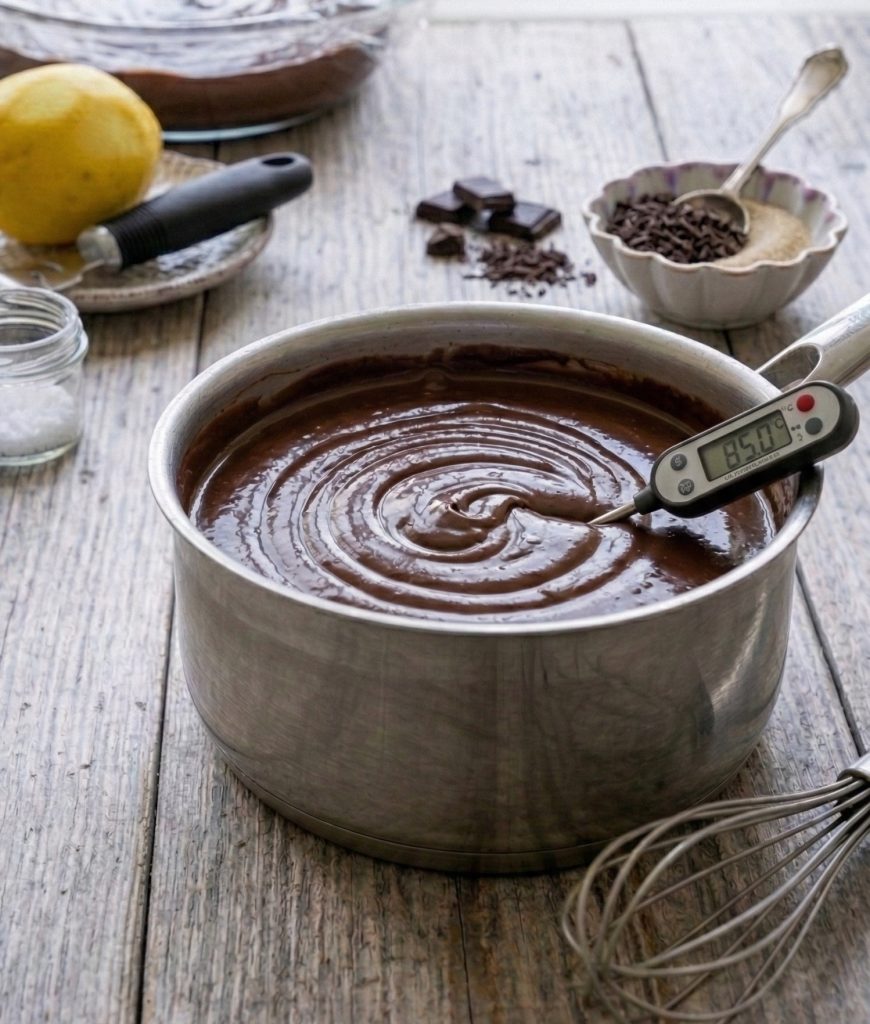
Reach the Temperature: As soon as the mixture starts to show the first surface bubbles (or reaches precisely 185°F if you use a thermometer), immediately remove the pan from the heat.Melt Chocolate and Butter: With the heat off, add the cold butter and the chopped chocolate to the hot cream.
Emulsify: Stir vigorously with the whisk until the butter and chocolate are completely melted and the cream becomes glossy, homogeneous and velvety.
Cooling: Pour the cream into a shallow, wide dish to cool faster. Immediately cover it with plastic wrap in direct contact with the surface.
Final Rest: Let the cream cool at room temperature for about an hour and then transfer it to the refrigerator for at least 3 hours before using.At the time of use, the cream will be very thick. Transfer it to a bowl and whisk vigorously by hand for a few seconds: it will immediately become smooth, creamy and ready to use.
Ingredient Notes and Substitutions
Milk: Whole milk is recommended for a richer cream and more enveloping flavor. It can be substituted with plant milk (oat or soy) for a dairy-free version, keeping in mind that the starch may behave slightly differently.
Starches: The mix of cornstarch and rice starch is the secret for the perfect texture. If you need to substitute them, you can use 50 g of cornstarch total, but the texture will be less silky. Avoid all-purpose flour (00), which tends to give a “floury” taste.
Chocolate: A 50-55% dark chocolate is ideal to balance the sweetness. If you prefer a more intense and bitter cream, you can use 70-75% dark chocolate.
Storage
Chocolate pastry cream keeps in the refrigerator, covered with plastic wrap in direct contact with the surface (as explained in the method), for 3 days. Freezing is not recommended because freezing and thawing can alter its texture, making it grainy.
Alternatives and Recipe Variations
Gianduia Cream: Replace 50 g of dark chocolate with 50 g of pure hazelnut paste or gianduia chocolate.
Spiced Aroma (Autumnal): Add a pinch of cinnamon or nutmeg to the milk before bringing it to a boil for a warm, enveloping aroma.
Egg-Free Cream: Replace the yolks with a total of 90 g of starches (45 g cornstarch + 45 g rice starch) and 20 g more sugar to maintain structure and sweetness (also add an aroma to compensate for the missing yolk).
Uses and Pairings
This cream is extremely versatile and not only for eating by the spoon!
Classic Filling: Cakes (tarts, sponge cakes, “grandma” cakes), cream puffs, cannoli and eclairs.
Spoon Desserts: Served in cups with fresh fruit (raspberries, strawberries) and crumbled amaretti.
Tiramisu Base: Use it as a base instead of mascarpone cream for an intense chocolate tiramisu.
Origins and History of the Recipe
Pastry cream, in its basic form as an egg-based thickened cream, has been a pillar of European pastry since the Middle Ages. However, its codification with egg yolks, sugar, milk and a thickener (formerly flour or starch) is mainly due to French and Italian tradition. The addition of cocoa/chocolate was a natural evolution, which took hold especially in Italy in the 19th and 20th centuries, particularly in regions like Piedmont, where chocolate culture is very strong, thus creating the delicious Chocolate Pastry Cream (Crème Pâtissière au Chocolat).
Why Add Butter at the End?
Many wonder why butter should be added with the heat off, after cooking the cream and chocolate. The reason is simple but fundamental for success: by adding cold butter at a lower temperature (about 158-176°F), it “emulsifies” perfectly with the other ingredients. The fat emulsion gives the cream an extraordinary shine, unmatched silkiness and improves its preservation. Don’t skip this step: it’s the professional pastry chef’s touch!
1. My cream has lumps, what did I do wrong?
From my personal experience, when pastry cream has lumps the main cause is almost always insufficient stirring at two moments: 1) when combining the starches and sugar (the paste must be smooth) or 2) during cooking. But don’t worry if lumps form — I have the solution! Quickly blend the cream with an immersion blender for a few seconds, off the heat.
2. Can I make the cream with milk chocolate?
Yes, but I recommend reducing the sugar to 100 g, because milk chocolate already contains more sugar and the cream could become too sweet.
3. Why should I whisk the cream vigorously after removing it from the fridge?
I strongly recommend whisking the pastry cream that has been refrigerated before using it. Indeed, during cooling the starches stabilize and the cream thickens a lot, temporarily losing its softness. Whisking it breaks this crystallized structure and restores its velvety, creamy texture, making it perfect for filling.
