
Candied Orange Peels: the Homemade Treat That Smells Like Happiness
When winter arrives and oranges fill the market stalls with their intoxicating scent, there is a simple and extraordinary way to capture that sunshine and preserve it in a jar: candy the peels.
Contrary to what you might think, making candied orange peels at home is not difficult at all.
It only requires a bit of patience, the same patience you dedicate to beautiful things, and one essential ingredient: the right oranges.
It is crucial that the oranges you choose are organic and untreated, because the peel we’ll use must be free of pesticides and any chemicals.
The result will reward you for the wait: sweet, tender bites with a slightly bitter aftertaste and an enveloping aroma like no other.
They are perfect to snack on by themselves for a sweet treat, or to enrich your desserts and savory dishes.
A little treasure to enjoy or give as a gift, containing all the flavor and history of an ancient tradition.
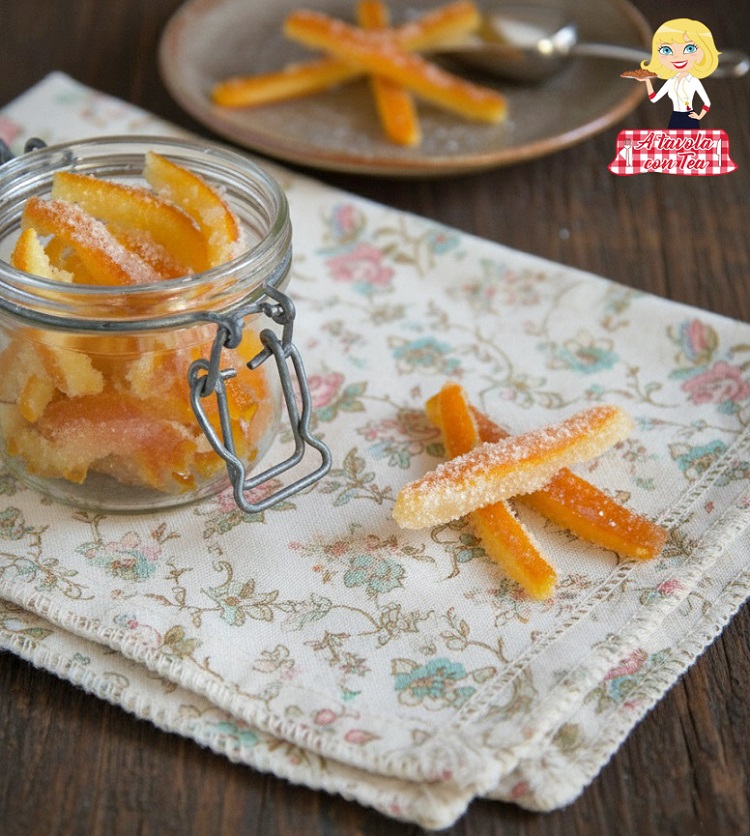
- Difficulty: Very easy
- Cost: Very inexpensive
- Preparation time: 10 Minutes
- Cooking time: 2 Hours
- Portions: about 11 oz
- Cuisine: Italian
Ingredients
- 1.1 lb Oranges (untreated (organic preferred))
- 2 1/8 cups Water
- 1 1/2 cups Sugar
Preparation CANDIED ORANGE PEELS
First, wash the oranges thoroughly under running water, scrubbing the peel with a sponge to remove any impurities. This step is crucial, as the peel will be the main ingredient in our recipe. Once clean, cut the oranges into segments and remove the flesh with a knife, leaving only the peel.
Next, cut the peels into strips about 1/4 inch (0.2 in) wide. Try to be precise and even so that the candying process happens uniformly.
In a pot, combine the water and sugar and bring to a boil over low heat. Add the orange peels and let them simmer gently for about two hours, stirring occasionally. After this time, turn off the heat and let the peels cool in their syrup for at least 24 hours. This long resting period allows the peels to absorb the syrup optimally.
Return the same pot with the peels and syrup to the stove. Bring to a boil again and cook for another two hours over low heat. This second step will make the peels even softer and sweeter. Turn off the heat and let them rest again for another full day in the syrup.
Using a slotted spoon, gently lift the peels from the liquid and place them on a cooling rack to dry. This will take several hours. Your candied orange peels are ready!
Notes on ingredients and substitutions
The choice of oranges is fundamental: they must be strictly untreated, preferably organic, to guarantee a healthy and natural product. If you don’t like oranges, you can use the same technique to candy the peels of other citrus fruits such as lemons, mandarins, or citrons. For a bolder flavor, you can add a pinch of cinnamon or a vanilla bean to the sugar syrup during cooking.
Storage
Candied orange peels keep perfectly for several weeks. You can store them in a glass jar with an airtight lid, immersed in their cooking syrup. If you prefer them drier, store them in an airtight container in a cool, dry place.
Alternatives and variations
Chocolate-coated: once the peels are dry, melt dark chocolate in a bain-marie and dip half of each peel. Let them dry on parchment paper.
Candied lemon peels: follow the same procedure using untreated lemons. The result will be more tart and refreshing.
Mixed: use a mix of orange, lemon and citron peels for a variety of flavors and colors. The sugar and water quantities remain unchanged.
Uses and pairings
Candied orange peels are a versatile ingredient in the kitchen. You can use them to garnish cakes, mousses, semifreddo, or to enrich doughs for leavened desserts like panettone and bundt cakes. They are also delicious paired with dark chocolate, or as a sweet-and-sour touch in salads and savory meat dishes like duck or pork.
The origins of an ancient sweet
Candying is one of the oldest food preservation techniques, born to extend the shelf life of fruit. Candied citrus peels in particular have a long history rooted in the Middle East and spread to Europe through trade. In the past, unlike today, they were considered a luxury item, often used for celebrations and special occasions. Even today, making this sweet at home is a way to connect with these ancient traditions.
1. Why are my peels hard?
It may be that you didn’t cook them long enough or the heat was too high. Remember that very low heat cooking for several hours is essential to soften the peels and allow the syrup to penetrate.
2. Can I use less sugar?
Sugar is essential not only for sweetness but also for preservation. If you use less, the peels may not keep as long and may not reach the soft, candied texture you want.
3. Can I speed up the process?
I strongly discourage rushing the process. The double cooking and two 24-hour rests are indispensable steps to obtain soft, perfectly candied peels. Patience is the secret ingredient!
