
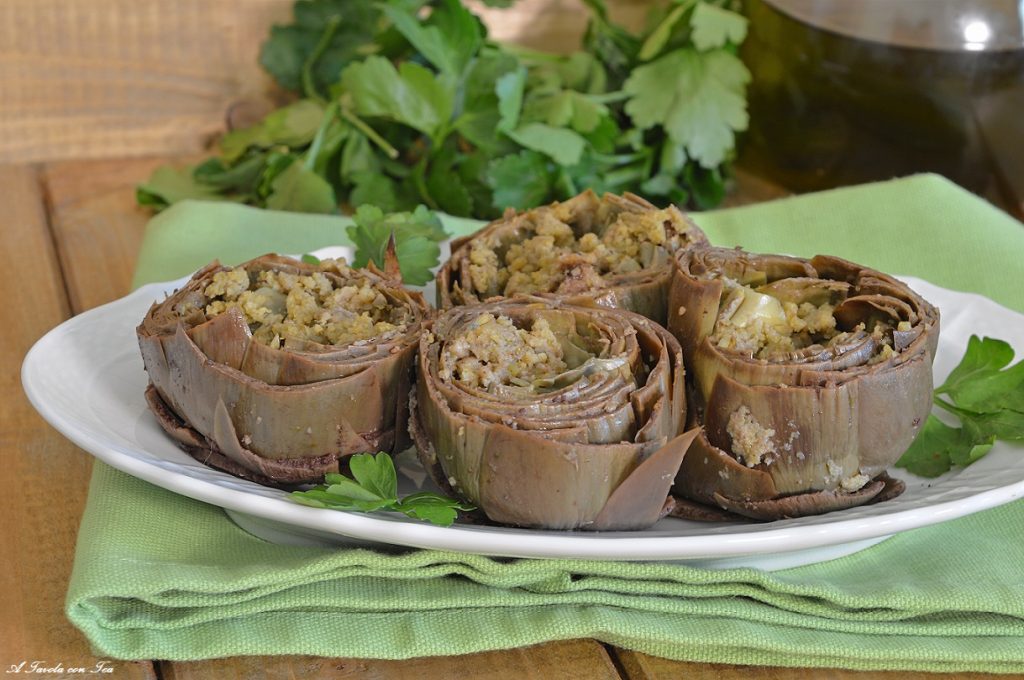
STUFFED ARTICHOKES in A PAN
In my opinion one of the most precious assets a family can have is the passing down of traditions.
Whether they are recipes as in my case or any other passion, carrying them on—perhaps even adapting them a little to our times—will make them immortal and will prevent this enormous heritage of experience from being lost.
Leaving aside the “philosophy” (I was never much into that subject anyway), let’s come down to earth and think about today’s recipe.
I talked about traditions because the recipe for these stuffed artichokes cooked in a pan was passed down to me by my grandmother Caita – whose real name was Margherita – who was originally from Messina.
They were so good that even as a child, and as such not fond of most vegetables, I was crazy about them. Maybe it was their tasty, slightly cheesy stuffing, or the softness and creaminess of the artichoke, or that fantastic little crust that formed at the base when it came into contact with the pan — I don’t remember exactly, I only know that describing them makes my mouth water.
We are in the middle of artichoke season, so what better time to try this recipe!
- Difficulty: Very easy
- Cost: Economical
- Preparation time: 15 Minutes
- Cooking time: 45 Minutes
- Portions: 4 servings
- Cooking methods: Stovetop
- Cuisine: Italian
- Seasonality: Easter
- Energy 418.71 (Kcal)
- Carbohydrates 29.28 (g) of which sugars 2.77 (g)
- Proteins 13.77 (g)
- Fat 26.09 (g) of which saturated 5.96 (g)of which unsaturated 9.44 (g)
- Fibers 5.96 (g)
- Sodium 429.23 (mg)
Indicative values for a portion of 100 g processed in an automated way starting from the nutritional information available on the CREA* and FoodData Central** databases. It is not food and / or nutritional advice.
* CREATES Food and Nutrition Research Center: https://www.crea.gov.it/alimenti-e-nutrizione https://www.alimentinutrizione.it ** U.S. Department of Agriculture, Agricultural Research Service. FoodData Central, 2019. https://fdc.nal.usda.gov
WHAT YOU NEED TO MAKE STUFFED ARTICHOKES IN A PAN
- 4 artichokes (large)
- 1 cup breadcrumbs
- 3/4 cup Parmigiano Reggiano PDO (grated)
- 1/3 cup pine nuts
- 2 anchovies in oil
- 1 clove garlic
- 2 tablespoons extra virgin olive oil (for the stuffing)
- 1 bunch parsley
- 1 glass red wine
- 1 glass water
Tools
- Food processor
- Bowl
- Frying pan
Preparation
First of all, clean the artichokes. Start by removing the outer leaves, which are the toughest, trim the stem and cut off the spiky tips of the leaves. Since the artichokes must remain whole to be stuffed, you cannot cut them into wedges: the only way to remove the inner “choke” is to open the leaves as wide as possible and scoop out the center with a teaspoon, creating a “hole” inside that you will then fill with the stuffing.
Now prepare the filling. Pulse the parsley, garlic and pine nuts in the food processor, then put them in a bowl and add the breadcrumbs, the grated Parmigiano and the drained anchovies chopped with a knife. Mix everything with a spoon, then add two tablespoons of extra virgin olive oil and stir again so the ingredients combine well. The stuffing for your artichokes is now ready.
Take the artichokes and fill the cavity you created with a generous spoonful of the stuffing. Press firmly so there are no gaps and the artichokes are completely filled. You’re now ready to cook them.
Place a non-stick frying pan over the heat and pour in two tablespoons of extra virgin olive oil. Heat the oil and when it’s hot, arrange the artichokes with the stuffed side facing up. Cook for a couple of minutes over high heat. At this point add the red wine and the water you mixed together earlier. You may not need all of it, but bear in mind the artichokes should be covered up to about three-quarters of their height. Reduce the heat and simmer over medium heat for about 30 more minutes. If you like a golden crust on top, finish cooking them under the oven broiler for 5 minutes at the highest setting.
-
TIPS
If you prefer a stronger flavor you can replace the Parmigiano Reggiano with pecorino. In that case, since there are several salty elements (pecorino, anchovies), do not add salt while cooking; if, once ready, they taste under-salted you can always add salt at the end to taste.
A Tavola con Tea on Instagram
https://www.instagram.com/atavolacontea_/?hl=it
To see more recipes return to the home page by clicking here https://blog.giallozafferano.it/atavolacontea/
