
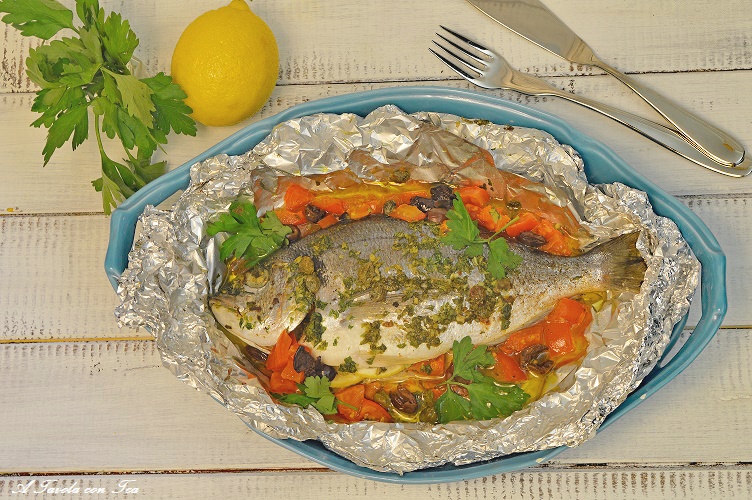
What happens when your husband decides to go on a diet? Well, for a food blogger it’s a catastrophic event!!!!! I can’t very well post and photograph plates of salad or vegetable purees. Fortunately, there are many light but tasty – and photogenic! – recipes that can still satisfy my urge to cook without forgetting my partner’s requests. One of these is baking fish in foil (en papillote) in the oven. It’s definitely one of the simplest cooking methods: by keeping the cooking juices inside the parcel the fish stays moist and flavorful, and besides, the oven stays clean! Even though it’s really easy and quick, you still need to pay attention to a few details for perfectly cooked fish because we don’t want it raw or rubbery. I’ll reveal my dad Peo’s tips—he was a fantastic fisherman as well as a cook! You’ll prepare a dish that is easy, quick and impressive, while at the same time light and fragrant. Today I’ll use gilthead sea bream (orata), but other types of fish are also suitable, as noted at the end of the recipe.
- Difficulty: Easy
- Cost: Medium
- Preparation time: 15 Minutes
- Cooking time: 25 Minutes
- Portions: 2 people
- Cuisine: Italian
Ingredients
- 1.3 lb gilthead sea bream (orata)
- 6 cherry tomatoes
- 15 salt-packed capers
- 10 Taggiasca olives (or pitted black olives)
- 1 lemon (untreated / unwaxed)
- 2 tablespoons extra virgin olive oil
- 1 bunch parsley
- 1 clove garlic
- to taste salt
- to taste freshly ground black pepper
Preparation
It goes without saying that for the best result the quality of the ingredients is crucial. Always make sure the fish is extremely fresh! As my dad used to tell me as a child, you can tell by the eye! It may sound trivial but it’s absolutely true. The eyes should be bright and convex, the gills a nice vivid red and the skin silvery with scales adhering to the flesh.
If you didn’t have the fish cleaned by your fishmonger, no problem—it’s very simple. First remove the dorsal and side fins by cutting them with scissors. Then scrape off the scales with the back of a knife from tail to head.
At this point open the belly of the fish by inserting the tip of the scissors into the small hole under the belly toward the tail and continue up to just under the head. Remove the entrails, rinse the sea bream inside and out under cold running water and dry it.
Then take the lemon, wash it thoroughly and cut it into slices. Chop the parsley and garlic in a food processor and once chopped put some of the mixture inside the fish. Insert a couple of lemon slices into the cavity as well. Finally season with salt and pepper.Take a baking dish and place two sheets of aluminum foil inside it, brush the bottom with olive oil and lay the sea bream on it. Once the cherry tomatoes are washed, cut them in half and distribute them around the fish in the baking dish; then rinse the capers well under running water to remove excess salt and add them along with the pitted olives. Drizzle the sea bream with a little olive oil, add a bit of the chopped parsley and garlic mixture left over and finally a pinch of salt. Close the foil packets by overlapping and sealing the edges tightly.
Now bake the sea bream in a preheated conventional oven at 392°F for about 25 minutes (time for a 1.1 lb sea bream). When cooked, take the sea bream out of the oven and serve it with the cooking juices, the tomatoes, the olives and the capers.
Notes
Because oven-baked fish is low in fat it can sometimes taste bland. The best way to add flavor is to marinate it beforehand. You can place the fish in a large container, sprinkle it with lemon juice, chopped garlic and parsley and a drizzle of oil, and let it marinate at room temperature for about an hour before baking.
Cooking times and temperatures are very important. If the oven is too hot the flesh will become rubbery; if it’s too low it will remain undercooked and show traces of blood.
After several attempts I’d say the optimal oven temperature is between 374°F and 392°F (it depends on the oven). Likewise, cooking times vary with the weight of the fish. As a guideline, a fish weighing about 1.1–1.3 lb requires 25 minutes of cooking; if it weighs 2.2 lb, consider about 35 minutes.
For this type of cooking, in addition to gilthead sea bream, sea bass, snapper and John Dory are suitable; small oily fish are not ideal as they prefer grilling or frying.
If you have leftover fish, reheating it is not great, but if you use it for a fish sauce it’s fantastic. Flake it with a fork and check with your hands that no bones remain. In a pan prepare a simple tomato sauce by adding just one clove of garlic (which you’ll remove) and a tablespoon of extra virgin olive oil. After 5 minutes of cooking the tomato sauce, add the flaked fish, mix well and remove from the heat. Meanwhile cook spaghetti, drain it al dente and finish cooking it in the pan with the fish sauce, adding a tablespoon of pasta cooking water. Plate and serve sprinkled with chopped fresh parsley.
