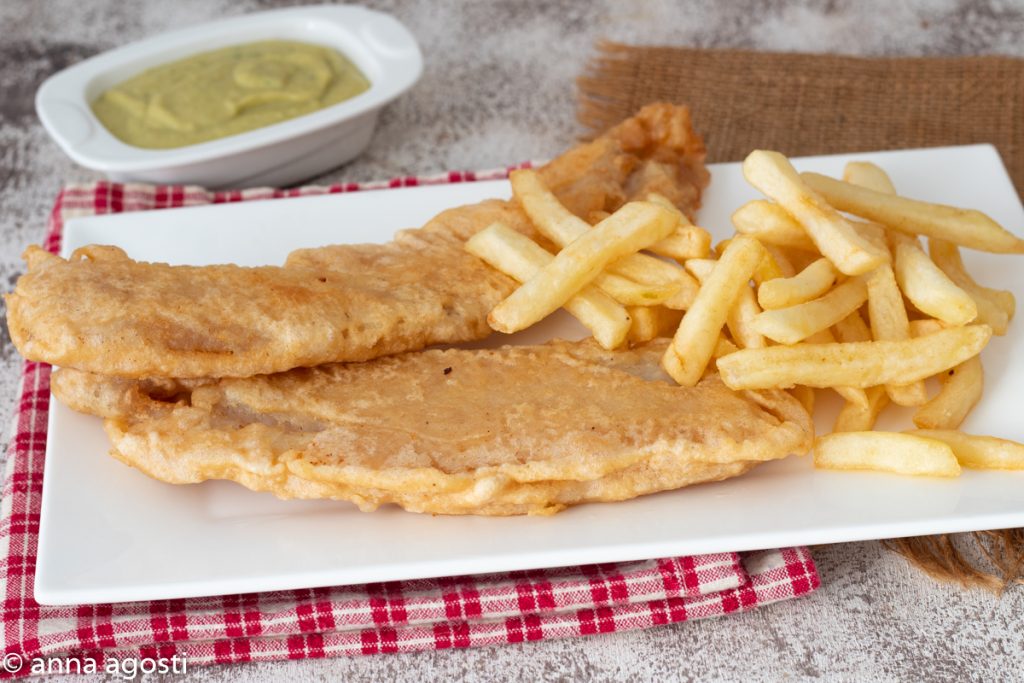
Want to travel to London while staying comfortably in your kitchen? Today I take you to the United Kingdom with the original Fish and Chips recipe: the authentic English version. Not just ordinary fried fish, but thick cod fillets wrapped in a puffed, golden, incredibly crispy beer batter.
The secret to a perfect result lies in the thermal contrast and the choice of fish: large, firm fillets that stay juicy inside while the outside becomes a crunchy shell. In this version, we serve it with the indispensable chips (fries) and tartar sauce (or a pea purée, depending on your taste) for a 100% authentic pub experience.
Below I leave, as always, some other tasty fish recipes to try and then we’ll go right under the photo to discover how to prepare the classic Fish and Chips 😉
See you soon with the next recipe, Ana Amalia!
- Difficulty: Easy
- Cost: Budget-friendly
- Rest time: 30 Minutes
- Preparation time: 20 Minutes
- Cooking time: 20 Minutes
- Portions: 4 Servings
- Cooking methods: Frying
- Cuisine: English
- Seasonality: All seasons
Ingredients for Fish and Chips
- 1 3/4 lbs cod fillets (cut into large pieces)
- 1 2/3 cups flour (plus a little extra to dust the fillets)
- 1 1/4 cups light beer (very cold)
- 1 tsp baking soda
- 2 pinches salt
- to taste black pepper (ground)
- 4 1/4 cups peanut oil (for frying)
- 1 3/4 lbs potatoes (yellow-fleshed (e.g., Yukon Gold))
- 2 2/3 cups peas (fresh or frozen)
- bunch mint (fresh)
- Half lemon
- 2 pinches salt
- 1 pinch black pepper
Preparation Fish and Chips
Prepare the chips (fries): Start by peeling the potatoes and cutting them into sticks. Leave them soaking in cold water for at least 30 minutes to remove the starch, then dry them thoroughly.
Begin with a first fry at a medium temperature (320°F) for a few minutes, drain them and set aside.
The “secret” beer batter: In a bowl, sift the flour with the baking powder. Pour the very cold beer in a thin stream, whisking quickly.
Don’t overwork it: if a few small lumps remain, the batter will be even lighter and crispier. Keep it in the fridge until ready to use.
The fish: Take your large fillets and make sure they are well dried by patting them with paper towels.
Salt and pepper them, then dust them lightly with flour, shaking off the excess. This step is essential to help the batter adhere well.
The perfect frying: Heat the oil to 356°F then dip the fillets in the cold batter and gently lower them into the hot oil.
Cook one or two at a time so you don’t lower the oil temperature. When they are nicely golden and puffed (about 4-5 minutes per side), drain them on paper towels.
Final touch: Return the chips to the hot oil for 2 minutes to make them super-crispy and serve everything piping hot with a generous amount of sauce in a small bowl on the side.
Cooking the peas: Boil the peas in salted boiling water for about 10 minutes (or until very tender).
Seasoning: Drain them and transfer to a pan where you have melted butter. Add finely chopped mint leaves.
Make the texture: For a rustic “mushy” version, roughly mash the peas with a fork or potato masher.
If you prefer a silky purée like in the photo, blitz briefly with an immersion blender, adding a tablespoon of cooking water if needed.
Finish: Adjust salt and pepper and add a little lemon juice to balance the sweetness of the peas. Serve warm alongside your crispy fish.
Storage Fish and Chips
Fish and Chips is a dish best enjoyed hot and freshly made to get maximum crispiness.
In the refrigerator: If you have leftovers, you can store the fillets in an airtight container for up to one day.
How to reheat: We don’t recommend the microwave because it will make the batter soggy. Better to reheat in a fan (convection) oven at 392°F for a few minutes or briefly in the air fryer to bring back some crunch.
Tips and variations
Cold is essential: Make sure both the fish and the batter (and especially the beer) are ice-cold. The thermal shock with the hot oil is what makes the batter light and full of air bubbles.
Don’t overcrowd the pan: Fry one piece at a time or at most two. If you add too many, the oil temperature drops rapidly and the fish will absorb oil and become heavy.
Drying: Use plenty of paper towels and do not stack the fillets right after frying, otherwise the steam will soften the batter of the fish underneath.
Salt: Salt the chips and the fish only just before serving. Salt tends to draw out moisture and could make them lose crispiness if added too early.
Alcohol-free batter: If you prefer not to use beer, use ice-cold sparkling mineral water or soda. The result will be very light and crispy, though less aromatic.
Spiced: You can add a pinch of sweet paprika or turmeric to the batter flour to give the fish a more intense color and a distinctive aroma.
Other recipes
🖥If you want to see more recipes you can return to HOME
📲If you don’t want to miss any recipe you can follow me on my Facebook Page, just turn on notifications and you’ll see many new recipes every day.
FAQ (Questions and Answers) Fish and Chips original recipe
Which beer is best for the batter?
For an authentic result, we recommend a pale beer such as a Lager or Pilsner. The important thing is that it is ice-cold, almost frozen.
Can I use frozen fish?
Yes, you can use frozen cod fillets, but be sure to thaw them completely and, above all, pat them very dry with paper towels.
How do I prevent the batter from coming off the fish?
The trick is the pre-dusting: pass the fish fillets in a light coating of flour before dipping them in the batter.
Do the chips need to be fried twice?
Yes, to get pub-quality chips the double fry is essential: the first at a lower temperature (320°F) to cook the inside, and the second at a higher temperature (356°F) to get them golden and crispy on the outside.