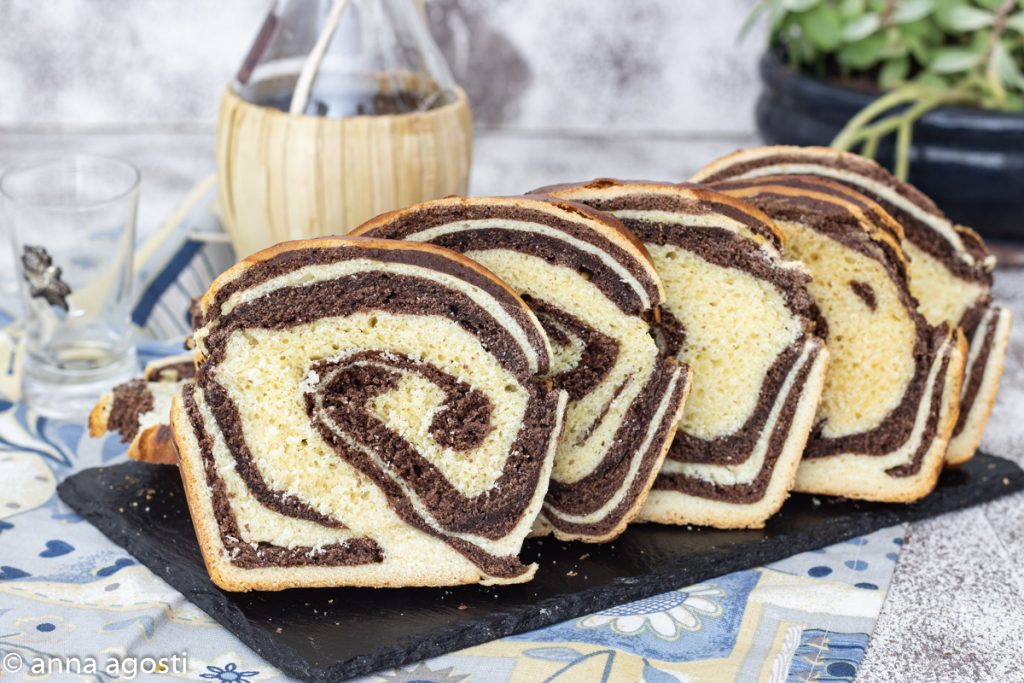
Today I want to share my recipe for the Two-Tone Rolled Brioche Loaf, a cloud-soft pastry with a dramatic look that will leave everyone speechless.
There is nothing more comforting than the smell of a leavened dough baking in the oven, that sweet aroma that fills every room and makes you want to sit down with a steaming cup of milk.
Many of you ask if it’s difficult to get that perfect spiral between the vanilla-colored dough and the darker cocoa: the truth is it’s very easy! It’s one of those “heart” recipes that smell like home and slow Sundays.
My advice? If you decide to prepare the dough by hand, get the little ones involved. There’s no greater joy for a child than to “get their hands in the dough”, feel the flour between their fingers and watch the dough, almost like magic, change color when you add the cocoa. It’s a wonderful way to teach them patience while the dough rises and the satisfaction of creating something good with their own hands.
Whether you use a stand mixer for convenience or prefer the warmth of manual work, this brioche will give you great satisfaction. Make it together: it will become the undisputed star of your breakfasts and sweetest snacks!
Below I’ll leave you other brioche recipes to try again and again and then, right under the photo, as always, we’ll discover how to prepare the Two-Tone Rolled Brioche Loaf 😉
See you soon with the next recipe, Ana Amalia!
- Difficulty: Medium
- Cost: Very inexpensive
- Rest time: 4 Hours
- Preparation time: 40 Minutes
- Cooking time: 35 Minutes
- Portions: 6 Servings
- Cooking methods: Electric oven
- Cuisine: Italian
- Seasonality: All seasons
Ingredients for the Two-Tone Rolled Brioche Loaf
- 4 cups type 0 flour (or Manitoba (strong flour))
- 1 cup whole milk (just lukewarm)
- 6 tbsp granulated sugar
- 6 tbsp butter (soft)
- 10 g fresh yeast (or 3 g active dry yeast (about 1 tsp))
- 1 egg (large whole)
- 1 pinch salt
- 1/2 teaspoon vanilla extract (or orange zest (optional))
- 3 tbsp unsweetened cocoa powder
- 2 tbsp whole milk
Tools
- 1 Kitchen scale
- 1 Loaf pan 10 1/4 in diameter
- 2 Bowls
Preparation Two-Tone Rolled Brioche Loaf
1. Forming the dough: In a large bowl, pour the flour and sugar then make a well in the center (the classic “fountain”) and pour in the lukewarm milk in which you have previously dissolved the yeast.
Start mixing with a fork or a wooden spoon, gathering the flour from the edges toward the center.
2. Adding the liquids and the butter: Add the whole egg and the vanilla extract (or orange zest). Continue kneading with your hands until the liquid is absorbed by the flour.
At this point, begin incorporating the soft butter a little at a time: work the dough energetically until the butter is completely absorbed before adding more. Finally, add the pinch of salt.
3. Working on the board: Turn the dough out onto a lightly floured work surface.
Work it with the heel of your hand, stretching and folding it over itself for about 10 minutes, until it becomes smooth, homogeneous and no longer sticks to your hands.
4. Creating the cocoa dough: Weigh the finished dough and divide it in half. Place the first half (the light one) in a bowl covered with plastic wrap to rise in a warm place. (A turned-off oven with the light on works perfectly).
For the second half: put it back in the large bowl, add the sifted cocoa and the two tablespoons of milk.Knead patiently with your hands, “squeezing” and folding the dough until the color becomes dark and even.
Now put this dough to rise as well in a second bowl covered with plastic wrap in the same warm spot where you placed the white dough.
1. Initial Mixing (K-beater): Attach the K-beater (also called the paddle) to your stand mixer.
Pour the flour, sugar and the yeast previously dissolved in the lukewarm milk into the bowl. Start mixing at speed 1, the lowest setting.
As soon as the ingredients begin to come together, add the whole egg. Continue working until you see a rough but homogeneous mass (this will take about 2-3 minutes).
2. Gluten development and butter (Hook): Replace the paddle with the dough hook (or spiral). This is the phase where the dough gains strength:
Turn the machine to speed 1 or 2 and begin adding the soft butter piece by piece.
It’s important not to rush: wait until each piece is completely absorbed before adding the next.With the last piece of butter, add the salt and the flavoring of vanilla (or orange zest).
Continue mixing for about 8-10 minutes. The dough is ready when it’s smooth, elastic and completely detaches from the sides of the bowl, remaining “clinging” to the hook.
3. The cocoa trick (without making a mess) to manage the two-tone dough cleanly:
Remove the dough from the bowl and weigh it, then divide it in half: put the first portion (white) to rise in a covered bowl.4. Without washing the mixer bowl, return the second half of the dough to it,
add the sifted cocoa and the two tablespoons of milk
Turn the hook on at low speed until the color is perfectly uniform. Now the dark dough is also ready for rising, so cover both bowls with plastic wrap and place them to rise in a warm spot.It will take 2 to 3 hours, or until the doughs have doubled in volume. It strongly depends on the room temperature.
Once your two doughs (the white one and the cocoa one) have doubled in volume, it’s time to create the beautiful spiral effect you see in the photo.
1. Rolling out the two doughs: Take the white dough and roll it out with a rolling pin on a lightly floured surface.
You should obtain a rectangle about 12 x 10 in. Do exactly the same with the cocoa dough, trying to give it the same dimensions as the white one.
2. Layering and rolling: Place the cocoa rectangle on top of the white one.
If you want them to adhere perfectly, you can brush the surface of the white rectangle with a little milk before placing the other on top.
Starting from the shorter side, begin to roll the two layers together, gently but firmly, until you form a compact two-tone cylinder.
3. Second rise in the pan: Take your loaf pan (26 cm / 10 1/4 in), butter it or line it with parchment paper.
Place the roll inside with the seam facing down. Cover with a tea towel and let it rise again for about 45-60 minutes in a warm place.
The brioche should puff up until it nearly reaches the top edge of the pan.
4. Baking: Preheat the oven to 356°F (conventional/static mode). Before baking, brush the surface of the loaf with a little milk or with a beaten egg yolk to make it shiny and golden.
Bake on the middle rack for about 30-35 minutes.Extra tip: If after 20 minutes you see the surface darkening too much, cover it with a sheet of aluminum foil and continue baking. To check if it’s done, you can perform the “toothpick test”: if it comes out dry, your brioche is cooked.
Remove from the oven and let it cool completely in the pan before taking it out and slicing. If you like, you can toast the slices in the toaster or on a griddle 😉
How to store the rolled brioche
To keep it soft like just-out-of-the-oven, place the brioche in a food bag as soon as it has completely cooled.
It keeps very well for 2-3 days. If you want a ready-made breakfast, slice it and freeze the slices individually: just pop them in the toaster for a minute to recover all the original softness and aroma.
Tips and Variations for the Two-Tone Brioche
👵Grandma’s Tips and Decadent Variations
To make your Two-Tone Brioche even more special or to adapt it to your tastes, here are some little tricks and variations to try:
💡 Tips for a perfect result
Ingredient temperature: For a dough that rises smoothly, make sure the milk is lukewarm (not hot!) and that the egg and butter are at room temperature. Butter that is too cold is hard to incorporate, while boiling milk can “kill” the yeast.
The finger test: Not sure if the dough has finished rising? Press the dough gently with a finger: if the depression returns slowly, it’s ready for the oven. If the hole remains, it has over-proofed; if it springs back immediately, it needs a bit more time.
Shiny surface: For a “bakery” look, brush with a mixture of egg yolk and a tablespoon of milk. For a more rustic, matte crust, use only milk.
✨ Delicious Variations
Chocolate Chip Center: Before rolling the two overlapping rectangles, sprinkle a handful of dark chocolate chips over the surface. They will add a crunchy, even more indulgent note to each slice.
Orange & Cinnamon Version: If you love spicy scents, replace the vanilla with plenty of grated orange zest in the white dough and add a pinch of cinnamon to the cocoa dough. The aroma while baking will be irresistible!
Lactose-Free: You can make this recipe lactose-free by using a plant-based milk (soy or oat milk are perfect) and replacing the butter with about 4 2/3 tbsp (approximately 65 g) of sunflower seed oil.
Reverse Two-Tone Effect: For a different look, try placing the light rectangle on top of the dark one before rolling. You’ll get a spiral with a light core and a dark exterior!
Other recipes
💻If you want to see more recipes you can return to HOME
📲If you don’t want to miss any recipes you can follow my Facebook Page, just turn on notifications and you’ll see how many new recipes every day.
FAQ (Questions & Answers)
Can I use active dry yeast instead of fresh yeast?
Of course! If you prefer dry yeast, you will need about 3-4 grams. Remember to dissolve it well in the lukewarm milk together with a teaspoon of sugar (taken from the total) to “activate” it before adding it to the flour.
Why did my brioche stay flat and not rise well?
There can be two causes: the milk was too hot (killing the yeast) or the environment was too cold. Make sure the milk is only lukewarm to the touch and, if your house is cold, use the trick of a turned-off oven with the light on.
Can I prepare the dough the evening before?
Yes, it’s an excellent solution! After shaping the two doughs (white and cocoa), place them in covered bowls and store them in the refrigerator overnight. The next morning, let them return to room temperature for about an hour, then proceed with rolling and shaping as per the recipe.
What can I use instead of Manitoba flour?
If you don’t have Manitoba flour, you can use a classic type 0 flour (Italian) or a strong all-purpose/bread flour. The important thing is that it’s suitable for long rises (with a good protein content). Avoid very weak 00 flour (the one for cookies), because the brioche would lose its characteristic soft, “stringy” texture.