
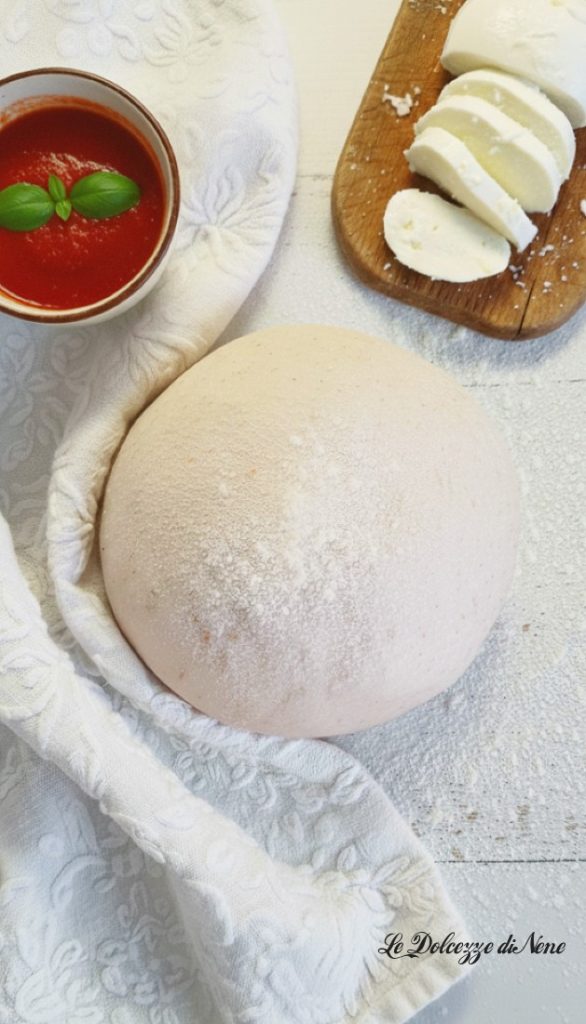
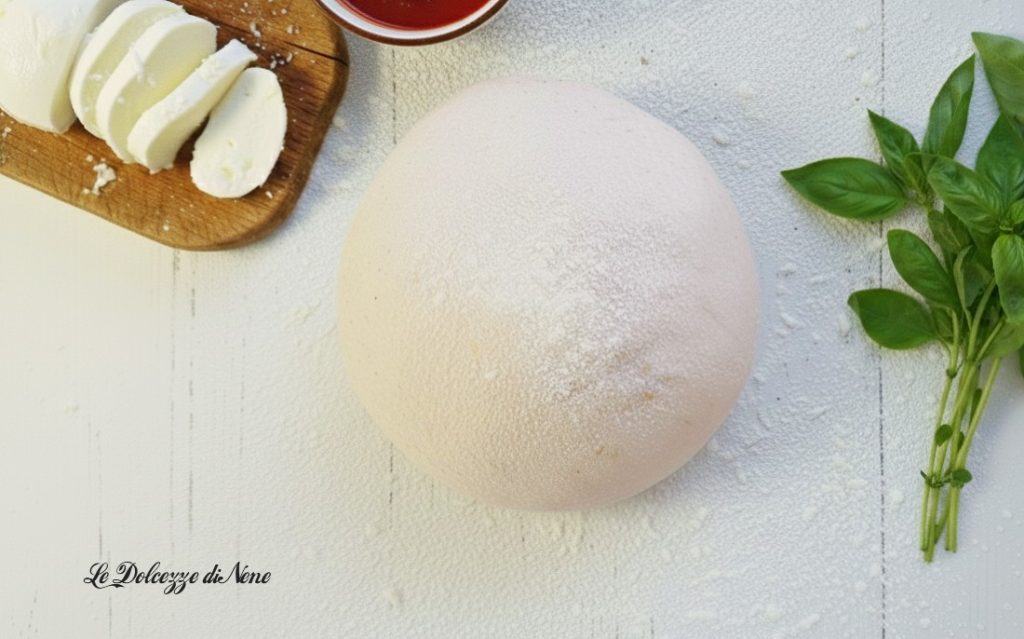
This basic dough for pan pizza is a recipe I’ve been using for many years. Very simple to prepare: I mix it in the morning for the evening, and it’s as light as a cloud! For a perfect dough there are three “rules” to follow: choose strong flour, allow a long fermentation, and use generous hydration.
(At the end of the recipe you’ll find some notes about strong flour)
Here are some variations to try
- Difficulty: Easy
- Cost: Low cost
- Rest time: 8 Hours
- Preparation time: 10 Minutes
- Portions: 1 Piece
- Cooking methods: No cooking
- Cuisine: Italian
- Seasonality: All seasons
Ingredients for the basic pan pizza dough
- 4 cups type 1 flour (W300)
- 1 1/4 cups water
- 2 tsp salt
- 1 tsp compressed baker's yeast
Tools
- 1 Food processor (Thermomix) Bimby tm31 – tm5 – tm6 – tm7
- 1 Stand mixer
- 1 Baking pan
- 1 Bowl
Preparation of the basic pan pizza dough
WITH BIMBY: Pour the water and the yeast into the bowl, mix at speed 2 for 1 minute. Add the flour and the salt, knead for 3 minutes on Dough (Spiga) setting. Remove the dough from the bowl.
WITHOUT BIMBY: Dissolve the yeast in the water by stirring with a fork, then add the flour and the salt. Knead by hand or with a stand mixer (using the dough hook) until you obtain a smooth, soft dough.
FERMENTATION: When the dough is ready, shape it into a ball and let it rise in a bowl lightly oiled with olive oil. Cover with plastic wrap and wait until it doubles in volume. The time will vary greatly depending on the room temperature (it can often take 5 or 6 hours).
Transfer the dough to a baking pan lined with parchment paper and lightly oiled. Stretch it out, cover with plastic wrap and let it rest for two hours.
After the resting time, dress it with your preferred toppings and then bake it.
NOTES
What does flour strength (W) mean?
The W value measures the flour’s ability to absorb water and retain gas during fermentation.
Strong flours have a W above 260, up to 400:
W 260–300: perfect for pan pizza, focaccias, brioche. (the one I used has W300)
W 300–400: ideal for panettone, pandoro, very rich doughs and long fermentations
How to recognize it
Look for the label Manitoba flour, type 0, type 1, or the W value on the package, although it is not always indicated.
If W is not shown, check the protein content: above 13% is a good sign, or the package often states “ideal for pizza”, “for long fermentations”, “for panettone”
Characteristics of strong flour
High protein percentage (gluten): 13–15%.
Greater elasticity: the dough copes better with fermentation.
Absorbs more water: useful for high-hydration doughs (70% or more).
Slow and stable rise: perfect for doughs matured in the refrigerator
You can use less yeast, for example 1 g, but you will need to let the dough mature in the refrigerator for 8 to 12 hours. After that time, let the dough come to room temperature and then continue with the second rise in the pan.
The dough can be frozen raw; when you want to use it let it thaw at room temperature until fully defrosted.
You can follow me on FACEBOOK by clicking HERE and liking the page
