
There are desserts that need no introduction, and then there are those that win you over before you even taste them — with a color, a scent, a gesture. dadar gulung belongs to the latter: a small green treasure, carefully rolled, that hides a soft heart of coconut and palm sugar. It’s one of those desserts you don’t forget, because it’s not just a recipe: it’s an encounter. With a country, with a market, with a way of enjoying food that smells of the street, of quick hands at work, of smiles opening behind a stall.
The first time you see it, dadar gulung almost looks like edible origami. Its thin crepe, colored with pandan, has a green tone unlike anything we find in our patisseries. It’s a vivid, bright green that immediately speaks of its tropical origin. And then there’s the filling: grated coconut, palm sugar melted until it becomes almost caramel, an aroma that recalls dark honey and spices. It’s a simple dessert, but not trivial. Humble, yet surprising. And above all, deeply tied to everyday Indonesian life.
Dadar gulung is the dessert of impromptu snacks, morning markets, lazy breaks on humid days in Bali or Java. It’s the treat bought from the street, wrapped in paper, still warm. It’s the one made at home when guests arrive, because it’s quick, inexpensive and puts everyone in a good mood. It’s a dessert that tells the story of an entire country through two ingredients: coconut and pandan, which in Indonesia are much more than flavors. They are identities.
Yet, despite its simplicity, dadar gulung carries a certain elegance. The way it’s rolled, the precision of the gesture, the care taken to close it so the filling doesn’t spill out: it’s almost a small ceremony. Making it at home means bringing a piece of Indonesia into your kitchen, turning an ordinary afternoon into a sensory journey. The scent of pandan released in the batter, the coconut lightly toasted in the pan, the color coming to life as soon as the crepe touches the hot surface: every step is an invitation to slow down and enjoy the moment.
The beauty of dadar gulung is that it doesn’t ask for perfection. It only asks for attention. And a bit of curiosity. It’s a dessert that welcomes learning hands and offers immediate satisfaction. And when you finally taste it, with that contrast between the soft crepe and the sweet, embracing filling, you understand why it’s so beloved in Indonesia. It’s a hug. A small everyday luxury. A bite that tastes like travel.
I discovered this recipe while researching for Pancake Day. At home we adore pancakes and every occasion is good to try a new version. I added this to my long list of recipes tried and below you’ll find a few other delicious ones to try.
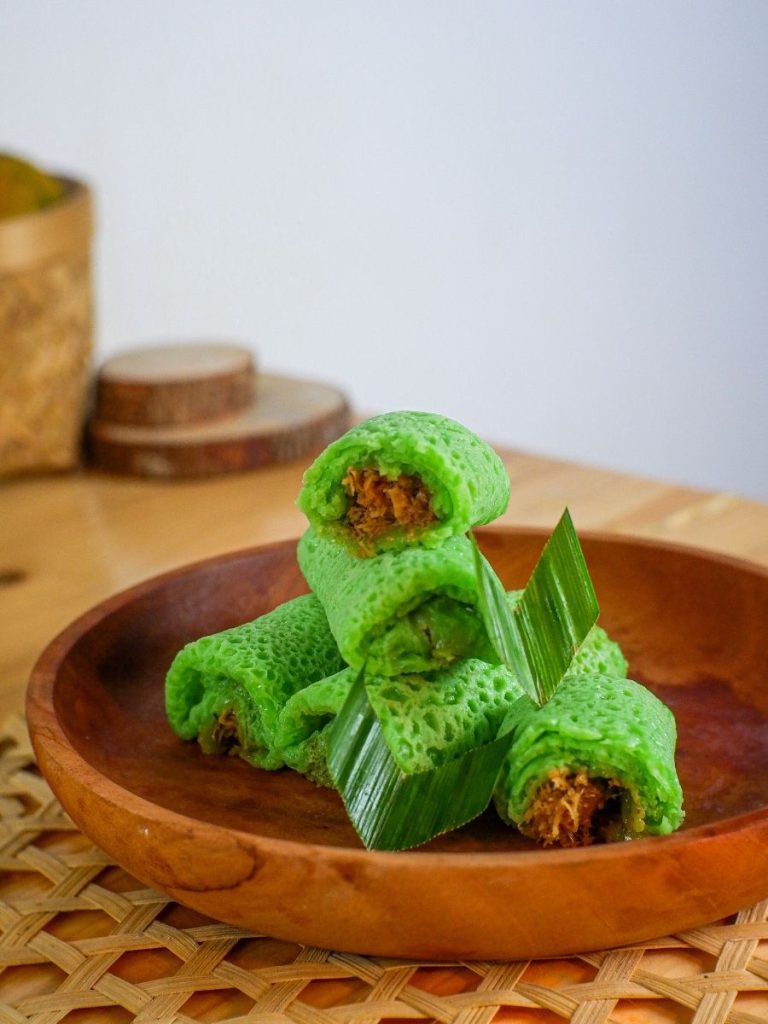
- Difficulty: Easy
- Cost: Budget-friendly
- Preparation time: 5 Minutes
- Cooking time: 20 Minutes
- Portions: 10 pancakes
- Cooking methods: Stovetop
- Cuisine: Indonesian
- Seasonality: All seasons
Ingredients for Dadar Gulung
- 1 cup all-purpose flour
- 1 2/3 cups coconut milk
- 1/2 cup water
- 1 egg
- 1 teaspoon pandan powder
- 1/2 teaspoon salt
- as needed peanut oil
- 3/4 cup palm sugar
- 1 1/2 cups grated coconut (rapè)
- 1/2 cup water
- 2 leaves pandan leaves (rolled)
Tools
- Crepe Pan
Preparation of Dadar Gulung
In a medium saucepan, place the grated coconut, palm sugar, 1/2 cup of water and the knotted pandan leaves. Cook the filling over low heat.
Keep stirring until all the palm sugar has melted and the coconut has taken on a nice golden color. This will take about 5–10 minutes. Transfer to a bowl and let cool slightly.Take a large bowl and add the flour, coconut milk, 1/2 cup of water, pandan powder, the egg and a pinch of salt. Whisk everything together until you get a fairly loose batter, similar to French crêpes.
Pour a little peanut oil into a medium frying pan over medium-high heat.
Wipe it with a paper towel to coat the entire surface and set it aside on a plate to re-oil before the next pancake.Pour a ladle of the pancake batter into the pan. Lift the pan and tilt it in a circular motion so the batter spreads and covers the bottom of the pan.
Let it cook slowly on one side. Check that the pancake takes on a slightly darker green tone across the surface—then you’ll know it’s ready. Shake the pan a couple of times to make sure it isn’t sticking before sliding it onto a plate ready to be rolled.Quickly mix the coconut filling and spoon a few tablespoons onto the bottom of the pancake. Now it’s time to fold. Start from the edge closest to you, lift it over the coconut filling. Then fold both sides in, making sure they’re straight, before rolling the pancake up to the plate surface. Watch our video for a step-by-step guide.
Serve immediately with ice cream, whipped cream and strawberries, or enjoy them on their own. They can be kept in the refrigerator for a day or two, but they are best eaten fresh.
There is a version of this recipe with chocolate and banana called
“Coklat Pisang Dadar Gulung”. Use banana instead of the coconut filling and flavor the pancake with chocolate or cocoa instead of pandan.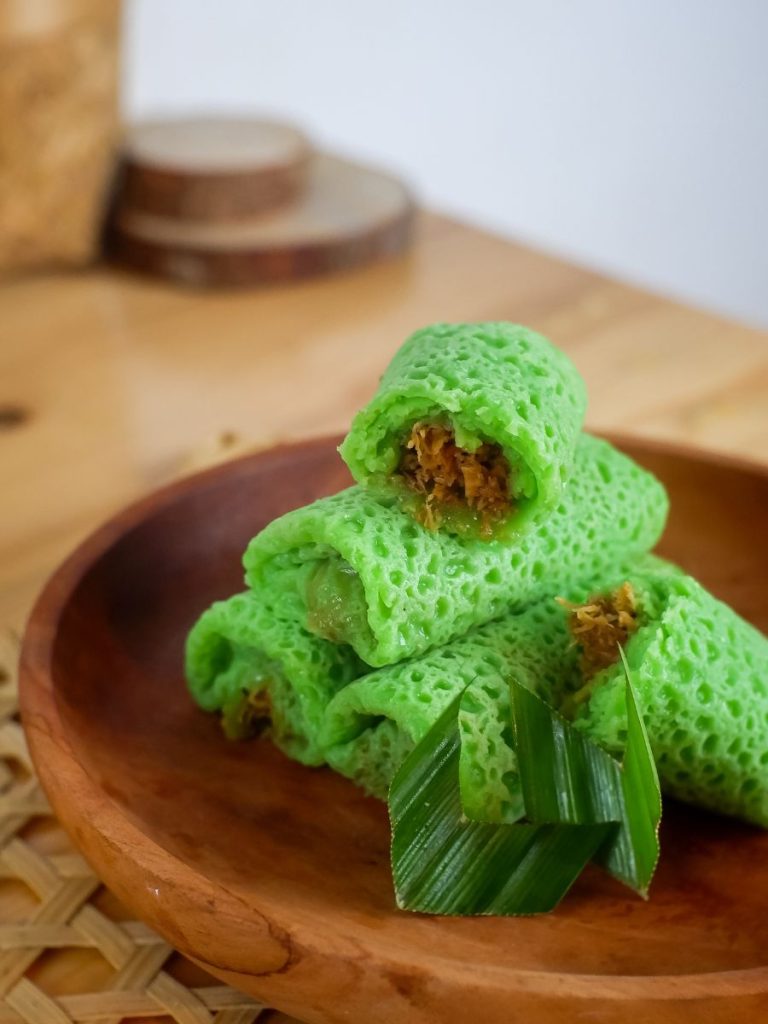
Follow me on social media
my Facebook page Facebook my Instagram profile Instagram my Pinterest page Pinterest
