
Zeppole di San Giuseppe are the typical Neapolitan pastry of the tradition, prepared on March 19 for Father’s Day. They are fried zeppole made with choux pastry, filled with pastry cream and decorated with amarena cherries in syrup: crispy outside, soft inside and truly irresistible.
In this recipe I explain step by step how to prepare fried Zeppole di San Giuseppe at home, just like the tradition requires, with all the tips to achieve a perfect result.
At my home they can never be missing. Every year I make them for my husband Giuseppe to celebrate his name day and Father’s Day. He is a wonderful dad and these zeppole are the sweetest way to say thank you.
If you love traditional pastries try also my homemade jam tart and the classic mimosa cake, perfect to celebrate special occasions.
See you soon
Susy 💛
Below I leave you other recipes that you might like and that are already on the blog.

- Difficulty: Medium
- Cost: Moderate
- Preparation time: 40 Minutes
- Cooking time: 40 Minutes
- Portions: 6
- Cooking methods: Oven
- Cuisine: Italian
- Energy 378.83 (Kcal)
- Carbohydrates 39.23 (g) of which sugars 20.58 (g)
- Proteins 9.58 (g)
- Fat 21.37 (g) of which saturated 12.56 (g)of which unsaturated 8.71 (g)
- Fibers 0.81 (g)
- Sodium 182.24 (mg)
Indicative values for a portion of 110 g processed in an automated way starting from the nutritional information available on the CREA* and FoodData Central** databases. It is not food and / or nutritional advice.
* CREATES Food and Nutrition Research Center: https://www.crea.gov.it/alimenti-e-nutrizione https://www.alimentinutrizione.it ** U.S. Department of Agriculture, Agricultural Research Service. FoodData Central, 2019. https://fdc.nal.usda.gov
Ingredients for Zeppole di San Giuseppe
- 1 cup 00 flour (Italian type 00)
- 1/2 cup water
- 7 tbsp butter
- 4 eggs eggs (4 medium eggs)
- 1 pinch salt
- 1 cup milk
- 1/3 cup sugar
- 3 egg yolks egg yolks (from large eggs)
- 4 1/2 tbsp cornstarch (maize starch)
- Half lemon zest (untreated lemon)
- 6 amarena cherries in syrup
- 2 tbsp powdered sugar
You will need
- Pan – non-stick
- Piping bag + star tip
- Whisk
- Parchment paper
Preparing the Zeppole di San Giuseppe
To fill the Zeppole di San Giuseppe I prepare my homemade pastry cream, smooth and velvety. It’s important to use it completely cold, so I prepare it in advance and keep it in the refrigerator covered with plastic wrap to prevent a skin from forming on the surface.
In a saucepan I pour the water, add the butter in pieces and a pinch of salt. I bring to a boil over medium heat, stirring until the butter is completely melted.
I remove the pan from the heat and add the flour all at once, stirring vigorously with a wooden spoon until you obtain a compact, lump-free mixture.
I put it back on the heat and continue stirring until the dough dries well and pulls away from the sides of the pan forming a smooth ball. This step is essential to obtain puffy, light zeppole when frying.
I transfer the dough to a bowl and let it cool slightly. I add the eggs one at a time, fully incorporating each egg before adding the next.
The final dough must be smooth, glossy and creamy but firm: when lifting the spatula it should fall slowly forming a compact ribbon.I transfer the dough into a piping bag fitted with a star tip. On squares of parchment paper I form a first circle and then a second ring on top of the first, leaving a small hole in the center. The shape should resemble a double-layered doughnut, typical of Zeppole di San Giuseppe.
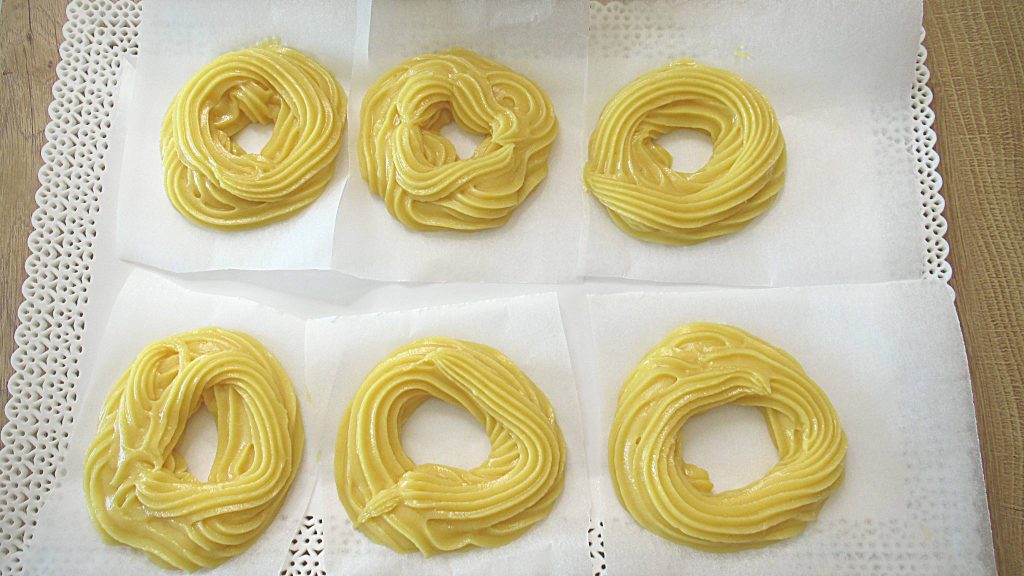
I heat a generous amount of peanut oil in a large pot and bring the temperature to 338°F. The temperature is crucial to obtain perfect Zeppole di San Giuseppe: if the oil is too hot they will brown immediately on the outside but remain raw inside, while if it’s too low they will absorb too much oil and be heavy.
I immerse the zeppola together with the parchment square into the hot oil. After a few seconds the paper will detach easily and I remove it with tongs.
I fry a few zeppole at a time for about 5–6 minutes, turning them gently during cooking to obtain an even golden color. They must be puffed, light and well drained.
I drain them on absorbent paper and let them cool completely before filling them.When completely cold, I fill the Zeppole di San Giuseppe with a generous dollop of pastry cream in the center. I add the classic amarena cherry in syrup and finish with a light dusting of powdered sugar.
Crispy outside, soft and hollow inside, with a creamy and enveloping heart: this is how real fried Zeppole di San Giuseppe should be, just like tradition wants 💛
Storage and useful tips
Zeppole di San Giuseppe are best freshly made, when they are still crisp outside and soft inside. I recommend filling them just before serving so they remain lighter and drier.
If necessary, you can store them for one day in the refrigerator, well covered, but without filling. The pastry cream should always be added at serving time.
To obtain perfect zeppole remember some fundamental tips:
Dry the dough well on the heat. It must pull away from the sides of the pan forming a compact ball; if it remains too moist the zeppole will not puff properly.
Add the eggs one at a time. Each egg must be completely absorbed before adding the next, so the dough will be smooth and of the right consistency.
Check the oil temperature. It should be around 338°F: too hot it will brown them outside leaving them raw inside, too low will make them greasy.
Fry a few at a time. Too many zeppole together lower the oil temperature.
Fill them only when cold. The pastry cream must remain compact and well defined.
For a gluten free variant you can use a gluten-free mix suitable for choux pastry, keeping the same proportions.
Frequently asked questions about Zeppole di San Giuseppe
Why don’t Zeppole di San Giuseppe puff up?
If Zeppole di San Giuseppe do not puff up when frying, the issue almost always depends on the dough or the oil temperature.
The most frequent cause is a dough that is too moist. After adding the flour, the choux pastry must dry well on the heat until it pulls away from the sides of the pan forming a compact ball. If this step is done too quickly, the zeppole will remain flat and underdeveloped.
Another common mistake is adding all the eggs at once. Eggs should be incorporated one at a time, mixing well before adding the next. The final dough must be smooth, glossy and firm.
The oil temperature is also fundamental. Zeppole di San Giuseppe should fry at about 338°F: if the oil is too hot they brown quickly on the outside but don’t have time to puff up; if it’s too cool they absorb oil and become heavy.
Following these suggestions you will obtain puffed, light zeppole perfectly hollow inside, ready to be filled with pastry cream.Why do the zeppole stay raw inside?
If Zeppole di San Giuseppe remain raw inside, the problem is almost always the oil temperature being too high. When the oil exceeds 347–356°F, the zeppole brown quickly on the outside but don’t have time to cook properly inside.
It’s important to fry Zeppole di San Giuseppe at about 338°F, keeping the temperature steady and turning them several times for an even browning.
Another cause can be a dough that is too soft or not sufficiently dried on the heat before adding the eggs. The choux pastry must be compact and well worked, otherwise it won’t develop properly during frying.
Following these tips you will obtain zeppole that are puffed, light and perfectly cooked inside as well.Can I prepare Zeppole di San Giuseppe the day before?
Zeppole di San Giuseppe are best just made, especially when fried, because they remain crisp outside and soft inside. However you can prepare in advance by making the pastry cream the day before and storing it in the refrigerator covered with plastic wrap.
You can also make the dough and fry the zeppole a few hours before, but I recommend filling them only shortly before serving so they keep the right texture and do not become soggy.
If you want to get ahead even more, you can fry the zeppole and store them without filling in the refrigerator for a day, then warm them slightly in the oven for a few minutes before decorating them with cream and amarena.
