
The homemade Simmental is truly a great cold dish, to enjoy almost all year round: from spring to autumn. It is a recipe that requires a little patience, but no cooking skills.
By using the pressure cooker, you also save a lot of time and money, because cooking times are significantly reduced. But if you don’t have one, no problem, it will just take more time to cook, while the process will remain unchanged.
Definitely healthier than the industrial one we find on supermarket shelves, because it obviously contains no chemical additives or preservatives. After years of trials, I have managed to get incredibly close to its original taste, preparing it with only natural ingredients. Let’s be honest, Simmental is nothing more than a concentrated broth, where the many tendons with which the meat is cooked produce a kind of gelatin that has nothing to do with gelatin sheets.
For those who want to clear up any doubts about the pressure cooker and start using it, I recommend reading my article: The pressure cooker and its use
If you love the pressure cooker, here are some recipe links:
- Difficulty: Easy
- Cost: Economic
- Rest time: 2 Hours
- Preparation time: 15 Minutes
- Portions: for 4 people
- Cooking methods: Pressure cooker
- Cuisine: Italian
- Seasonality: Spring, Summer and Autumn
Ingredients
- 1.32 lbs beef muscle
- 8.8 oz beef/veal tendons
- 4.23 cups water
- to taste salt
- 1 carrot
- 1 stalk celery
- 1 onion
- 1 tsp heaping marjoram
- 1 tsp heaping tomato paste
- 2 medium carrots
- 1 large egg
Tools
- 4 Molds
- 1 Pressure cooker
- Bowl
- Spatula
- Strainer
- Plastic wrap
How to prepare Homemade Simmental
Place the meat inside the pressure cooker (to ease cooking, we can cut it into pieces), along with the tendons, and the basic vegetables after cleaning and peeling them but leaving them whole.
Add the tomato paste, marjoram, all the necessary water, salt, and mix as best as you can.
Close the pot with the airtight lid, place on high heat, and as soon as you hear a loud whistle, lower the heat to the minimum and let it cook for about an hour and a half. While the meat cooks, boil an egg, the carrots and as soon as they’re ready, let them cool well first at room temperature and then in the refrigerator. Once the necessary time has passed, turn off and let cool or at least warm down. Place the meat in a large, high-edged bowl and shred it as much as you can with your hands. Finally, filter the cooking liquid over it.
If using the traditional cooking method, as soon as it starts boiling, lower the heat and calculate about three hours of cooking or check until the meat has softened.
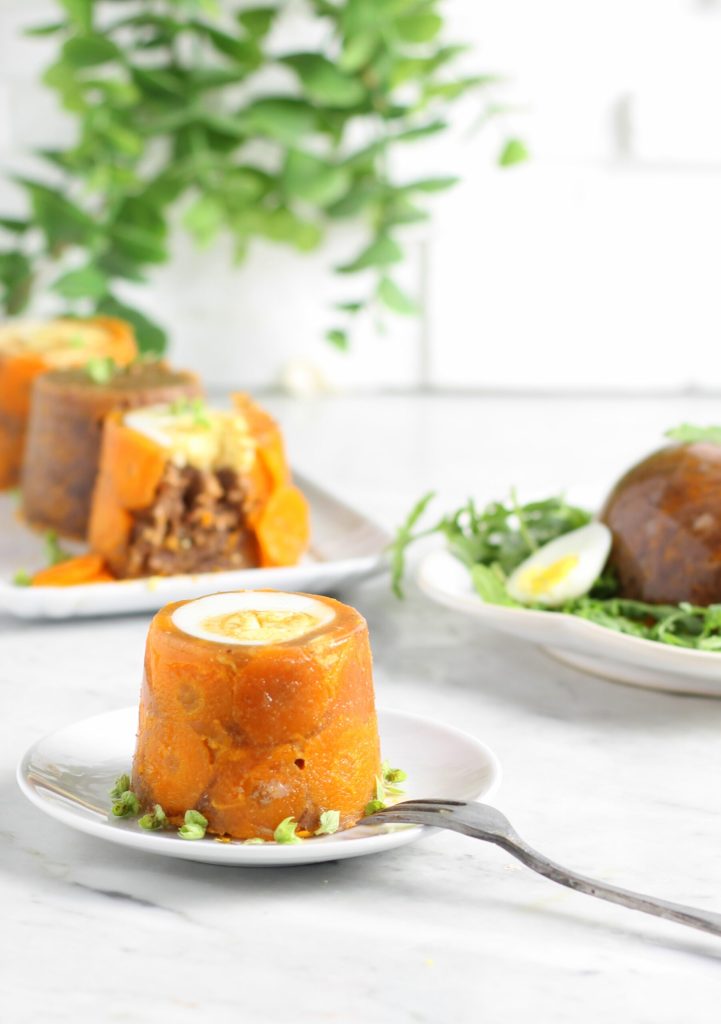
At this point, slice both the boiled eggs and carrots and line our molds with them. I usually put the egg at the bottom and line the sides with the carrots, but you can skip this step, as the goodness of the recipe is not in the decoration. In fact, I usually prepare them this way only when I decide to serve Simmental to my guests. Now equally distribute the meat mixed with the liquid into the molds and finish with an extra layer of liquid.
Cover with plastic wrap and chill in the refrigerator for at least two hours. Take out the Simmental at least half an hour before serving so it reaches the right temperature to be enjoyed. Gently detach the meat from the edges of the mold with the help of a small spatula and turn it directly onto a plate.
Serve our Homemade Simmental, accompanying it with the vegetables we prefer, either raw or cooked will certainly be fine.
Tips and storage:
You can keep the Simmental in the fridge for at least three days, but sealed tightly in a container or in its own steel molds.
Be sure to avoid both aluminum and plastic, because they would release chemical substances.
You can also freeze it, either with or without decorations.
Remember to defrost it slowly in the refrigerator, so it is not attacked by bacteria that could make it harmful to our health.
It is my habit to prepare the Simmental the day before, to be sure it has solidified well.
