
If you are from Genoa and you read this article you already know … but for those who don’t, the Pandolce Genovese or simply pandolce, often also called Genoese panettone, is a typical product especially from the Genoa area, but also from the rest of Liguria.
The quintessential cake during the Christmas holidays: circular in shape, there are two versions, “alto” (tall) and “basso” (low), and they differ not only for the presence or absence of yeast in the dough but also for some aromas and different ingredient proportions.
Last year in Genoa the Low Genoese Pandolce Championship of the ANTICA GENOVA tradition was held for the first time, in which more than 100 participants competed and where I also took part. After an exhausting “battle” full of raisins, pine nuts and flour I managed to stand out and I placed 2nd!!!!
I’m therefore pleased to share with you my grandmother’s legendary and ancient recipe for LOW GENOESE PANDOLCE, the original recipe that allowed me to reach second place at the World Low Pandolce Championship.
If you want more information about how the whole event is organized, maybe because you decided to participate this year as well, read this ARTICLE.
The event is organized by Confcommercio Genova – CNA Genova and Liguria Gourmet, with the patronage of the Liguria Region. All the info regarding the II LOW GENOESE PANDOLCE CHAMPIONSHIP can be found at this LINK.
Before going into detail I’ll summarize the Quick Procedure of the Low Genoese Pandolce (4 Essential Steps)
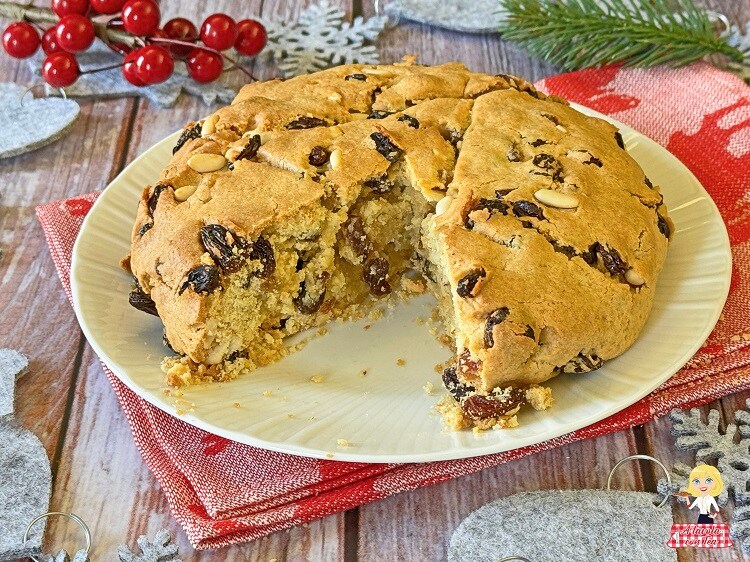
- Difficulty: Easy
- Cost: Medium
- Preparation time: 30 Minutes
- Cooking time: 50 Minutes
- Portions: 10
- Cooking methods: Oven
- Cuisine: Italian
- Seasonality: Christmas
- Energy 760.87 (Kcal)
- Carbohydrates 121.60 (g) of which sugars 66.18 (g)
- Proteins 13.08 (g)
- Fat 28.28 (g) of which saturated 13.45 (g)of which unsaturated 13.07 (g)
- Fibers 3.57 (g)
- Sodium 109.80 (mg)
Indicative values for a portion of 150 g processed in an automated way starting from the nutritional information available on the CREA* and FoodData Central** databases. It is not food and / or nutritional advice.
* CREATES Food and Nutrition Research Center: https://www.crea.gov.it/alimenti-e-nutrizione https://www.alimentinutrizione.it ** U.S. Department of Agriculture, Agricultural Research Service. FoodData Central, 2019. https://fdc.nal.usda.gov
Ingredients
- 5 cups 00 flour (all-purpose type)
- 2 1/2 cups Manitoba flour (strong bread flour)
- 4 eggs (whole)
- 1 1/3 cups butter (at room temperature (about 10.6 oz / 300 g))
- 2 1/2 tbsp honey
- 1 1/2 cups sugar
- 1 tsp orange extract
- 1 packet baking powder
- salt (1 pinch)
- 3 1/2 cups raisins (dry (do not soak))
- 1 cup candied citron (diced)
- 1 cup candied orange (diced)
- 1 cup pine nuts
Tools
- Bowl
- Baking tray
How to prepare the Low Genoese Pandolce step by step
You can proceed either by mixing by hand or with a stand mixer. If you decide to mix by hand I recommend halving the quantities to make handling easier. You will still obtain a Low Genoese Pandolce with a baked weight of about 2.1 lb (approx. 950 g).
Sift the two flours together with the baking powder in a bowl or in the stand mixer.

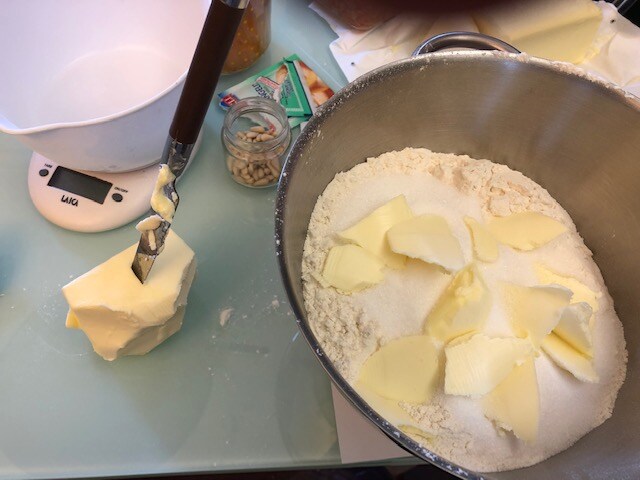
Add the butter, at room temperature, cut into pieces, and the sugar.
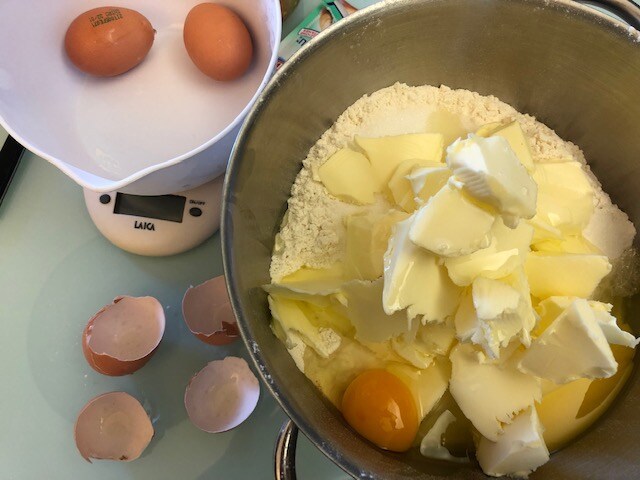
Also add the other ingredients: eggs, honey, orange blossom essence and a pinch of salt.
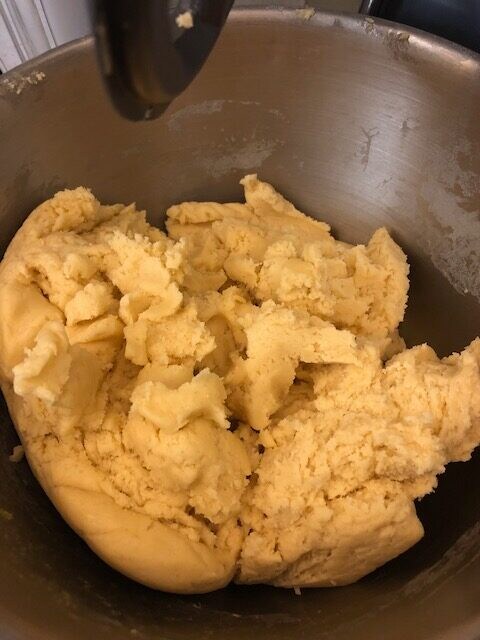
Knead everything in a bowl or on a work surface for at least 5-6 minutes so that all the ingredients combine well and the mixture becomes homogeneous (if you use a stand mixer, 3 minutes are enough).
Now you can add the “mix-ins”: raisins, diced candied citron and orange (dice them as uniformly as possible and to roughly the size of the raisins) and finally the pine nuts. Knead again so the dried fruit is distributed evenly throughout the dough. I recommend adding them in two batches, it’s easier to incorporate. Remember: in this recipe the raisins must not be soaked under any circumstances; you take them straight from the supermarket bag and add them dry!
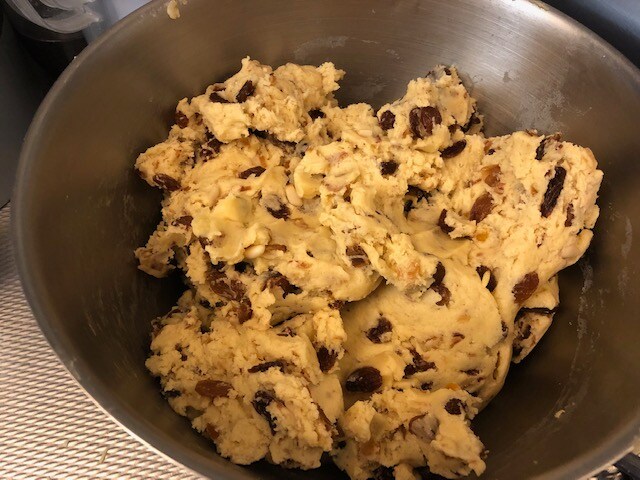
Now the dough is ready to be baked; you only need to decide the size of your pandolci. I usually divide the dough in two and obtain 2 Low Genoese Pandolce loaves of about 2.65 lb (approx. 1.2 kg) each (good for 6-8 people). You can of course make 4 to obtain the typical bakery size of Genoese pandolce of about 1.2-1.3 lb (550/600 g) each.
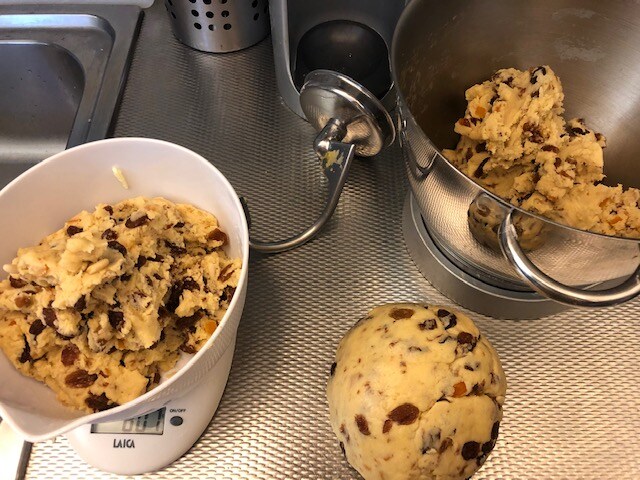
Once you’ve decided the piece size, divide the dough, place it on a lightly floured work surface, spread it slightly then fold it over itself as if it were a loaf. Put each pandolce on a baking tray lined with parchment paper and press it down lightly with the palm of your hand to lower it slightly and obtain a disk about 1 3/8 in thick (about 1.4 in), slightly domed.
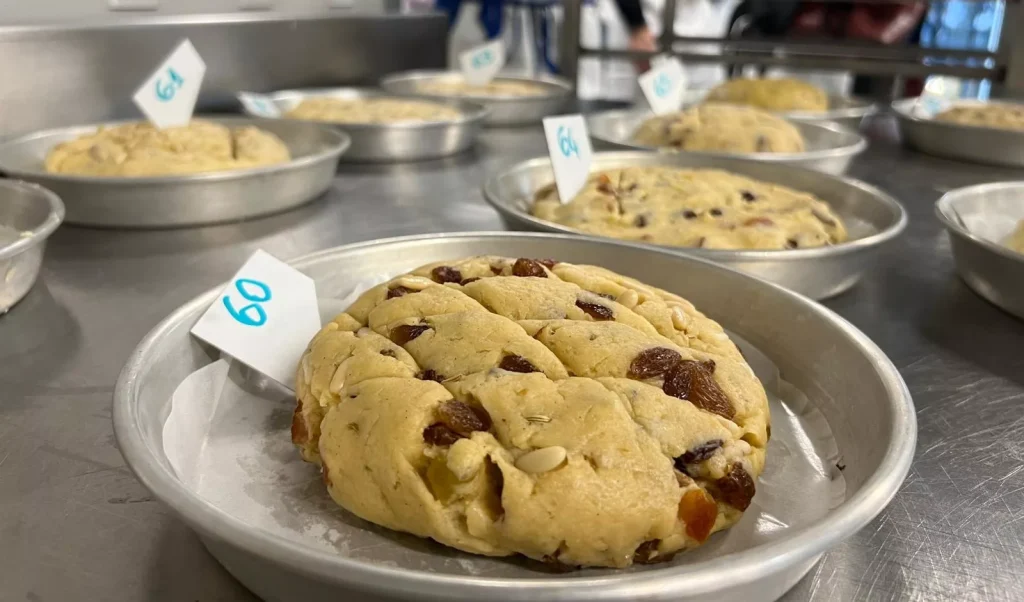
Bake in a preheated static oven at 338°F (170°C) for about 50 minutes. Cooking times obviously depend on the size of your pandolce. I recommend checking after 45 minutes with the skewer test. If it’s still a little raw inside, leave it in the oven a few more minutes, preferably covered with aluminum foil so the surface doesn’t overbrown. Once ready, remove from the oven and let cool.
STORAGE
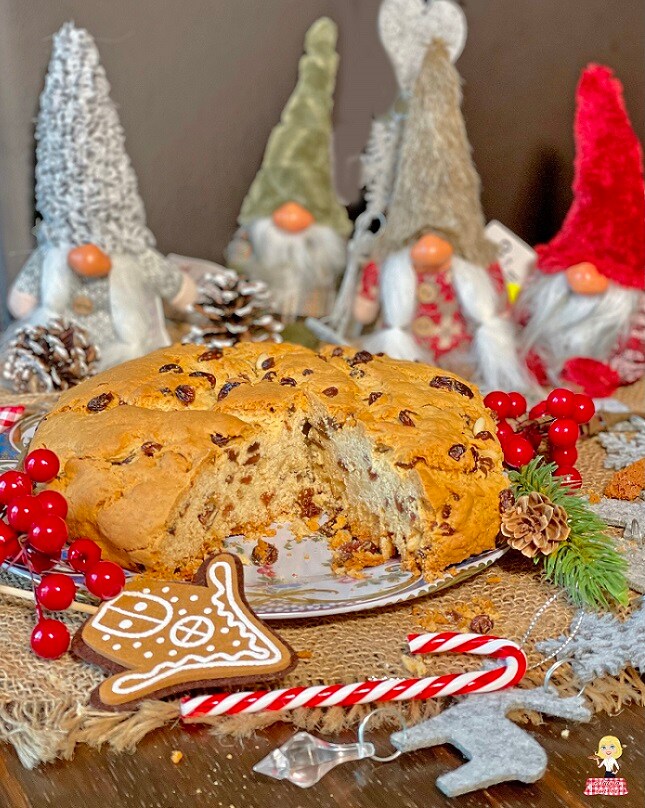
Once ready, the Low Genoese Pandolce keeps for up to 10 days if well wrapped in aluminum foil and stored in an airtight container
ORIGINS OF THE GENOESE PANDOLCE
The origins of the pandolce are ancient and date back to the 1500s. It is said that during the government of Andrea Doria, Doge of Genoa, it was prepared for the first time to showcase the cultural and gastronomic wealth of the Ligurian maritime Republic.
CURIOSITIES
According to tradition, the GENOESE PANDOLCE had to be brought to the table at Christmas by the youngest representative of the family, who would pass it, for cutting, to the oldest.
From each pandolce two slices had to be kept: one was traditionally given to the poor, while the other was to be consumed on February 3, the day of Saint Blaise, for protection of the throat.
The first edition of the LOW GENOESE PANDOLCE CHAMPIONSHIP was held in Genoa on November 12, 2023.
VARIATIONS
Some recipes include the addition of fennel seeds and rum for an even more fragrant and aromatic product; others use anise seeds and Marsala.
You can also use grated lemon or orange zest for an extra citrus note.
For some time in GENOA versions have appeared that are even more indulgent and suitable for children, with the addition of chocolate chips instead of candied fruit and toasted hazelnuts.
Why the Raisins Should Not Be Soaked in Low Pandolce
Unlike many leavened products like Panettone, the Low Genoese Pandolce recipe does not require soaking the raisins. The reason is simple: the pandolce is a “dead” dough, meaning it uses quick chemical leavening. Wet raisins release water into the dough during baking, altering its balance and making the final product too compact and less crumbly. In this authentic recipe, the raisins should be added directly from the bag, dry, to maintain the perfect texture of the Genoese cake.
How to Understand the Right Doneness (Championship Tips)
If there is a critical moment in the Low Pandolce, it is baking. Don’t be fooled by the surface color! For a perfect pandolce, as required in the Championship, you must monitor two things:
Skewer Test: Insert it into the center. It must come out completely dry.
Internal Temperature (Chef’s Tip): If you have a kitchen thermometer, the heart of the pandolce should reach about 198°F (approx. 92°C). If the surface colors too much before the internal baking is complete, cover the tray with aluminum foil for the last 10 minutes. Precise baking will guarantee unbeatable internal crumb texture.
Usage and Pairings: Pandolce Beyond the Holidays
The Low Genoese Pandolce, although the king of the table at Christmas, is a versatile cake. For a gourmet snack, try it with a smear of pastry cream or bitter orange marmalade. Traditionally it is paired with Ligurian sweet wines such as Sciacchetrà or, alternatively, it goes very well with a glass of Marsala or Ruby Port. If you keep it for the morning, it is excellent dipped in caffèlatte, thanks to its compact consistency that does not fall apart easily.
FAQ (Questions and Answers)
How do you say pandolce in the Genoese dialect?
In Genoese, Pandolce is written pandôçe and pronounced panduse.
What is the difference between Low Pandolce and High Pandolce?
The Low Pandolce (or “ancient”) is made with chemical baking powder, has a firmer texture and is ready quickly. The High Pandolce (or “modern”) uses brewer’s yeast, requires long fermentation (up to 36 hours) and is softer.
Why don’t the candied fruit and raisins sink to the bottom in the pandolce?
To prevent dried fruit and candied pieces from settling at the bottom, it is essential that the dough is firm enough and that the ingredients are incorporated at the end of mixing and evenly.
How can I make the Low Pandolce more aromatic?
For a more intense aroma, add fennel seeds to the dough (as in Genoese tradition) and replace part of the honey with Marsala or Rum (as suggested in the variations).
Should I soak the raisins for the Genoese pandolce?
No, in this recipe the raisins must NOT be soaked under any circumstances.
