
The Magic Epiphany Focaccia: A Sweet and Lucky Tradition traditional and Bimby recipe
Today we will talk about a delicious Italian tradition related to the Epiphany holiday: the Epiphany focaccia. As Epiphany approaches, all children await the arrival of the Befana, the kind old lady who distributes gifts and surprises. But there is another star of this celebration, a culinary tradition rooted in ancient Piedmont: the Epiphany focaccia.
A Journey Through the Origins of an Ancient Flavor
In Piedmont, the Epiphany focaccia makes an appearance to celebrate the day of Epiphany. A delight whose recipe might even precede the birth of sweets like Panettone and Colomba. It is said that its origin dates back to ancient times when exotic ingredients, like candied fruits, were imported during the Crusades, slowly introduced into noble kitchens and then into everyone’s.
Traditional Recipe
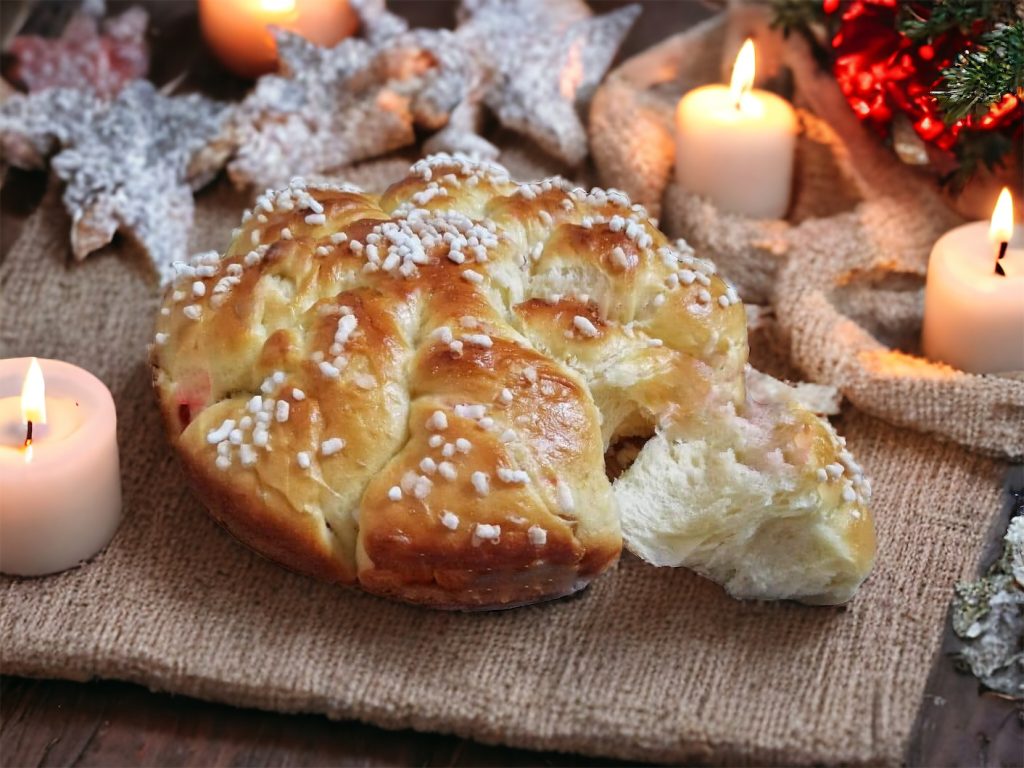
The base of this exquisite focaccia is a brioche dough, leavened and enriched with sugar, candied fruits, and raisins, usually shaped like a sun or a daisy. The magical touch is given by the “surprise” hidden inside: traditionally, it is a white or black bean. Whoever finds it can expect a lucky year, or conversely, an invitation to live more altruistically.
Luck and Superstition: The Bean Game
Finding the white bean in one’s piece of focaccia symbolizes prosperity and new beginnings. The black bean, though feared, seems to remind us of the importance of generosity and benevolence. A tradition that combines the pleasure of taste with the luck game, cementing bonds of friendship and affection.
Old Customs and New Interpretations
Over the centuries, the Epiphany focaccia has traveled beyond the borders of Piedmont, taking on new shapes and flavors depending on the Italian region, with some variations including the addition of new types of candied fruits as a symbol of prosperity.
Read also:
- Difficulty: Easy
- Cost: Economical
- Rest time: 4 Hours
- Preparation time: 30 Minutes
- Portions: 8 servings
- Cooking methods: Oven
- Cuisine: Italian
- Seasonality: Winter
Epiphany Focaccia what you need to prepare it
The Epiphany focaccia is a typical dessert prepared in Italy for Epiphany. Here are the main ingredients needed.
Flour: Manitoba flour is commonly used for its strength and to help leavening, but some recipes also include the use of all-purpose flour.
Yeast: Sourdough is often preferred for its aroma and natural leavening ability, but you can also find beer yeast, both dry and fresh.
Milk: Whole milk is used both in the dough and to brush the focaccia before baking.
Eggs: The eggs are a key ingredient to enrich the dough. Some recipes require one egg, others may require two.
Sugar: Essential for giving sweetness to the focaccia.
Butter: Adds richness and flavor to the dough.
Salt: A small amount to balance the flavors.
Candied fruits: Candied orange or mixed candied fruits are often included in the dough to add aromatic notes and texture. If you do not like candied fruits, you can use chocolate chips instead.
Sugar sprinkles: Used to decorate the focaccia before baking.
- 1 1/4 cups Manitoba flour
- 3/4 cup all-purpose flour
- 2 tsp fresh beer yeast
- 1/4 cup sugar
- 1/2 cup whole milk
- 1 egg (medium)
- 3 1/2 tbsp butter
- 1/2 tsp salt
- 1/2 cup candied fruits
- 2 tbsp pine nuts
- 1 egg yolk
- milk (as needed)
- sugar sprinkles
Tools
To make the Epiphany focaccia, you will need some kitchen tools:
- Bowl
- Stand Mixer
- Baking Pan
- Parchment Paper
How to Make the Epiphany Focaccia
To prepare the Epiphany Focaccia, start by making the Brioche Dough. Follow the listed doses and proceed with the preparation as indicated in the recipe.
To achieve an excellent brioche dough, it is essential to pay attention to certain details during preparation. Here is a detailed guide to help you make a soft and perfect dough:
Temperature: It is a common mistake to think that the milk must be heated to activate the yeast. In reality, if you are in a warm environment, it is better to use milk and eggs that have been refrigerated. This is because the dough, during prolonged processing, tends to heat up on its own. If you start with room temperature or warm ingredients, you might risk overheating the dough, thus preventing the gluten from developing correctly.
Starting the Dough: Prepare your stand mixer with the hook attachment. Pour in the selected flours, add the previously crumbled yeast and sugar. It is crucial not to leave the sugar in direct contact with the yeast for prolonged periods because this could inactivate it. Start the stand mixer at a medium speed.
Milk Integration: While the dough is working, gently incorporate all the COLD milk. This step should be done gradually to ensure that the milk blends evenly without weighing down the dough.
Adding the Eggs: Proceed by adding the eggs, one at a time, ensuring that each egg is completely absorbed before adding the next.
Incorporating the Fats: When the dough begins to take shape and becomes more homogeneous, it is time to add the fats. If you use lard, do it little by little. This will allow the fats to integrate slowly and promote the development of an elastic and resistant gluten network inside the dough
Flavoring and Salt: Once the fats have been completely absorbed, you can add the flavors chosen for your brioche. Finally, incorporate the salt, which should be added in the last phase so as not to interfere with the yeast activity.
Final Processing:
When the dough wraps around the kneading hook and clings to it, add the pine nuts, the whole almond (the gift), and the chopped candied fruits, and work for a few more minutes.
Now it is time to move on to manual processing. Transfer the dough to a lightly floured surface. Then proceed to work it with your hands, but only enough to form a homogeneous ball. The result you are looking for is a smooth, soft, and only slightly sticky dough.
Once the desired ball is obtained, take a clean bowl and lightly grease it with a little oil to prevent the dough from sticking during leavening. Place the brioche dough inside the bowl and cover it carefully. You can use cling film for foods, which adheres well to the edges of the bowl and prevents moisture dispersion.
The next step is leavening, which is crucial for the development of flavor and structure of the brioche dough. Place the bowl in a warm and draft-free environment, where the dough can grow. The goal is to allow the dough to double or triple its original volume. This process can take several hours, depending on the ambient temperature and the yeast’s strength. It is important not to rush this phase: patience is key to ensuring that the brioche dough develops all its qualities.
After letting the dough rise for the necessary time, gently turn it over onto the base of a 22 cm springform pan, previously lined with a sheet of parchment paper. Use your hands to flatten the dough, making it extend until it touches the edges of the plate.
Next, take a knife and make eight cuts starting from the center of the dough outwards, dividing it into wedges. Roll each wedge on itself, forming spirals. Put the outer ring of the springform pan back around the dough and allow a second leavening, this time for a short period of about 30 minutes.
Once the dough has risen, prepare a mixture by beating together the milk and egg yolk in a small bowl. Use a kitchen brush to spread this emulsion over the surface of the focaccia, then evenly distribute the sugar sprinkles over the dough. Bake the focaccia in a static oven preheated to 355° F and let it bake for an approximate time of 20-25 minutes. Remember that each oven has its peculiarities, so these times and temperatures should be considered as a general guide.
Monitor the cooking until the Epiphany Focaccia acquires an inviting golden color. Once cooked, remove it from the oven and let it cool on a rack. Who will be the lucky one to find the hidden surprise inside?
Tips and Notes
The Epiphany Focaccia is a traditional Italian dessert prepared for Epiphany, rich in history and flavors.
Here are some tips and notes to best prepare this specialty:
Leavening: For optimal leavening, some suggest leaving the dough in the refrigerator overnight. This slows down the leavening process but allows the dough to develop more aroma and a better structure
Milk Temperature: It is important that the milk is not too hot, as it could damage the yeast, nor too cold, otherwise it would not activate the yeast correctly
Candied fruits: The traditional recipe includes the use of candied fruits, like candied orange. You can vary the amount of candied fruits according to your taste, or replace them with other types of candied fruit if you prefer
Traditions: According to the Piedmontese tradition, inserting a dry bean inside the dough would bring luck to whoever finds it in their piece of focaccia, but you can also put an almond. However, whoever finds the bean or almond should also pay for the focaccia, symbolizing prosperity and happiness for the coming year
Baking: The baking times and temperatures may vary depending on the oven used. It is always a good practice to check the focaccia during baking to avoid it becoming too dark or remaining raw inside
Decoration: Before baking, brush the surface of the focaccia with an emulsion of milk and egg yolk to achieve a perfect browning and sprinkle with sugar sprinkles for a sweet and crunchy final touch
Remember that every little detail can make a difference in the final result, so take your time to care for each step of the recipe.
The Epiphany focaccia remains soft for about 3 days if stored in food bags; it will be enough to briefly heat it in the oven to make it return as freshly baked.
The Epiphany focaccia remains soft for about 3 days if stored in food bags; it will be enough to briefly heat it in the oven to make it return as freshly baked.
Epiphany Focaccia (Pan Brioche) with Bimby
Start by pouring the milk into the Bimby cup. Add the yeast, sugar, the essence of your choice, and one whole egg. Start the Bimby for one minute at speed 3 or 4. After that, gradually add the flour and set “speed spike” for 5 minutes. During these 5 minutes of processing, after the first minute, start inserting the lard through the specific hole of the mixer, little by little, allowing the dough to gradually absorb it. In the final thirty seconds of the process, incorporate the salt.
Once the dough has reached the desired consistency, detaching itself from the sides of the cup and sticking to the hook, it is time to transfer it to a slightly floured surface. Knead it briefly with your hands to form a uniform ball. The goal is to obtain a smooth and not too sticky dough.
Now take a bowl and lightly grease it with some oil to prevent the dough from sticking. Place the brioche dough ball carefully inside the bowl and cover it thoroughly with cling film.
Finally, let the dough rise in a warm place until it has tripled its initial volume. This step is essential to ensure that your Unbeatable Brioche Dough develops the right texture and flavor. Once the dough has adequately risen, it will be ready to be transformed into your culinary creations.
Finally, let the dough rise in a warm place until it has tripled its initial volume. This step is essential to ensure that your Unbeatable Brioche Dough develops the right texture and flavor. Once the dough has adequately risen, it will be ready to be transformed into your culinary creations.
FAQ (Questions and Answers)
The Epiphany Focaccia is a traditional Italian dessert that is typically prepared for Epiphany. Here are a series of frequently asked questions with corresponding answers that may assist you in preparing this delicious focaccia.
What type of yeast should be used for the Epiphany Focaccia?
You can use fresh or dry beer yeast. If using dry yeast, remember that the required amount will be about half that of fresh yeast
Is it necessary to use Manitoba flour?
Manitoba flour is often recommended for its high gluten properties, which help create a robust structure and a softer dough. However, you can also use a strong all-purpose flour if you don’t have Manitoba.
How long should the Epiphany Focaccia rise?
Leavening times can vary, but generally, the dough should double or triple in volume. This can take several hours depending on the ambient temperature.
Can the dough be prepared in advance?
Yes, some recommend doing a slow rise in the refrigerator overnight, which can improve both the flavor and the structure of the focaccia.
