
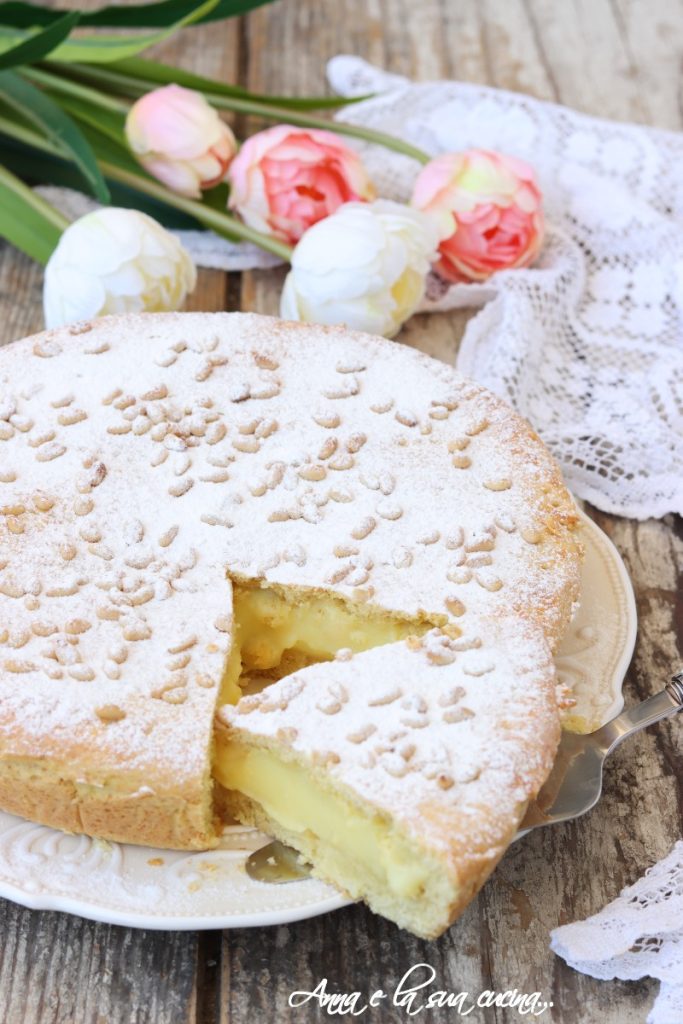
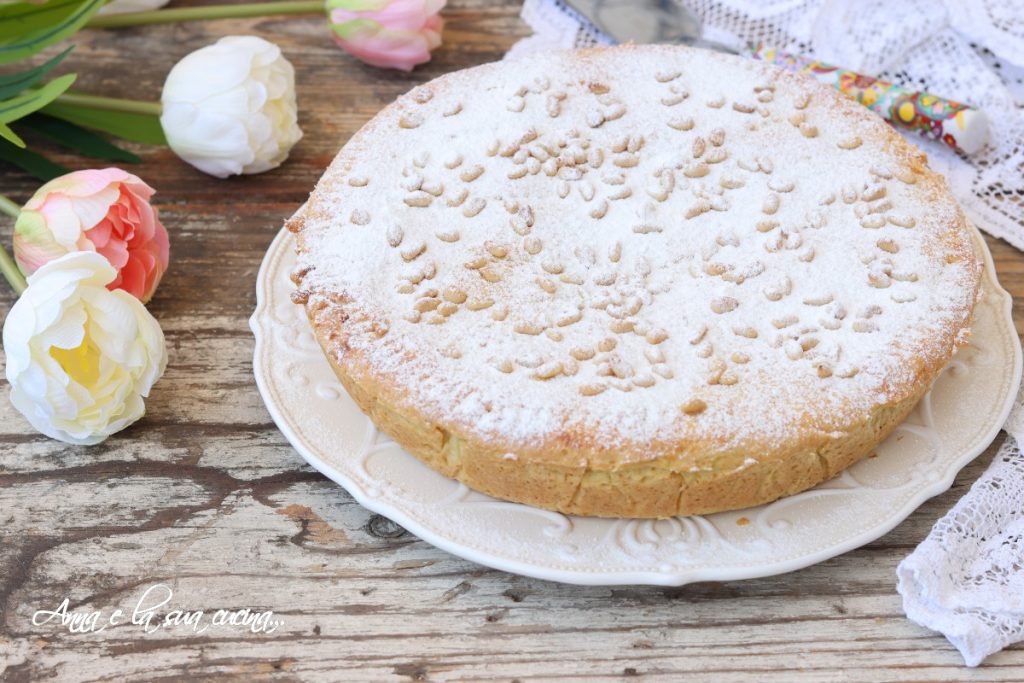
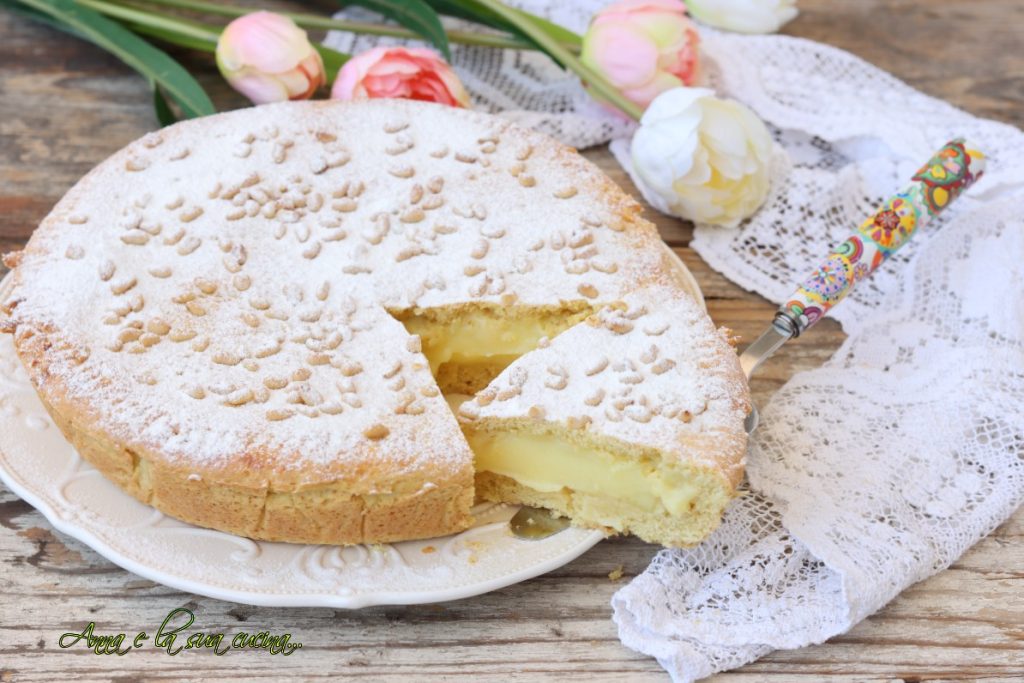
The soft and creamy grandmother’s cake is a timeless dessert of Tuscan origin, consisting of two shortcrust pastry shells enclosing a creamy custard filling flavored with lemon and vanilla, topped with lots of pine nuts and powdered sugar.
It is a well-loved dessert that every family has surely tried, with a dual consistency: crumbly on the outside like a tart and soft and creamy on the inside, with a fresh and delicate vanilla taste.
The grandmother’s cake is very rich and nutritious and is perfect for breakfast or a snack, even for a post-meal accompanied by a good coffee!
I recommend trying it; it is really very good and delicious!
YOU MIGHT ALSO BE INTERESTED IN THESE RECIPES
- Difficulty: Easy
- Cost: Medium
- Rest time: 30 Minutes
- Preparation time: 20 Minutes
- Portions: 8
- Cooking methods: Oven
- Cuisine: Italian
- Seasonality: All seasons
Ingredients for the Soft and Creamy Grandmother’s Cake
- 3 1/4 cups all-purpose flour
- 14 oz butter
- 2 whole eggs (medium)
- 1 egg yolk
- 3/4 cup sugar
- Half teaspoon baking powder
- 1 lemon zest (grated)
- 1 pinch salt
- 2 cups milk
- 2 eggs (medium or 4 yolks)
- 3/4 cup sugar
- 1/3 cup cornstarch (or flour)
- 1 lemon zest (grated)
- 1 vanilla sachet (or seeds from the pod.)
- 1/3 cup pine nuts
- as needed powdered sugar
Tools
- 2 Bowls
- 1 Small Pot
- 1 Rolling Pin
- 1 Baking Pan
- 1 Oven
Steps for the Soft and Creamy Grandmother’s Cake
To prepare the cake, start with the base, so first make the shortcrust pastry.
You can make the dough by hand in a bowl or with a simple food processor or stand mixer.
In the stand mixer bowl, put the sugar with the slightly softened butter cut into pieces, and work for a few minutes at speed 2, then add the eggs, the grated organic lemon peel, continuing to work with the salt, and lastly, the sifted flour and baking powder.
Work the dough quickly and mix the ingredients well, if necessary, add a dusting of flour; it should not stick.
Pour it onto a work surface, compact the dough by hand, form a ball, and refrigerate to rest for about 30 minutes.

While the dough rests, prepare the custard. Heat the milk in a small pot, and in the meantime, beat the eggs with the sugar using a whisk.
I used 2 whole eggs, but you can substitute with 4 yolks.Add the cornstarch or flour and a bit of the warmed milk, taking care not to leave lumps.
Add the remaining warmed milk, the vanilla, and the lemon zest (being careful not to include the white part) and place over medium-low heat; you don’t want to bring it to high heat, as too much boiling can leave an egg smell after cooking.
Continue stirring until the cream thickens completely. If it gets too thick, add some butter or warm milk until you reach the desired consistency. If it’s too thin, add a full teaspoon of cornstarch dissolved separately with a little milk, without creating lumps.Once the custard is ready, pour it into a bowl, cover with plastic wrap to prevent a crust from forming, and let it cool in the fridge.

Take the pastry from the fridge and divide it into two parts, with the base piece slightly larger. Roll out a sheet with a rolling pin on a sheet of parchment paper to a thickness of about 1/8 inch, cut out a nice circle, and line a round pan 9-9.5 inches if you want a tall cake, otherwise use a larger one. Then prick the edges with the tines of a fork and remove the excess edges.
Take the custard from the fridge, mix well, it should not have lumps, otherwise blend it with an immersion blender.
Pour the cream onto the pastry base, leveling it well.
Roll out the remaining pastry and cover the cake, cut off the excess edges, prick well with a fork, and brush the surface with a bit of melted butter and milk.
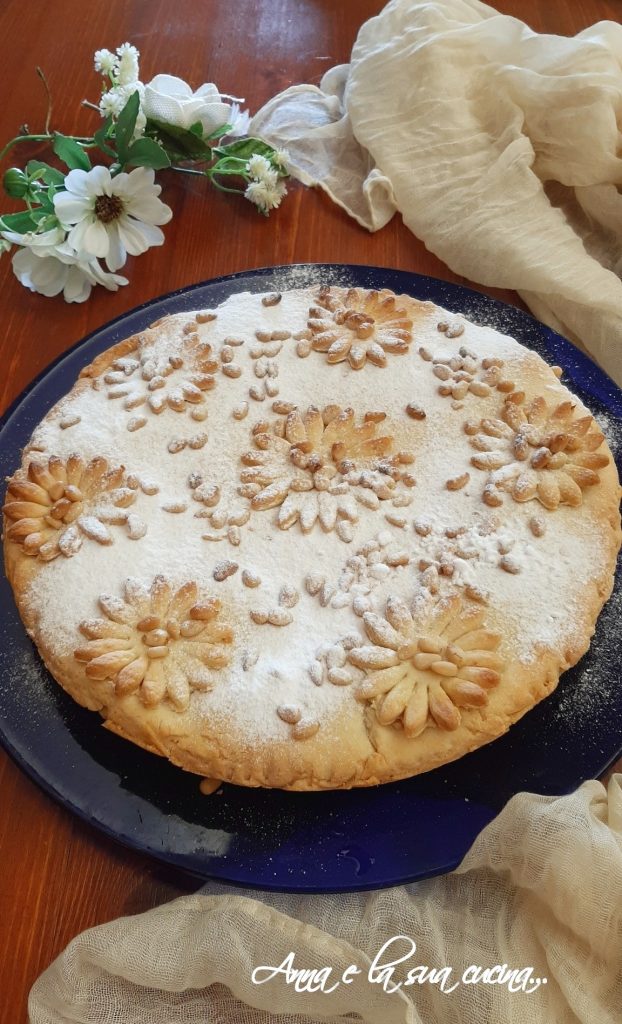
Sprinkle the surface with pine nuts.

Bake the Grandmother’s Cake in a preheated static oven at 320°F (160°C) for about 50 minutes on the lower rack, or 40 minutes with a fan, then raise the temperature to 355°F (180°C) and bake for another 10 minutes or 8 minutes with a fan.
If the pine nuts become too colored during cooking, cover with aluminum foil.
The baking time of the oven also depends on the power of your oven, so use your judgment to decide when to remove it.
The cake is ready when it is golden on the surface, slightly puffs up (it will settle back down), and the pine nuts are toasted but not burnt!
Once baked, remove and let cool completely, do not cut immediately as the cream needs to set with the pastry.
Sprinkle with plenty of powdered sugar and serve your delicious grandmother’s cake.

Storage and Tips
The grandmother’s cake keeps fresh for about 2-3 days, you can store it in the fridge but consume it at room temperature.
If you prefer, you can prepare the pastry in advance, freeze it, and thaw it as needed.
The custard can also be prepared in advance: in this case, store it in the refrigerator covered with plastic wrap until ready to use.
Tips
If you prefer, you can also try the open and revisited version of the grandmother’s cake.
Sprinkle the custard with pine nuts and bake as indicated; once ready, sprinkle with powdered sugar.
See the recipe here: Tart with Cream and Nuts
See the recipe here: Tart with Cream and Nuts
FAQ (Questions and Answers)
Can I add chocolate chips?
To add a special touch, you can add chocolate chips or shavings to the cream for an even more delicious variant.
There is also a chocolate variant called the “Grandfather’s Cake” which is made by filling it with chocolate custard.
