The Calabrian Sgute (also known as Cudduraci, Cuzzupe or Angute depending on the area) are not just simple brioches, but the very symbol of Easter in Calabria. Making these pastries brings an age-old tradition to the table that celebrates rebirth: the hard-boiled egg nestled in the center represents life beginning again.
In the past, the size of the Sguta and the number of eggs carried a clear message: giant Sgute with many eggs were made for fiancés or heads of households as a sign of great respect and love. In this recipe I propose a butter-free version, light and wonderfully fragrant, perfect for dipping in milk at breakfast or for taking in the Easter Monday picnic basket.
The secret to making them as soft as clouds? A double proofing and a pinch of patience. Follow my steps and you’ll smell how your kitchen fills with fragrance!
Don’t limit yourself to preparing Calabrian Sgute only at Easter and don’t make them the only pastry: there are many perfect Easter desserts for the season such as Stuffed Easter Eggs or the Neapolitan Pastiera or the rice pastiera.
If you enjoy making brioches at home, below I leave you other recipes to copy — and as always we’ll continue just after the photo!!
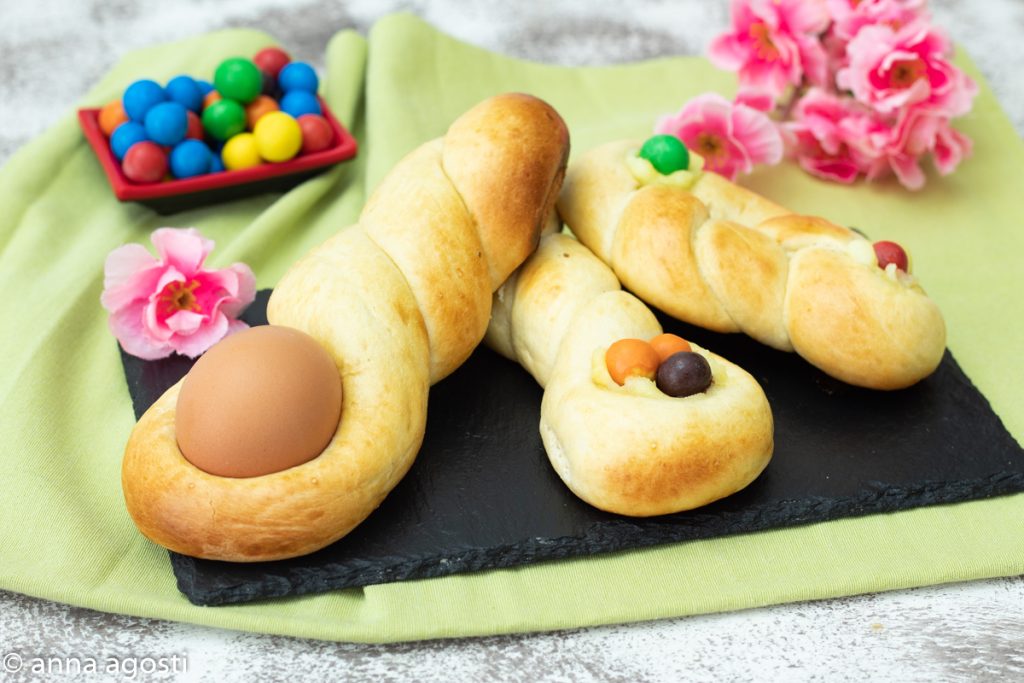
- Difficulty: Easy
- Cost: Very economical
- Rest time: 5 Hours
- Preparation time: 45 Minutes
- Portions: 6 servings
- Cooking methods: Electric oven
- Cuisine: Italian
- Seasonality: All seasons, Easter
Ingredients Calabrian Sgute Easter brioche
- 4 3/4 cups all-purpose flour (type 0)
- 1/2 cup granulated sugar
- 1/2 cup vegetable oil
- 3/4 cup water (about 200 ml)
- 1 egg
- 0.35 oz fresh baker's yeast (about 10 g)
- 1 tbsp honey
- 1 tsp vanilla extract
- 1 tbsp lemon zest (grated)
- 1 1/4 tsp salt (about 7 g)
- 1 egg yolk
- to taste milk
- 6 hard-boiled eggs
Tools
- 1 Stand mixer
- 1 Bowl
- 1 Baking sheet
Preparation Calabrian Sgute Easter brioche
Activate the yeast: Dissolve the fresh baker’s yeast in warm (not hot) water together with the tablespoon of honey.
Let rest for 5 minutes until a light foam forms.
The dough: In a stand mixer or a large bowl, combine the flour, sugar and lemon zest.
Begin kneading while adding the egg, the vegetable oil and the vanilla extract. Pour the yeast‑water mixture in a thin stream.
Kneading: Work the dough for at least 10 minutes (if using a stand mixer, use the dough hook). Add the salt last.
You should obtain a smooth, elastic ball that is not too sticky.
First proofing: Place the dough in a bowl lightly oiled with a drizzle of oil, cover with plastic wrap and let rise in a warm place (an oven turned off with the light on is fine) for about 3–4 hours, or until doubled in volume.
Shaping: Take the dough and divide it into 6 equal pieces. For each Sguta, form a rope about 12–16 in long.
Fold the rope into a “U”, place the hard‑boiled egg in the curve and braid the two ends of the dough to “embrace” the egg.
Second proofing (essential step): Place the Sgute on a baking sheet lined with parchment paper, spaced well apart.
Cover with a clean kitchen towel and let rise again for 45–60 minutes. This step ensures maximum softness.
Decoration and baking: Preheat the oven to 356°F (static). Gently brush the brioches with the yolk beaten together with a little milk and, if you like, decorate with colored sprinkles. Bake for about 20–25 minutes, until well golden.
Cooling: Remove from the oven and let cool on a rack. Sgute keep perfectly for 3–4 days if stored in a food bag or a tin box.
Storage and tips Calabrian Sgute Easter brioche
Extra tip: If you want an even more traditional aroma, add a tablespoon of anise liqueur or Strega to the dough: it’s the typical grandmotherly touch from Calabria that makes these brioches unmistakable!
Washing the eggs: Since the egg comes into direct contact with the dough, wash the shells of the hard‑boiled eggs thoroughly and dry them well before placing them.
Shine: For extra gloss, brush the brioches once immediately after shaping and a second time just before baking.
Without the hard‑boiled egg: If you prefer a more modern version, you can form simple braids and, once baked and cooled, decorate them with chocolate eggs attached with a little royal icing or spreadable cream.
Without the hard‑boiled egg: If you prefer a more modern version, you can form simple braids and, once baked and cooled, decorate them with chocolate eggs attached with a little royal icing or spreadable cream.
How to store Sgute: Sgute stay soft for 3–4 days if stored correctly:
In a bag: Seal them in a food‑grade plastic bag or a tin box as soon as they are completely cool.
Freezing: You can freeze them once baked and cooled. When you want to eat them, let them thaw at room temperature and pop them in a hot oven for 2 minutes to restore their aroma.
More recipes
🖥If you want to see other recipes you can return to HOME
📲If you don’t want to miss any recipes you can follow me on my Facebook Page, just enable notifications and you’ll see how many new recipes every day.
FAQ (Questions and Answers)
Can the hard‑boiled egg be eaten after baking in the oven?
Certainly! The egg, already hard‑boiled, undergoes a second baking in the oven that makes it firmer, but it remains perfectly edible.
Can I use active dry yeast instead of fresh yeast?
Yes, you can replace the 10 g of fresh yeast with about 3.5 g of active dry yeast (half a packet). Remember to activate it in warm water with the honey to help the proofing process.
Why did my brioche crack during baking?
This usually happens for two reasons: either the second proofing was too short, or the oven was too hot. Make sure the Sgute have visibly doubled in volume on the tray before baking.
Can I prepare the dough the night before?
Yes! You can make the dough in the evening, use half the indicated yeast (5 g instead of 10 g) and let the dough rise in the refrigerator overnight in a covered bowl. The next morning, let it come to room temperature for an hour before shaping the Sgute.