You can make chocolate Easter eggs at home using dark chocolate, milk chocolate, or white chocolate. If you want, you can also mix the chocolate with chopped hazelnuts, pistachios, or any other nuts you like for even more delicious chocolate Easter eggs.
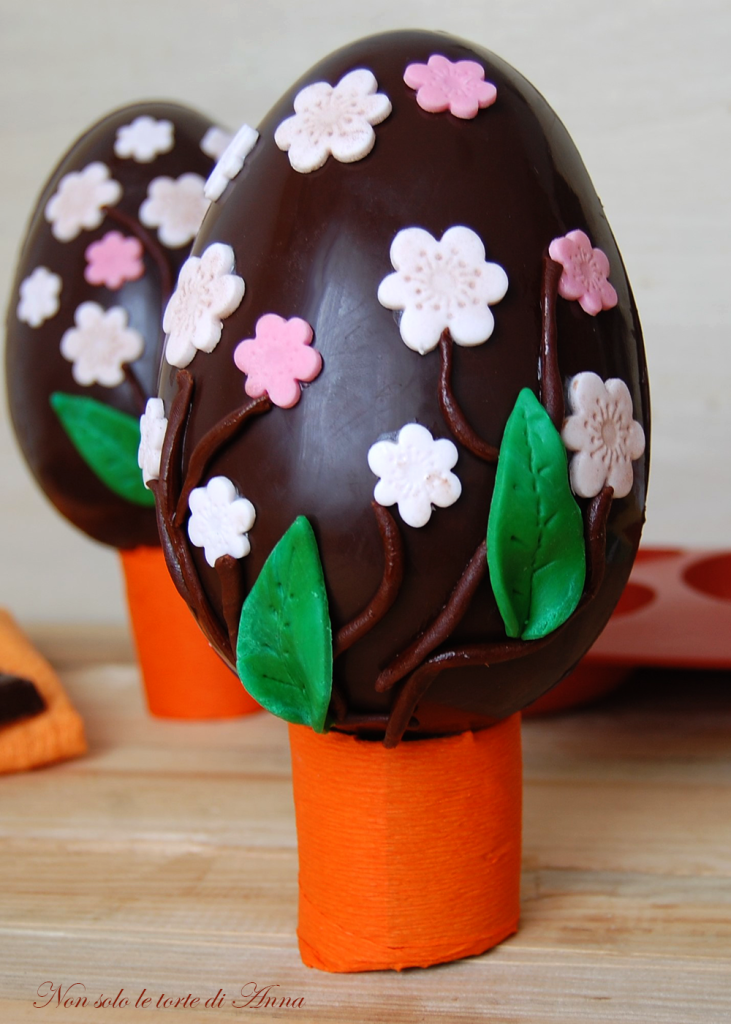
I know, they are not the easiest to make, but once you get the hang of melted chocolate, you’ll find it fun to make them even with your kids, who can help create flowers and other decorations in sugar paste to attach to the eggs once they’re done.
Below, I’ll leave you more ideas for recycling Easter egg chocolate and some other delightful Easter desserts to try, and then we’ll dive right after the photo, as always, to discover how to prepare chocolate Easter eggs!
- Difficulty: Difficult
- Cost: Economical
- Rest time: 2 Hours
- Preparation time: 20 Minutes
- Portions: 5
- Cooking methods: Stovetop
- Cuisine: Italian
- Seasonality: Winter, Spring
- Energy 1,454.40 (Kcal)
- Carbohydrates 89.04 (g) of which sugars 29.74 (g)
- Proteins 28.64 (g)
- Fat 109.42 (g) of which saturated 64.55 (g)of which unsaturated 35.24 (g)
- Fibers 33.20 (g)
- Sodium 48.00 (mg)
Indicative values for a portion of 200 g processed in an automated way starting from the nutritional information available on the CREA* and FoodData Central** databases. It is not food and / or nutritional advice.
* CREATES Food and Nutrition Research Center: https://www.crea.gov.it/alimenti-e-nutrizione https://www.alimentinutrizione.it ** U.S. Department of Agriculture, Agricultural Research Service. FoodData Central, 2019. https://fdc.nal.usda.gov
Ingredients for the Easter eggs
- 2.2 lbs dark chocolate (of excellent quality)
- 7 oz sugar paste (in various colors)
Tools
- Bowl
- Spatula
- 1 Thermometer kitchen
- Flower and dove cutter
- 1 Mold Easter egg
- Metal scraper
How to make chocolate Easter eggs
Making chocolate Easter eggs is simple, not quick, but fun. The only thing to be careful about is the chocolate.
You should melt it in a double boiler or in the microwave, little by little.
Break the chocolate into the smallest pieces you can and place it in a bowl, preferably a Pyrex glass one, and then melt it in a double boiler or in the microwave.
Once the chocolate is melted, you need to measure the temperature; for dark chocolate, it should not exceed 113°F.
Once melted, pour it onto a marble or steel surface and quickly lift and spread it with a metal scraper to cool it down.
The tempered dark chocolate should reach a temperature of 88°F.
At this point, take the Easter egg molds.
Pour the chocolate into the molds with the help of a spatula.
Rotate the mold so that it reaches the edges well, then remove the excess chocolate, letting it fall back into the bowl.
Place the mold upside down on parchment paper and let it cool completely.
You will see that after an hour or so, the chocolate halves will detach from the mold by themselves.
Once the chocolate halves are detached from the mold, melt more chocolate.
Place the surprise inside the half egg, then brush melted chocolate on the edges and attach the two halves.
Use cutters for flowers, leaves, bunnies, or whatever you want from sugar paste to decorate the Easter eggs, wrap them in foil or clear paper, and store them in a cool, dry place.
Wait, before you go, I’ll leave you my FACEBOOK PAGE if you want to be updated daily with my recipe.
This article contains sponsored links IconA Amazon
Storage of chocolate Easter eggs
Chocolate Easter eggs can be stored outside the fridge for several months. If you want, you can also store them in the freezer, even broken into pieces once you have removed the surprise.
Other recipes
If you want to see other types of recipes, you can return to HOME.