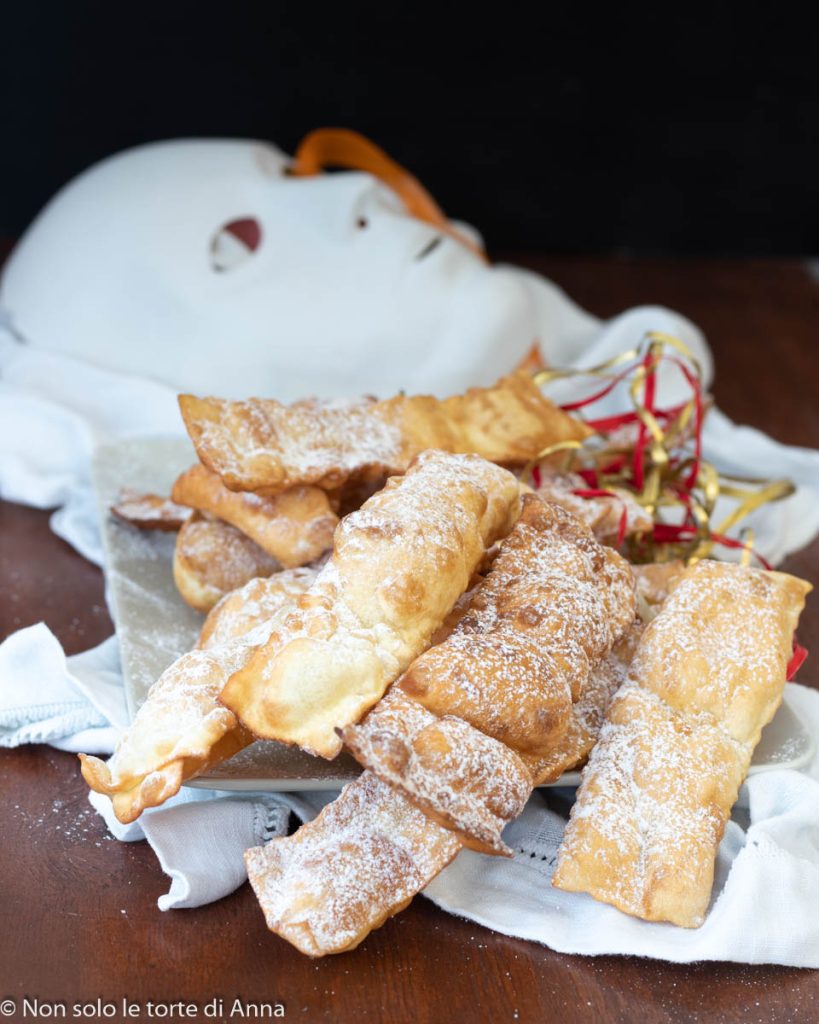
The fried frappe recipe (also known as chiacchiere) is the symbol of Carnival.
Let’s face it: it’s not truly Carnival until your fingers are covered in powdered sugar! Fried Frappe are the undisputed symbol of the celebration: thin, crispy sheets filled with those golden bubbles that burst in your mouth with the first bite.
Making them at home is a ritual that smells of family and joy. Are you ready to discover the secret to making them ultra-light and super crispy? Warning: they are addictive, one leads to another.
There’s a sound that, more than any mask or confetti, announces the arrival of Carnival: it’s the decisive ‘crack’ of a Carnival chiacchiera just bitten, dissolving in your mouth and turning into a sugar cloud.
If you’re looking for the ultimate recipe for bubbly and light as clouds bugie, you’re in the right place. Let’s get right under the photo, as always, to discover how to prepare this Fried Frappe Recipe😉
See you soon with the next recipe, Ana Amalia!
- Difficulty: Very easy
- Cost: Very economical
- Rest time: 30 Minutes
- Preparation time: 15 Minutes
- Portions: 25 pieces
- Cooking methods: Frying
- Cuisine: Italian
- Seasonality: Carnival
Ingredients for the Fried Frappe Recipe
- 1 3/4 cups all-purpose flour
- 3 1/2 tbsps butter
- 2 tbsps sugar
- 2 eggs (medium)
- 1 tbsp lemon zest (grated)
- 1 tbsp grappa
- 1 pinch salt
- as needed peanut oil (for frying)
Preparation of the Fried Frappe Recipe
To prepare the fried frappe, place all the ingredients starting with flour in a large bowl.
Knead quickly at first with a fork and then with your hands until the mixture begins to gain consistency.
Turn the mixture over onto the work surface and shape it into a smooth and compact ball that you’ll wrap in plastic wrap, let it rest for 30 minutes.
After the resting time, take the dough and divide it into two or three parts, roll it out with a rolling pin or with a pasta machine to a thin sheet a few millimeters thick.
Cut the dough into many strips 3 inches long and 1 inch wide using a fluted pastry wheel, sprinkle with a little flour to prevent them from sticking together.
Meanwhile, heat plenty of oil for frying (between 340/350°F) and fry few frappe at a time to not lower the oil temperature, drain them with a slotted spoon onto paper towels.
Crunchy, fragrant, and irresistible: your fried frappe are ready to be enjoyed.
Get ready, because once you taste this crispy version, you won’t go back.
I just have to wish you a sweet Carnival, and don’t forget the generous final sprinkle of powdered sugar!
Storage, tips, and variations for Fried Frappe
The fried frappe recipe can be kept for 4 or 5 days.
The golden secret: humidity is the enemy!
The reason why frappe become soft is due to humidity (both from the air and residual from the dessert itself).
Complete cooling: Before closing them in any container, make sure they are completely cold. If you close them while they are still warm, condensation will form, and they will become soft quickly.
Paper towels: Once fried, drain them well on paper towels. Change the paper if it becomes too soaked with oil: the less residual oil there is, the crisper they will remain.
Powdered sugar: This is a fundamental trick. Powdered sugar tends to absorb moisture. If they are not going to be eaten immediately, dust them only at the moment of serving.
If they become slightly moist, don’t despair! You can “revive them” by placing them in a warm (but turned off) oven or at a low temperature (around 120-140°F) for a few minutes. This will evaporate the surface moisture, and they will become crunchy again. Then, once cooled, add a new layer of sugar.
The Tricks for Perfect Frappe (the secret of the bubbles!)
The Tricks for Perfect Frappe (the secret of the bubbles!)
The true success of a frappa is measured by the number of bubbles and its crispiness. Here’s how to ensure them:
Resting is sacred: Never skip the dough rest (at least 30-60 minutes). It helps to relax the gluten: only then you can roll out a very thin sheet without it snapping back.
Thin as tissue paper: The thinner the sheet, the lighter and crispier the frappa will be. If you have a pasta machine (the “nonna papera”), go to the last or penultimate setting.
The importance of alcohol: Whether it’s grappa, marsala, white wine, or anise, alcohol is essential. In cooking, it evaporates immediately, creating steam that lifts the dough and forms the famous bubbles.
The temperature of the oil: The oil should be between 340°F and 350°F. If it’s too cold, the frappa soaks up oil; if it’s too hot, it burns outside and remains raw inside.
Fry few pieces at a time: If you add too many, the oil temperature drops drastically, and goodbye crunchiness
Tasty variations for super delicious Cenci
The “Choco-Frappe”: Once cooled, dip half of the frappa in melted dark chocolate and let it dry on parchment paper. An amazing contrast!
Baked Version: For those who want to stay light, you can bake them at 375°F for about 8-10 minutes. They will be less “bubbly” but still delicious.
Citrus Flavored: Instead of the classic vanilla, add plenty of finely grated orange, lemon, and tangerine zest into the dough for an irresistible citrus aroma.
Filled (Sweet Ravioli): Use the same dough to create small ravioli filled with Nutella, jam, or ricotta cream, then fry them.
Other recipes
🖥If you want to see other types of recipes, you can return to HOME
📲If you don’t want to miss any recipe, you can follow me on my Facebook Page, just activate notifications and see how many new recipes every day.
Frequently Asked Questions for the Fried Frappe Recipe
Can they be frozen?
The dough: Yes, you can freeze the raw dough wrapped in plastic wrap. When you want to use it, let it thaw slowly in the refrigerator.
The cooked frappe: I strongly advise against it. The structure of the fried frappa is too delicate, and freezing would destroy its crispiness, making them soggy when defrosted.How long do they last?
If stored correctly in a cool and dry place (not in the fridge!), frappe remain excellent for 4-5 days.
Why didn’t my frappe have bubbles?
The bubbles depend on three factors: the presence of an alcoholic component (like your grappa!), the rest of the dough which must be very elastic, and especially the thickness of the sheet. The thinner you roll it out, the more air and steam will be able to lift the dough creating bubbles.
Can I prepare the dough in advance?
Absolutely yes! You can prepare the dough and leave it in the refrigerator, wrapped in plastic wrap, for up to 24 hours. Just remember to let it sit at room temperature for at least 30 minutes before starting to roll it out, so it will be easier to work with.
What’s the best oil for frying frappe?
My advice is to use peanut oil. It has a high smoke point (it doesn’t burn easily) and a neutral flavor that does not overshadow the aroma of grappa and lemon.
Can I bake this same recipe?
Yes! If you prefer a lighter version, you can bake the frappe in a static oven at 375°F for about 8-10 minutes. They will be more like crunchy cookies and less “bubbly,” but still delicious.
Why did the frappe come out too hard?
Usually, this happens if the dough is worked too long after adding the flour or if the sheet remains too thick. Another reason could be the oil temperature being too low: the frappe should cook quickly (a few seconds per side).
How do I prevent them from being greasy?
The secret is to maintain the oil at a constant temperature of 350°F. If you immerse too many at once, the temperature drops, and the dough absorbs the oil. Always drain them on paper towels without stacking them until they are dry.