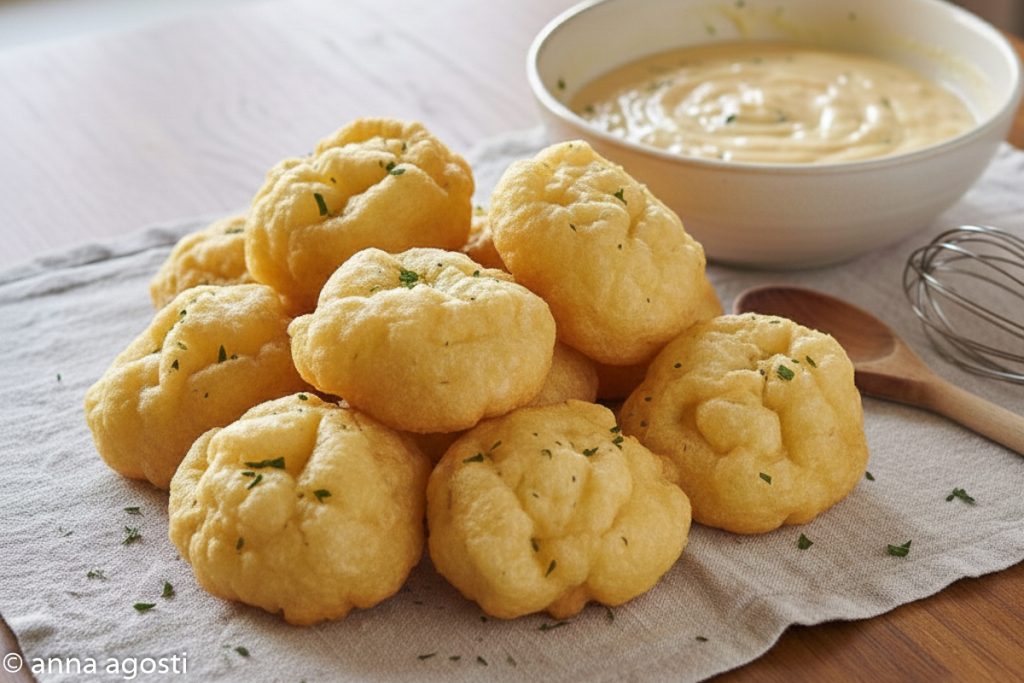
If there is a scent that can instantly transport you to the alleys of Genoa, between an ancient noble palace and a historical shop, it is that of Genoese Frisceu.
These small clouds of fried batter are not just appetizers: they are a piece of Ligurian culinary history, a ritual that smells like home and family Sundays.
But what exactly are Frisceu?
The term comes from the dialect and means, very simply, “fritters”.
Their uniqueness lies in their simplicity: a yeasted batter, light as a breath, that encloses the flavors of the garden.
Although today we often find them as delicious street food in paper cones (the famous “sciamadde”), the frisceau originate as a poor dish, capable of turning a few basic ingredients into a feast.
Below, I leave you with other delicious fried foods to try, and then as always, right below the photo, let’s discover how to prepare the Ligurian fritters!
See you soon with the next recipe, Ana Amalia!
- Difficulty: Very easy
- Cost: Very cheap
- Rest time: 3 Hours
- Preparation time: 20 Minutes
- Portions: 4 People
- Cooking methods: Frying
- Cuisine: Regional Italian
- Region: Liguria
- Seasonality: Carnival, All seasons
The Ingredients: Few, Simple, and Extremely Fresh
This recipe was developed with the support of artificial intelligence for content optimization and dose calculation, ensuring full fidelity to Ligurian tradition.
- 12 oz all-purpose flour
- 1 1/4 cups sparkling water (cold)
- 1 packet fresh yeast
- 1 bunch chives (fresh)
- 4 leaves lettuce
- Half teaspoon salt
- 1 pinch sugar
- as needed seed oil (for frying)
How to Get Soft and Crunchy Genoese Frisceu
Take your time: the secret to a good frisceu is all in the slow rise and the heat of the oil.
Waking up the yeast: Start by dissolving the yeast (1 packet for our 4-person recipe) in a small part of the 1 1/4 cups of water provided.
Ensure the water is just lukewarm and add a pinch of sugar: this will activate the yeast and ensure perfect rising.
A batter that “writes”: In a large bowl, sift the 12 oz of flour. Start pouring in the well-chilled sparkling water and the dissolved yeast, mixing with a whisk.
You should obtain a fluid but firm batter: the test is to lift the spoon; the batter should fall slowly and “write,” leaving a visible trace for a few moments on the surface.
The garden on the plate: Chives and Lettuce, Wash and dry the lettuce leaves and chives thoroughly.
Cut the lettuce into very thin strips (almost invisible julienne) and finely chop the chives. Add the vegetables to the batter along with a generous pinch of salt and mix well.
The rest: Cover the bowl with plastic wrap or a clean cloth. Place the batter in a protected area (the turned-off oven is ideal) and let it rise for about 2.5 to 3 hours.
You’ll know it’s ready when you see many small bubbles on the surface and the volume has doubled.
The plunge into oil: Heat plenty of seed oil in a high-sided pan. When the oil reaches the ideal temperature (340-355°F), get into action with two spoons:
use one to take a small amount of batter and the other to gently push it into the oil. Do not overcrowd the pan; Genoese frisceu need space to puff up and become golden and crispy on each side.
The final touch: Drain the fritters with a slotted spoon and place them on straw paper or absorbent paper to eliminate excess oil. Serve them piping hot, perhaps with a final pinch of salt on top.
Secrets for Perfect Frying
The oil temperature: It is the number one secret. It should be around 340-355°F. If you don’t have a thermometer, dip the tip of a toothpick: if it bubbles around, we’re there. If the oil is too cold, the frisceu will soak; if it’s too hot, they’ll be raw inside.
Do not overcrowd the pan: Fry a few pieces at a time. If you add too many, the oil temperature drops sharply, and goodbye crunchiness!
Drying: Use kitchen absorbent paper or, even better, straw paper (the yellow one for fries), which absorbs the oil without making the fritter “soggy”.
How to Store Genoese Frisceu (if there are any leftovers!)
Frisceu are at their best freshly made, but if there are leftovers, here’s how to handle them:
In the fridge: Once cold, place them in an airtight container. They keep for 1-2 days.
How to reheat them: Never use the microwave as they would become rubbery. The best way is to pass them in a convection oven or air fryer at 355°F for 3-4 minutes. They’ll be almost as good as freshly made!
Freezing: You can freeze them (already fried and cold). When you crave a snack, put them directly in a hot oven without thawing.
Other Recipes Beyond Genoese Frisceu
🖥If you want to see other types of recipes, you can return to HOME
📲If you don’t want to miss any recipe, you can follow me on my Facebook Page, just enable notifications and you’ll see how many new recipes every day.
FAQ (Questions and Answers) for Genoese Frisceu
Can I use dry yeast instead of fresh yeast?
Absolutely! If you use dry yeast, about 3 grams (a scant teaspoon) will be sufficient for the 12 oz of flour. Remember to always activate it in a bit of lukewarm water before adding it to the flour.
Why are my frisceu raw inside?
Probably the oil was too hot! If the oil exceeds 375°F, the outer part darkens immediately, but the heat doesn’t have time to cook the heart of the fritter. Try to maintain the temperature around 340-355°F.
Can I prepare the batter in advance?
Yes, you can prepare it a few hours earlier. If you see it rising too quickly because it’s warm, place it in the least cold part of the fridge. Take it out 20 minutes before frying to bring it back to temperature.
Is there a gluten-free version?
Yes, you can replace all-purpose flour with a mix of rice flour and cornstarch, or with a gluten-free universal flour. In this case, adjust the water gradually as gluten-free flours absorb liquids differently.
Which lettuce is best to use?
Traditionally, butterhead or romaine lettuce is used, the important thing is to use the tenderest and innermost leaves (the heart). It’s crucial that they’re as dry as a desert before ending up in the batter!