Homemade Tuscan Bread: the art of “Sciapo”
If there is one product that embodies the essence of Tuscan rural tradition, it is undoubtedly its bread.
Known to all as “pane sciapo,” its peculiarity of being completely salt-free is not accidental, but a historical choice dating back to ancient disputes between Pisa and Florence. But don’t be fooled: the lack of salt does not mean lack of character!
This bread stands out for its golden, crunchy crust and a compact yet soft crumb, with a slightly sour taste thanks to the use of sourdough (or a pre-dough called “biga”).
It is the inseparable companion for a platter of Tuscan DOP ham or finocchiona, and it is the essential base for simple yet flavor-rich dishes like ribollita or pappa al pomodoro. Making it at home means bringing the authentic aroma of wood-fired ovens into your kitchen.
Let’s go right under the photo, as always, to discover how to make Sciapo Tuscan Bread, but first take a look at the other Tuscan recipes I propose😉
See you soon with the next recipe, Ana Amalia!
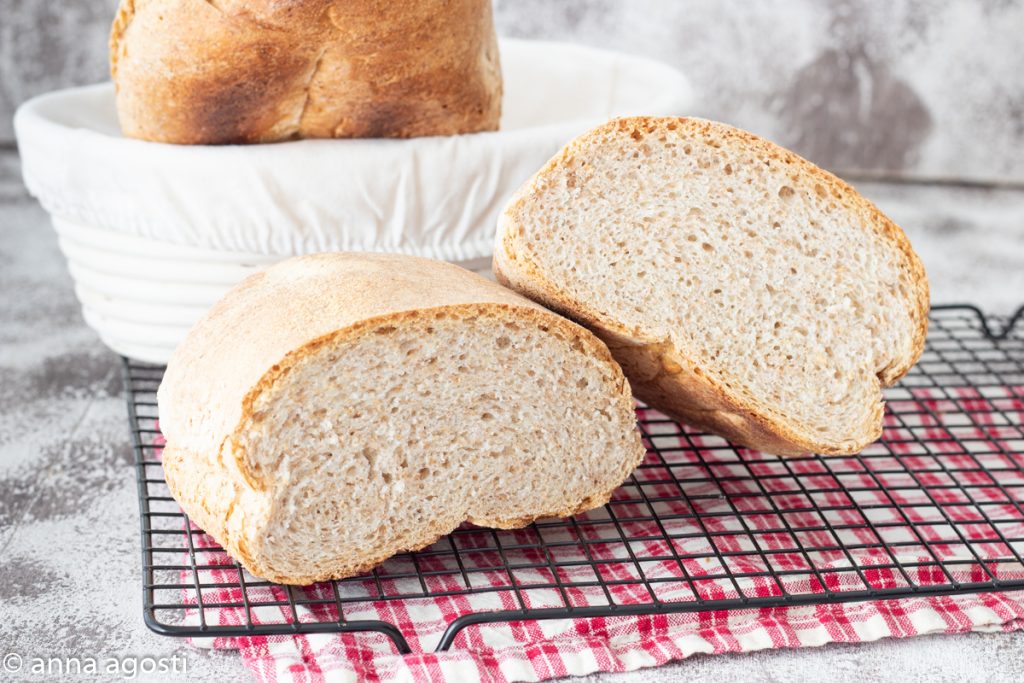
- Difficulty: Easy
- Cost: Very cheap
- Rest time: 14 Hours
- Preparation time: 20 Minutes
- Portions: 1.1 lbs
- Cooking methods: Oven, Electric oven
- Cuisine: Regional Italian
- Region: Tuscany
- Seasonality: All seasons
Ingredients for Homemade Tuscan Bread
- 3/4 cup all-purpose flour
- 1/4 cup water
- 1 tsp fresh yeast
- 2 1/2 cups all-purpose flour (preferably stone-ground)
- 3/4 cup water (warm)
- 3/4 tsp fresh yeast
- 1 tsp barley malt (or honey)
Steps
1. The night before: Dissolve the gram of yeast in water and add it to the flour.
Knead quickly (it should remain a bit rough), cover with plastic wrap, and let it ferment at room temperature for about 12-16 hours.
2. The dough: The next day, dissolve the rest of the yeast and the malt (or honey) in warm water.
In a large bowl, combine the flour, the biga in pieces, and the water with yeast.
3. Kneading: Knead energetically for at least 10-15 minutes until you get a smooth and elastic dough. Remember: no salt!
4. First rise: Form a ball and let it rise in a bowl greased with a thin layer of oil, covered, for about 2 hours or until doubled.
5. Shaping: Take the dough and shape it into a loaf or a round loaf (the bozza).
Place it on a baking tray lined with floured parchment paper, sprinkle the surface with a little flour, and let it rise for another hour.
6. Baking: Make cuts on the surface and bake in a preheated static oven at 428°F.
For an extra crunchy crust, place a pan of water at the bottom of the oven for the first 15 minutes. Bake for about 30-35 minutes, lowering to 392°F in the last 10 minutes.
7. Cooling: Remove from oven and let the bread cool on a rack to allow moisture to escape.
Bloggers’ tip: Tuscan bread is famous because it should never be thrown away. If it becomes stale after a few days, it is perfect to be “reborn” as a bruschetta with new oil or a summer panzanella!
Storage and Tips for Unsalted Tuscan Bread
Unsalted bread has excellent storage, but you must avoid moisture making it gummy:
At room temperature: Wrap the bread in a clean cotton cloth or store it in a paper bag. It keeps well for 3-4 days. If it becomes hard, it’s perfect for soups!
In the freezer: You can freeze it already sliced in food bags. It keeps for up to 3 months. To enjoy it at its best, heat the slices directly in the oven or toaster without thawing first: they will become as crispy as freshly baked.
What not to do: Never put it in the fridge, because cold accelerates the staling process and ruins the texture of the crumb.
Homemade Tuscan Bread – Other Recipes
🖥If you want to see other types of recipes you can go back to HOME
📲If you don’t want to miss any recipes you can follow me on my Facebook Page, just activate notifications and you will see how many new recipes every day.
FAQ (Frequently Asked Questions)
Why is Tuscan bread unsalted?
Legend says that in the 12th century, during the disputes between Florence and Pisa, the Pisans blocked the trade of salt towards the inland. The Florentines did not lose heart and began producing salt-free bread, discovering that it paired perfectly with their flavorful cured meats and cheeses.Can I use only fresh yeast without making the biga?
Yes, you can do it by increasing the fresh yeast to 10-12g for 500g of flour, but the result will be different. The biga gives that slight sour note and characteristic aroma that compensates for the absence of salt. Without biga, the bread will taste more “flat.”
What flour is best to use?
The tradition prefers type 0 soft wheat flour, ideally Tuscan and stone-ground. If you want a more rustic bread, you can mix the type 0 flour with 20% whole wheat flour.
Why is my bread crust pale?
Salt helps the crust to color. Without salt, the bread struggles to brown. That’s why we added a teaspoon of malt or honey in the recipe: sugars aid caramelization during baking, giving you that nice golden color.
How do I get an extra crunchy crust?
Besides the pan of water in the oven, during the last 5 minutes of baking, slightly open the oven door (keeping it “ajar” with a wooden spoon). This will release residual steam and make the crust incredibly crispy.