If you’re looking for a dish that captures all the freshness and lightness of the coming season, you’re in the right place. This version of spring rice with peas and thyme is a true call to spring: fragrant basmati grains that stay nicely separated, the sweetness of freshly picked (or carefully frozen) peas and a bouquet of aromatic herbs that will turn your kitchen into a blooming garden.
This is a magical recipe because, despite its restaurant-like appearance, it practically cooks itself in a single pot. Whether you’re experienced at the stove or you’ve just bought your first set of pans, this dish will make you shine. Ready to bring a ray of sunshine to the table? This is my take on the classic Pilaf Rice, turned into a light and fragrant Spring Rice.
Below I always leave other recipes perfect for the approaching spring and then, as always, right under the photo you can discover how to prepare the Spring Rice with Peas and Thyme 😏
See you soon with the next recipe, Ana Amalia!
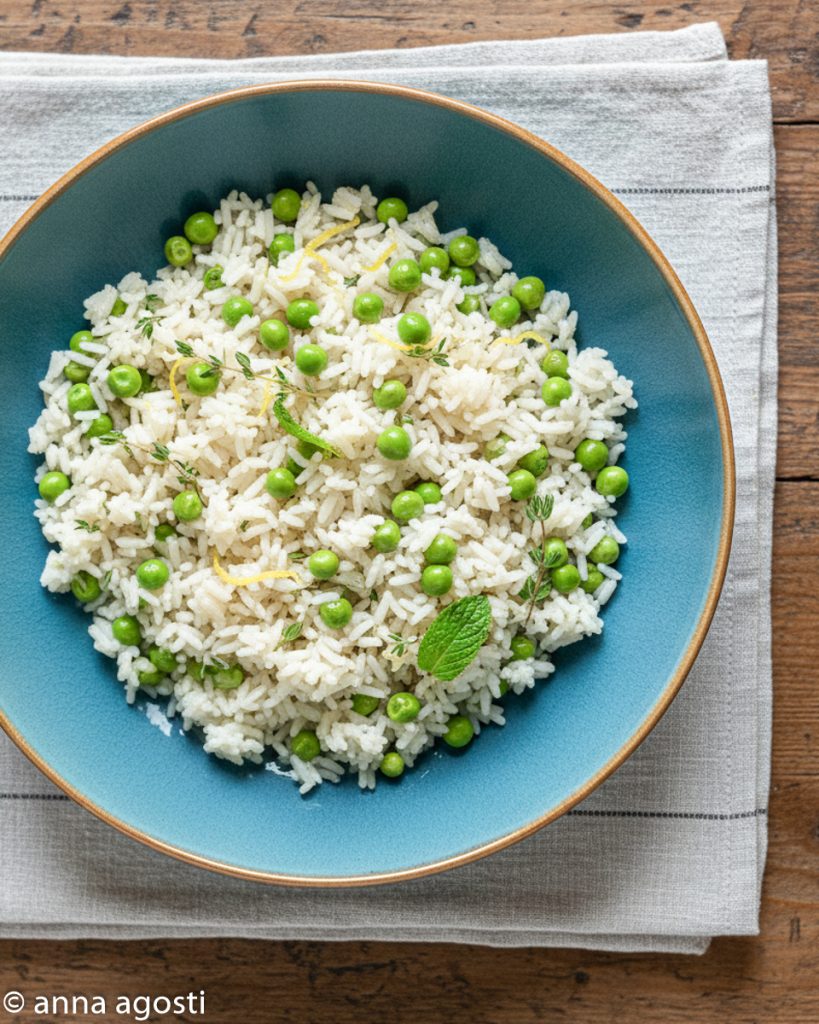
- Difficulty: Very easy
- Cost: Very inexpensive
- Preparation time: 10 Minutes
- Cooking time: 15 Minutes
- Portions: 3 People
- Cooking methods: Stovetop
- Cuisine: Italian
- Seasonality: Spring, Summer and Autumn
- Energy 240.79 (Kcal)
- Carbohydrates 29.17 (g) of which sugars 5.39 (g)
- Proteins 5.99 (g)
- Fat 10.79 (g) of which saturated 1.44 (g)of which unsaturated 0.19 (g)
- Fibers 4.76 (g)
- Sodium 776.64 (mg)
Indicative values for a portion of 300 g processed in an automated way starting from the nutritional information available on the CREA* and FoodData Central** databases. It is not food and / or nutritional advice.
* CREATES Food and Nutrition Research Center: https://www.crea.gov.it/alimenti-e-nutrizione https://www.alimentinutrizione.it ** U.S. Department of Agriculture, Agricultural Research Service. FoodData Central, 2019. https://fdc.nal.usda.gov
Ingredients for Spring Rice with Peas and Thyme
- 1 1/3 cups Basmati rice
- 2 cups vegetable broth
- 1 1/4 cups peas (fresh or frozen)
- Half yellow onion
- 1 stalk celery
- 3 tbsp extra virgin olive oil
- 4 sprigs thyme (fresh)
- 2 leaves sage
- to taste mint (fresh)
- 2 pinches salt
- to taste black pepper (ground)
Tools
- 1 Fine mesh strainer
- 1 Pot
- 1 Kitchen scale
Preparation Spring Pilaf Rice with Peas and Thyme
1. The Secret of Washing: Before you start, put the basmati rice in a fine-mesh strainer and rinse it under cold water until the water runs clear.
This removes excess starch and ensures the grains stay separate. Let it drain well.
2. The Aromatic Base: Finely chop the onion and celery. In a saucepan (preferably with a thick bottom and a lid that seals well), heat the oil and gently soften the chopped vegetables over low heat for about 5 minutes.
They should not fry strongly; they should just become tender and fragrant.
3. Toasting and Aromas: Raise the heat slightly, add the well-drained rice and the peas.
Stir for 2 minutes: you’ll hear the rice begin to “sing” (a light sizzle) and the grains will become glossy and almost translucent. Now add the thyme, sage and mint.
4. Cook Without Worry: Pour the hot vegetable broth over the rice. Add a pinch of salt (be careful if the broth is already flavorful) and a grind of pepper.
Give a single quick stir to level everything, then put the lid on.
IMPORTANT: Turn the heat to the lowest setting and do not open the lid or stir for the next 10-12 minutes. The trapped steam will cook the rice perfectly.
5. The Tea Towel Trick: When the cooking time is up, turn off the heat. Remove the lid, place a clean kitchen towel over the pot and close again with the lid (the cloth sits in the middle).
Let it rest like this for 5-10 minutes: the fabric will absorb the residual moisture, making the rice incredibly fluffy.
6. Serve: Remove the lid, discard the sprigs of herbs and gently fluff the rice with a fork (never use a spoon).
Serve with a drizzle of raw olive oil, a sprig of fresh thyme, a few fresh mint leaves and, if you like, some lemon zest for garnish.
Variations of Spring Pilaf Rice with Peas and Thyme
Turn it into a main dish (Protein)
If you want to serve the rice as the main course and not just as a side, you can add a protein note that pairs with the sweetness of the peas:
Steamed or sautéed shrimp: Add them in the last 2-3 minutes of rice cooking (on top of the grains, without stirring) or sauté them separately with a little lemon zest and fold them in at the end.
Crumbled feta: The contrast between the saltiness of feta and the sweetness of peas is amazing. Add it cold just before serving.
Small cubes of cooked ham or speck: If you prefer meat, quickly sauté them in a pan until crisp and use them as a final garnish.
To give that extra touch that surprises guests:
Lemon Zest: Grate the peel of an organic lemon over the rice just before fluffing with a fork. The freshness of lemon with thyme and peas is the quintessence of spring.
Sliced almonds: Toast a handful of sliced almonds (or pine nuts) in a small nonstick pan and sprinkle them over the finished dish. They’ll add a crunchy note that completes the softness of the rice.
How to store spring rice with peas and thyme
Pilaf rice stores very well if you follow a few precautions: In the refrigerator: Put it in an airtight container once cooled. It keeps perfectly for 2-3 days.
How to reheat: To avoid drying the grains out, warm it in a pan with a tablespoon of water or broth, or in the microwave covered with food wrap (creating a steam effect).
In the freezer: You can freeze it for about 1 month. I recommend thawing it in the refrigerator the evening before.
✨ Now it’s your turn!
Now that you have all the secrets for a textbook Pilaf Rice, all that’s left is to get cooking! It’s the ideal dish for a light yet refined lunch, or to impress friends with a fragrant side dish.
Experiment with the aromatic herbs you have on the balcony and, if you like, try the shrimp variation we mentioned earlier: it will become your “go-to” spring dish.
If you want to see other types of recipes you can return to HOME
If you don’t want to miss any recipe you can follow me on my Facebook Page, just turn on notifications and you’ll see how many new recipes every day.
FAQ (Questions & Answers) Spring Pilaf Rice
Can I use Arborio or Carnaroli rice?
Not recommended for the pilaf method. These rices release a lot of starch and tend to become creamy (like risotto), while pilaf should have separate grains. Basmati or Jasmine are ideal.
What happens if I open the lid during cooking?
You would ruin the steam effect! The trapped steam is what cooks the rice evenly. Resist the temptation!
Do frozen peas need to be thawed first?
No, you can put them directly into the pot with the rice during toasting. They’ll only add about a minute to the time the broth needs to return to a boil.
Do the aromatic herbs have to be fresh?
Dried thyme can work (use less), but mint and sage are best fresh. If you don’t have them, it’s better to omit them than to use the dried versions.