
Beef Tenderloin with Red Wine Sauce: The Chic and Quick Dish for an Unforgettable Dinner
Want to impress or pamper someone with a restaurant-worthy dish without spending hours at the stove?
Then make Beef Tenderloin with Red Wine Sauce.
The tenderloin is a noble cut, but the problem is that it often becomes tough or dry during cooking. Also, the red wine sauce can easily become too thin or, worse, bitter because of an improper reduction.
I’ll tell you the secrets for a flawless result, perfect for special occasions:
Perfect Meat: You should season the steaks only on the surface and cook them over a medium-high flame to seal in the juices. Crucial: let them rest for 2-3 minutes after cooking on a cutting board before serving.
This makes them extremely tender.
Glossy Sauce: Caramelizing the onion gives intense flavor, but for the right texture you must strain the sauce and then thicken it with cornstarch diluted in cold water. This prevents a watery sauce and ensures that glossy consistency that “coats the spoon”.
Get ready to bring to the table a meat main course that is a pleasure for the palate: simple but highly impressive.
- Difficulty: Easy
- Cost: Medium
- Rest time: 3 Minutes
- Preparation time: 20 Minutes
- Cooking time: 25 Minutes
- Portions: 4
- Cooking methods: Stovetop
- Cuisine: Italian
Ingredients — BEEF TENDERLOIN WITH RED WINE SAUCE
- 1.8 lb beef tenderloin (4 pieces of about 7 oz each; thickness about 1 1/4–1 1/2 in)
- 2 cloves garlic
- A few sprigs rosemary
- 2 tbsp extra-virgin olive oil (EVOO)
- to taste salt
- 2 1/2 cups red wine (Chianti, Merlot or Cabernet)
- 1 white onion
- 2 tbsp brown sugar
- 1 tbsp cornstarch
- 2 tbsp balsamic vinegar
- as needed water (To dilute the cornstarch)
- to taste salt
- to taste extra-virgin olive oil
Tools
- Saucepan
- Hand whisk
- Fine mesh strainer
- Frying pan
Procedure — BEEF TENDERLOIN WITH RED WINE SAUCE
Trim and finely chop the onion. In a small saucepan, heat a drizzle of EVOO, add the onion and sweat it over medium heat for a couple of minutes. Add the brown sugar and let it flavor for one minute. Pour in the balsamic vinegar and briefly caramelize.
Add the red wine and bring to a boil. Lower the heat slightly and let the sauce reduce for about 10-15 minutes, or until it has decreased by about half. The reduction concentrates sugars and aromas.
Strain the sauce through a fine-mesh strainer into another bowl, pressing the onion with the back of a spoon to extract all the aromatic liquids. In a small bowl, dissolve the cornstarch in a very small amount of cold water (1-2 tbsp) to form a slurry. Pour this mixture into the strained sauce (with the heat off), mix well and check the consistency: it should coat the back of a spoon. Return briefly to the heat, if necessary, to thicken. Season with salt and keep the sauce warm.
In a large frying pan, heat the EVOO with the two garlic cloves (crushed but unpeeled) and the sprigs of rosemary. Meanwhile, season the steaks only on the surface. When the oil is very hot, place the steaks. Sear over medium-high heat: Rare: 3 minutes per side. Medium: 4 minutes per side. Well done: 5 minutes per side.
When the steaks are ready, transfer them to a rack or a cutting board (do not pierce the meat!) and let them rest for 2-3 minutes. This step is crucial to allow the juices to redistribute, making the meat tender. Serve the steaks generously drizzled with the hot red wine sauce.
Ingredients Notes and Substitutions
Choosing the Wine
The red wine doesn’t have to be the most expensive, but it should be of good quality and a flavor you enjoy, because its taste will be concentrated. Avoid wines that are too sweet or too fizzy. Choosing a full-bodied wine (like Chianti, Merlot, or Cabernet Sauvignon) is ideal.
Substitutions
Meat: If you can’t find tenderloin, you can use the same cooking technique for sirloin or top round cut thickly sliced (but keep in mind they will be less tender).
Cornstarch: You can replace the cornstarch with 1 tsp of all-purpose flour dissolved in water or, for a more rustic version, with a knob of butter (about 1 tbsp / 15 g) added off the heat (finishing by creaming).
Aromatics: Instead of rosemary and garlic, you can use a sprig of thyme or a bay leaf during cooking.
Storage
Beef tenderloin is a dish best enjoyed immediately to appreciate its texture and ideal serving temperature.
Sauce: The red wine sauce can be prepared in advance and kept in the refrigerator in an airtight container for 2-3 days. It will thicken slightly, so just reheat it over low heat with a tablespoon of water or wine.
Cooked Tenderloin: I do not recommend storing cooked tenderloin, as it will lose juiciness when reheated.
Recipe Alternatives and Variations
Port-Style Tenderloin: Replace 1 1/4 cups (300 ml) of red wine with 1 1/4 cups (300 ml) of Port wine and increase the brown sugar slightly (adding another 2 tsp).
Gourmet with Chocolate Drops: For a chef’s touch, once the sauce is ready, add a piece of dark chocolate (about 10 g) off the heat. It will give a darker color and a complex bitter note.
Shallot Sauce: Replace the onion with 2 shallots for a more delicate and refined flavor.
Pairings and Serving Suggestions
Beef tenderloin with red wine sauce is a very refined main course.
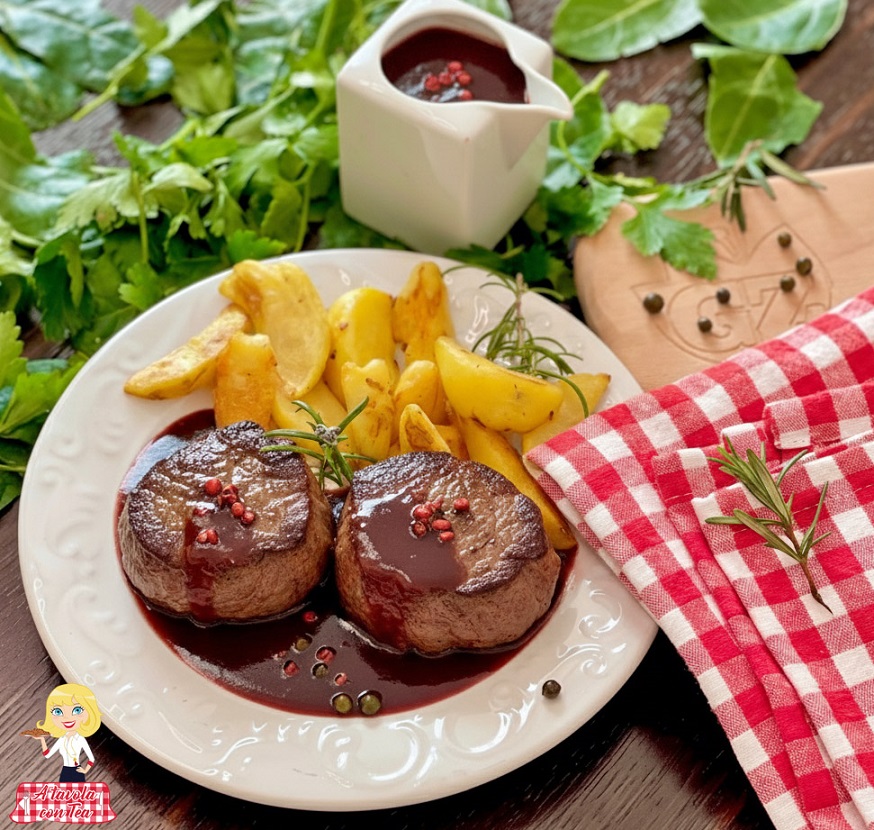
Sides: It traditionally pairs beautifully with the sweetness of mashed potatoes or duchess potatoes (as seen in the photos!). Bitter cooked greens such as sautéed chicory are also an excellent choice.
Wine pairing: Serve the same red wine used for the sauce, perhaps a Chianti Classico Riserva, a Barolo, or an Amarone. If you prefer something lighter, a Pinot Noir.
The Secret for Perfect Cooking
Never Pierce the Meat! It may seem trivial, but it’s the key to juiciness. During high-temperature cooking, the meat juices (the treasure of flavor) move toward the center. If you pierce the meat with forks or sharp tongs, all those liquids will escape into the pan and your tenderloin will be dry. Always use spatula tongs or a wooden spoon to turn the steaks. The final rest on a rack serves precisely to redistribute those precious juices evenly before slicing.
FAQ (Questions & Answers)
1. Can I use cornstarch to thicken the sauce while the liquid is hot?
It’s better to dilute the cornstarch in cold water with the heat off or in a cold liquid and then return to the heat. If you add it directly into a hot, boiling liquid, you risk lumps forming immediately.
2. How long should the meat rest after cooking?
At least 2 minutes for steaks as thick as these. Resting time should be about one third of the total cooking time. This is essential for tender meat and to avoid losing all the juices when cutting.
3. Can I use white wine for the sauce?
Yes, but the flavor will be very different. If you use white wine, I recommend creating a mushroom sauce (porcini or button mushrooms) by reducing the wine with stock, and adding heavy cream or milk for creaminess, instead of brown sugar and balsamic vinegar.
