
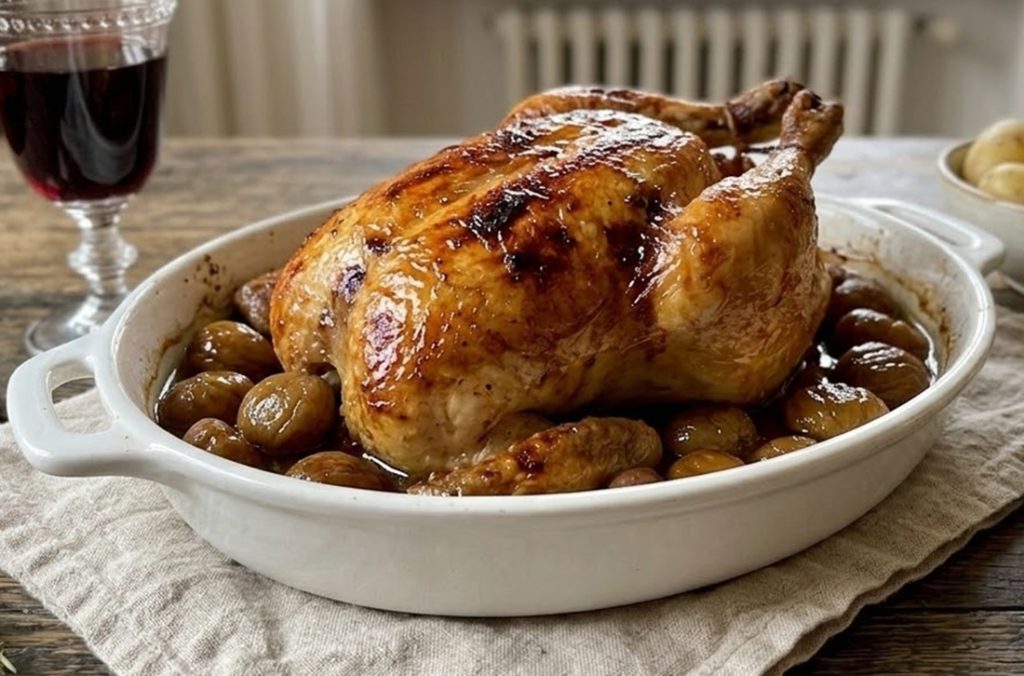
Chestnut- and Sausage-Stuffed Chicken, juicy and golden
DOES STUFFED CHICKEN TURN OUT DRY AND STRINGY? THE TRICK IS SLOW, HUMIDIFIED COOKING!
The Chestnut- and Sausage-Stuffed Chicken is a classic of autumn and holiday cooking, a complete dish that evokes warmth and tradition.
The main problem is that the chicken, when cooked long enough to cook the stuffing through, tends to become dry while the skin risks burning before the center is ready.
This optimized recipe solves the issue by ensuring the juiciness of the meat, the perfectly cooked stuffing and a crispy skin.
The secret is to seal the stuffing well and, if necessary, cover the chicken with foil halfway through cooking, removing it only at the end for browning.
We will also use the liquids from the wine and the sauce to keep a moist cooking environment.
- Difficulty: Easy
- Cost: Budget-friendly
- Preparation time: 40 Minutes
- Cooking time: 1 Hour 20 Minutes
- Portions: 6
- Cooking methods: Oven
- Cuisine: Italian
Ingredients — CHICKEN STUFFED WITH CHESTNUTS
- 1 chicken (whole about 3.3 lb (≈1.5 kg))
- to taste extra virgin olive oil (For massaging the chicken.)
- 7 oz chestnuts
- 5 oz sausage (crumbled and cooked (or use Speck/Pancetta))
- 1 cup bread (Soaked in milk and well squeezed)
- 2 eggs
- as needed milk (To soften the bread)
- to taste chopped parsley
- 11 oz chestnuts (Boiled and peeled)
- 6 tbsp butter
- 1 glass white wine
- 3 leaves bay leaves
- to taste fine salt
- 1 pinch black pepper
Detailed Procedure — Chestnut- and Sausage-Stuffed Chicken, juicy and golden
Chestnuts: Boil the about 1.1 lb total of chestnuts (7 oz for the stuffing + 11 oz for the sauce) and peel them. Divide them: 7 oz to chop finely for the stuffing and 11 oz for the sauce (part of which will be chopped and part left whole).
Sausage and Bread: Heat a drizzle of oil in a pan and cook the crumbled sausage. Meanwhile, soften the bread in milk and squeeze it well.
Filling: In a large bowl, combine the chopped chestnuts, cooked sausage, squeezed bread, eggs, chopped parsley, salt and pepper. Work until you obtain a homogeneous, compact mixture.Stuffing: Fill the chicken with the mixture, avoiding overpacking. Seal the opening by sewing it or tying it well with kitchen twine.
Baking (Juiciness Tip): Place the chicken in a roasting pan, rub it with oil, salt and pepper. Bake in a static (conventional) oven preheated to 356°F for about 1 hour and 20 minutes.
Browning Control: If the chicken browns too quickly, cover it with a sheet of aluminum foil, removing it only for the last 15-20 minutes to finish browning.Sauce Preparation: Take the 11 oz of chestnuts for the sauce. Chop half of them and leave the other half whole. In a pan, melt the butter with the bay leaves, add the chopped chestnuts, salt and pepper. Cook for a few minutes, then deglaze with the white wine. Stir until you obtain a homogeneous sauce.
To Serve: Remove the chicken from the oven and cut the twine. Add the whole chestnuts to the roasting pan and baste the chicken and chestnuts with the sauce. Serve immediately.
Tips and Variations for Perfect Results
Tips for juiciness
Managing Chestnuts: You can boil all the chestnuts together at the start (for stuffing and sauce) and divide them after peeling to save time.
Chicken Temperature: For a juicier result, take the chicken out of the fridge about 30 minutes before stuffing and baking.
Measurement: For perfect doneness, a kitchen thermometer inserted into the thickest part of the stuffing (not touching bone) should read at least 165°F.
Variations and Alternatives
Meat Alternative: Replace the sausage with Pancetta or Speck for a different smoky flavor.
Poultry Alternative: Instead of chicken, you can use turkey.
Sauce on the Side: If you prefer, serve the chestnut sauce separately in a sauceboat.
Storage
The stuffed chicken should be eaten immediately.
Any leftovers can be stored in the refrigerator for a maximum of one day in an airtight container.
FAQ (Questions & Answers)
How do I prevent the stuffed chicken from becoming dry and stringy?
The trick is to seal in moisture. Roast the chicken at 356°F. If you notice the skin darkening too early (after about 40-50 minutes), cover it with a sheet of aluminum foil. Remove the foil only for the last 15-20 minutes to finish browning. Additionally, basting the chicken with cooking juices or the chestnut sauce helps maintain a humid environment in the oven.
How do I know if the stuffing is cooked?
To be sure the stuffing (which cooks more slowly) is done, the internal temperature at the thickest point (avoiding the bone) should reach at least 165°F. If you don’t have a kitchen thermometer, make sure the juices that run out when you pierce the chicken are clear, not pink.
Can I prepare the stuffed chicken in advance?
Yes, you can prepare and stuff the chicken entirely in advance. Wrap it well and store it in the refrigerator for up to 12 hours. Take it out of the fridge 30 minutes before baking to bring it closer to room temperature for more even cooking.
Can I use precooked or frozen chestnuts?
Yes, to save time you can use vacuum-packed precooked chestnuts or frozen ones. If you use frozen chestnuts, thawing is not strictly necessary, but the stovetop boiling time may vary.
If I don’t use the chestnut sauce, what can I put in the pan to keep the chicken juicier?
If you choose not to use the chestnut sauce, you can add a hot cup of vegetable broth, white wine or water (or a mix of all three) to the bottom of the roasting pan along with mirepoix (carrots, celery, onion). This will create steam that helps keep the chicken moist and juicy.
