
Chocolate Danubio: a pastry that makes you fall in love at the first bite!
The aroma of a freshly baked pastry immediately brings you home. If this pastry is a Chocolate Danubio, the effect is guaranteed.
This is a recipe that has given me a lot of satisfaction, so much so that I was invited to prepare it live on a show cooking for a Christmas event in a small town on the Ligurian coast.
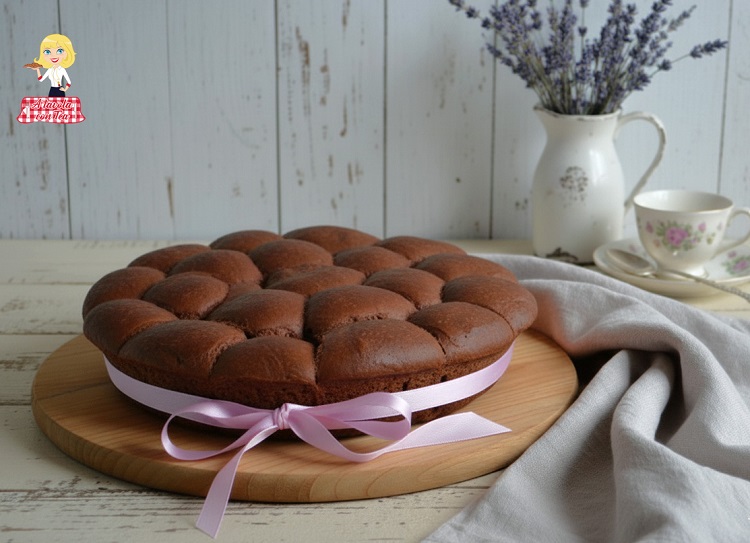
The Danubio’s hallmark is its incredible softness and cluster shape, with many little balls that pull apart.
But the common problem with yeasted pastries is that the dough can turn out dry, chewy, or fail to develop properly during rising.
I’ll reveal the secret to getting a soft, fluffy, irresistible Danubio that literally melts in your mouth:
Smooth Dough: Work the mixture with a stand mixer (or by hand) until you obtain a smooth and elastic dough that pulls away from the bowl.
Proper gluten development is essential for fluffiness.
Slow Proofing: The double proofing (about two hours initially and one hour in the pan) in a warm, draft-free place is crucial. Slow proofing allows gluten to develop, creating the spongy structure.
Cold Butter: Gradually adding melted, cooled butter guarantees the final softness.
Unsweetened cocoa gives an intense flavor and this pastry is the perfect companion for breakfast or a delicious afternoon snack.
- Difficulty: Easy
- Cost: Very affordable
- Rest time: 3 Hours
- Preparation time: 15 Minutes
- Cooking time: 40 Minutes
- Portions: 10-inch pan
- Cooking methods: Oven
- Cuisine: Italian
Ingredients – quantities for a 10-inch pan
- 2 1/3 cups Manitoba flour
- 1 1/2 cups 00 flour
- 1 cup milk
- 6 tbsp + 1 tsp granulated sugar
- 3 1/2 tbsp butter (melted)
- 4 tbsp unsweetened cocoa powder
- 1 egg
- 1 tsp active dry yeast
- milk (for brushing before baking)
Tools
- Kitchen scale
- Stand mixer
- Baking pan
Procedure CHOCOLATE DANUBIO
Start preparing the dough in a large bowl or in the stand mixer. Combine the two flours and the unsweetened cocoa powder, mixing well. Add the sugar, the yeast, the whole egg and the melted, cooled butter. Begin to mix and, little by little, add the milk at room temperature. Work the mixture with the mixer’s hook until you obtain a smooth and elastic dough that pulls away from the sides. Cover the bowl with a clean kitchen towel and let it proof in a warm, draft-free place for about 2 hours, or until the dough has doubled in volume.
Once the dough has risen, gently deflate it with your hands on a lightly floured surface. Divide it into many portions of about 1.8 oz each (about 50 g) and shape them into balls. Butter and flour a round pan (10-inch diameter) and place the balls side by side, filling the entire pan. Cover with a clean kitchen towel and let rise again for about 1 hour, or until the balls have puffed up and joined together.
Preheat a conventional oven to 338°F.
Gently brush the surface of the Danubio with a little milk. Bake for about 40 minutes, or until golden and cooked through. To check doneness, perform the skewer test. Once ready, remove from the oven and let cool completely before removing from the pan and serving.
Notes on ingredients
Flour: The combination of Manitoba flour (strong) and 00 flour (weaker) ensures the right structure and softness in the dough. If you don’t have Manitoba, you can use a mix of 00 and 0 flours.
Butter: Make sure the butter is melted but not hot, so as not to “cook” the egg and compromise the rising.
Yeast: If you use fresh yeast, the equivalent amount is about 9 g.
Storage
The Chocolate Danubio keeps best in a food bag or airtight container at room temperature for 2-3 days. To keep it soft longer, you can gently reheat it in the oven or microwave before eating.
Variations and alternatives
Filled Danubio: For an even more indulgent version, you can fill each ball with a piece of dark chocolate, white chocolate or a spreadable cream before placing them in the pan.
Two-tone: For a striking effect, divide the dough in half before adding the cocoa, and form the balls alternating the plain dough with the chocolate dough.
Savory Danubio: Want a savory version? Omit the sugar and cocoa from the dough and fill the balls with cured meats and cheeses as desired (for example, ham and provola).
Usage and pairings
The Chocolate Danubio is perfect for breakfast, served with a glass of milk or a cup of coffee. It’s a delicious snack for children, but also an excellent treat to offer friends at an afternoon tea. For the adventurous, a slightly warm Danubio ball with a scoop of vanilla ice cream is a kingly dessert.
One more idea: fun in the kitchen
Making the Danubio can become a moment of creativity and fun, especially if you involve children. Let them help shape the balls: they’ll be thrilled to create their own pastry with their hands. It’s a way to spend quality time in the kitchen and to spark their interest in baking.
FAQ (Questions and Answers)
1. Why isn’t my Danubio soft?
The softness of the Danubio depends on proper proofing. Make sure the yeast is active and that the dough has had enough time to double in volume in both stages. The quality of the flours is also essential.
2. Can I prepare the dough in advance?
Of course! You can prepare the dough, put it in the fridge and let it rise slowly overnight. The next day, simply let it sit at room temperature for about 30 minutes before deflating it, shaping the balls and proceeding with the second proof.
3. Why did my Danubio burn on the outside but stay raw inside?
This can happen if the oven temperature is too high. Make sure the oven is well preheated and, if the surface browns too quickly, cover the Danubio with aluminum foil during the last minutes of baking. The skewer test will ensure it’s cooked through inside as well.
