
Cicerchiata for Carnival (or Pignolata): The Easy Recipe for a Legendary Sweet
Carnival is synonymous with joy, masks and, of course, fried sweets!
But if you are tired of the usual chiacchiere and castagnole, get ready to fall in love with Cicerchiata, a true treasure of Italian pastry that brings an explosion of festivity and honey to the table.
Known in some regions as Pignolata, this recipe is a celebration of simplicity and taste.
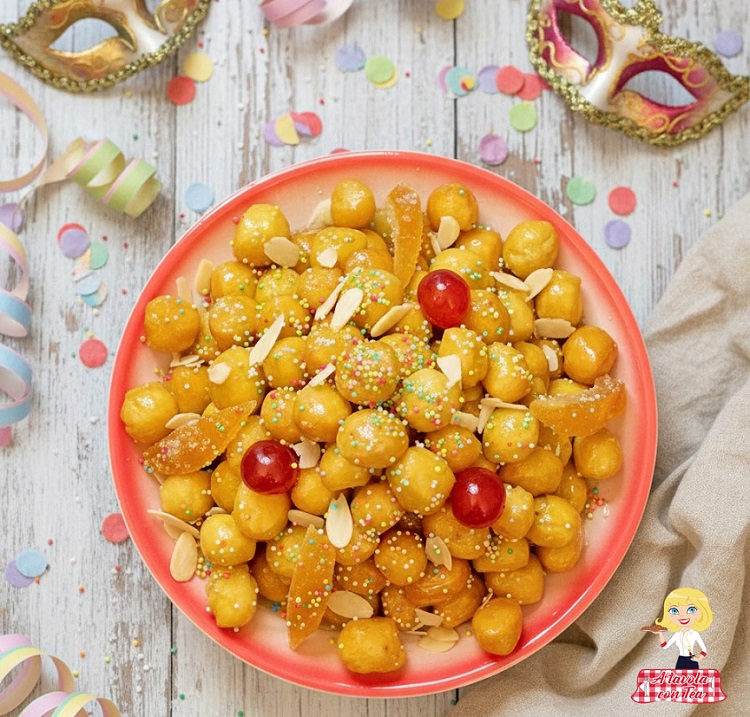
Imagine many small crunchy balls (our “cicerchie”), fried to perfection and then dipped in warm, fragrant wildflower honey, enriched with toasted almonds and a cascade of colorful sprinkles.
The result is a golden cloud, crisp outside and soft inside, that literally melts in your mouth.
The beauty of Cicerchiata is that, while it looks impressive, it is surprisingly easy to prepare. The dough, similar to fresh pasta dough, requires very few ingredients and a bit of elbow grease. The secret?
Quick frying and attention to the honey, which must caramelize just enough to hold the little balls together without becoming too hard. It’s a perfect family activity, especially the final decoration with sprinkles!
So, if you’re looking for a traditional recipe that brings a touch of authentic Carnival magic to your table and is easy to photograph (food creator’s word!), you’re in the right place.
- Difficulty: Medium
- Cost: Very economical
- Rest time: 30 Minutes
- Preparation time: 25 Minutes
- Cooking time: 15 Minutes
- Portions: 6/8
- Cooking methods: Frying
- Cuisine: Italian
Ingredients CICERCHIATA FOR CARNIVAL
- 2 1/2 cups all-purpose flour (00 flour)
- 3 eggs
- 1 tbsp + 1 tsp tbsp extra virgin olive oil
- 2 tsp anise liqueur
- 1 zest of 1 lemon
- 1 1/2 cups wildflower honey
- 2.5 oz (≈3/4 cup) sliced almonds
- to taste colorful sprinkles
- to taste peanut oil for frying
Tools
- Bowl
- Frying pan
- Skimmer
- Small saucepan
- Serving tray
Procedure CICERCHIATA FOR CARNIVAL
In a bowl, pour the whole eggs, the anise liqueur, the extra virgin olive oil and the grated lemon zest. Quickly beat everything with a fork. Add the all-purpose flour and mix the ingredients first with the fork and then with your hands. Transfer the mixture to the work surface and knead vigorously until you obtain a smooth, elastic and homogeneous dough (it should resemble fresh pasta dough). Wrap the ball in plastic wrap and let it rest at room temperature for about 15 minutes.
After the resting time, divide the dough into small portions. Form little ropes about 3/8 inch thick. Cut each rope into small pieces, also about 3/8 inch long. Round each piece with the tip of your fingers to obtain small balls, our “cicerchie”.
Heat the peanut oil to 392°F (a kitchen thermometer is ideal). Fry the balls in small batches. When they are evenly golden (this will take just a few minutes), drain them quickly and let them cool on paper towels to remove excess oil.
Meanwhile, coarsely chop the sliced almonds. Pour the wildflower honey into a large saucepan and gently heat it for a few minutes until it begins to lighten and form small bubbles. Remove the pan from the heat and immediately pour in the fried balls while the honey is hot. Stir well to coat them evenly, then add the almonds and most of the sprinkles (leave some aside for the final decoration). Gently mix everything again.
Lightly oil a serving plate about 10 inches (25 cm) in diameter with a drizzle of extra virgin olive oil. Place the mixture of cicerchie and honey on the plate, leveling the base with a spoon. Allow to cool at room temperature. Once the mixture has cooled and set, garnish with the reserved almonds and sprinkles. Serve your Cicerchiata!
Notes on Ingredients and Substitutions
00 flour: Essential for the texture. You can use Type ‘0’ flour or another weak all-purpose equivalent.
Anise liqueur: Gives the characteristic aroma. Rum or grappa (same amount of 10 g) for a different flavor, or orange juice or limoncello.
Peanut oil: It’s the best oil for frying due to its high smoke point. High-oleic sunflower oil is a good alternative.
Peeled almonds: Add crunch. Walnuts, pine nuts or roasted hazelnuts (70 g) work as substitutions.
Wildflower honey: The most versatile and neutral. Acacia honey (more liquid) or chestnut honey (more intense flavor) are alternatives.
Storage
Cicerchiata keeps perfectly at room temperature, covered with a cotton cloth or in an airtight container, for 5-7 days. Avoid the refrigerator, which tends to harden the honey and make the balls less crunchy.
Pairings and Use
Cicerchiata is the sweet symbol of Carnival, but also of Easter in some regions. It is traditionally served at the end of a meal.
Wine: It pairs wonderfully with a passito wine (such as Passito di Pantelleria) or a slightly sparkling, aromatic Moscato d’Asti, which balance the honey’s sweetness.
Tea: Perfect with a spiced black tea (like Chai or Earl Grey) or a cinnamon herbal tea for a cozy winter moment.
History and Origins of Cicerchiata
This sweet has very ancient roots and claims from several regions, particularly Abruzzo, Molise and Umbria, where it is listed among Traditional Agri-food Products (PAT). The name “cicerchiata” comes from the cicerchia, a legume similar to the chickpea, to which the small fried balls resemble. Historically, it was a poor, peasant sweet, made with simple ingredients (flour, eggs and honey), consumed especially to celebrate important events or the arrival of spring. In Sicily and Calabria it is known as Pignolata, while in Naples it is called Struffoli (the Neapolitan version differs slightly in dough and decoration).
Variants and Alternatives to Try
Extra flavoring: If you want a more intense aroma, you can replace 10 g of anise liqueur with:
Citrus: 10 g of Limoncello or orange juice (and add a splash of orange juice to the hot honey for a fresh touch).
Vanilla: Add 1 teaspoon of vanilla extract to the base dough.
The Bicolored Pignolata (Sicilian Version) To recreate Messinese Pignolata: Keep the Cicerchie: Fry them as per the base recipe. Divide the honey: Dissolve 250 g of honey with 20 g of water (about 3/4 cup honey with 1 tbsp + 1 tsp water). Divide the mixture in half. Lemon glaze: In one bowl, mix one half of the honey with 200 g of powdered sugar and 1 tablespoon of lemon juice. Chocolate glaze: In the other half, mix with 200 g of powdered sugar and 2 tablespoons of unsweetened cocoa powder (add a splash of milk if too thick).
Assembly: Dip half of the balls in the lemon glaze and the other half in the chocolate glaze. Arrange the two halves side by side on the serving plate.
FAQ (Questions and Answers)
1. How do I know when the oil is at the right temperature (392°F)?
If you don’t have a kitchen thermometer, you can test with a wooden skewer: dip the tip into the oil; if many small bubbles form immediately around the skewer, the oil is ready for frying. Be careful not to exceed the temperature, otherwise the cicerchie will burn on the outside and remain raw inside.
2. Why did my cicerchiata become too hard?
This happens because the honey was cooked too long or over too high heat, causing it to caramelize excessively. Make sure to heat the honey only until it melts and becomes fluid (about 3-4 minutes over low heat) and remove the pan from the heat immediately before adding the balls.
3. Can I bake the cicerchie instead of frying them?
Yes, it’s possible for a lighter version. Brush the balls lightly with a little oil and bake them in a conventional oven at 356°F for about 15-20 minutes, or until golden. The flavor and texture will be less crunchy than frying, but they will still be tasty once dipped in honey.
