
Clarified Capon Broth: The Traditional Method for a Crystal-Clear, Flavorful Stock
The Secret Against Cloudy, Tasteless Broth
What mistake ruins the elegance of the dish? A cloudy, murky, or weak-tasting broth.
This happens if you use ingredients that are not cold or if the water boils too fast.
The main problem we solve is: achieving a perfectly clear and intensely flavored broth.
The solution is a twofold strategy: always start with cold water and never let the broth break into a rolling boil during the slow cooking, to prevent impurities from mixing into the liquid.
You will obtain a capon broth worthy of holiday tables, the ideal base for your tortellini and passatelli!
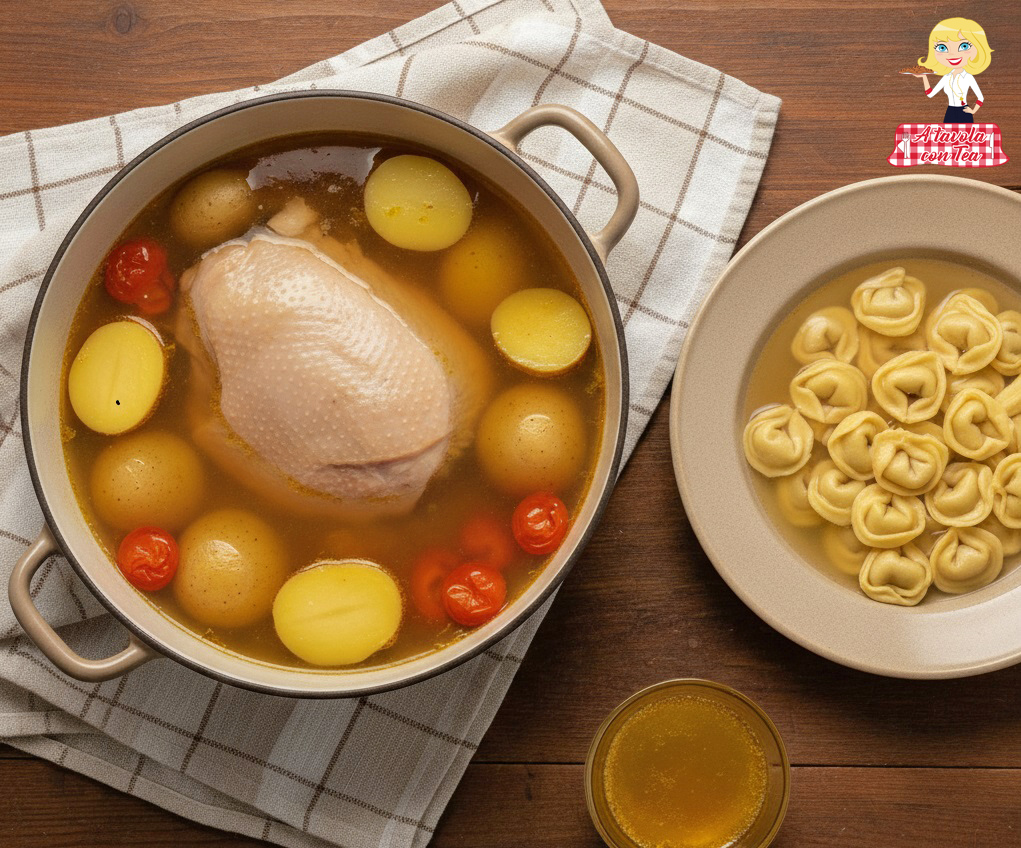
- Difficulty: Very easy
- Cost: Medium
- Preparation time: 10 Minutes
- Cooking time: 3 Hours
- Portions: about 2.6 quarts (about 10.6 cups)
- Cooking methods: Stovetop
- Cuisine: Italian
Ingredients for Capon Broth (About 2.6 quarts / 10.6 cups)
- 2.2 lbs capon (Should include parts with bones and skin)
- 1 onion
- 2 carrots
- 2 stalks celery
- 4 whole cloves
- 3.2 quarts water (Use strictly COLD water)
- 2 tsp coarse salt (Adjust at the end)
- aromatic herbs (2 bay leaves; juniper berries to taste)
Tools
- Pot
- Fine-mesh strainer
Procedure: The Method for a Crystal-Clear Broth
Prepare the Aromatics: Peel the carrots and onion; cut the celery and carrots into large pieces. Stud the whole onion with the whole cloves so they don’t disperse.
Prepare the Meat: If the capon has any downy feathers, quickly singe them over the stovetop flame to remove them. Rinse the meat pieces under cold running water.
Start Cooking: Put the aromatics, the clove-studded onion, and the capon in the bottom of a tall, large pot. Cover with 3.2 quarts of STRICTLY COLD water. Season with a little salt.Slow Bring to a Simmer: Bring the broth to a boil very slowly with the lid on, over medium-low heat.
Crucial Skimming: As soon as the first impurities appear (the grayish foam), remove them carefully and patiently with a skimmer.
❗ Anti-Cloudiness Tip: The foam is coagulated proteins; if you don’t remove it immediately, the broth will become cloudy.
Slow Cooking: Remove the lid. Cook for at least 3 hours over very low heat (the broth should barely simmer, never a rolling boil). If you like, add the juniper berries and bay leaves.Separation: When cooking is finished, lift out the meat and aromatics and transfer them to a bowl.
Perfect Filtering: Line a fine-mesh strainer with cheesecloth (or two sheets of dampened and wrung-out paper towels) placed over a large serving bowl. Slowly strain the broth.
Rest and Degrease (The Secret): For a lighter broth and a crystal-clear result for the holiday table, let it cool completely and refrigerate for several hours. The fat will solidify on the surface and can be removed easily with a spoon.Use: The capon broth is ready to be brought back to a simmer. It will be the star of your holiday table, ready to host homemade tortellini or cappelletti!
1. COLD Water Is Mandatory
Less flavorful broth and dry meat.
Starting with cold water allows the nutrients and collagen from the meat to slowly dissolve into the broth, creating a richer, more intense flavor.
2. Skim and Keep at a Bare Simmer
Cloudy broth and circulating impurities.
Skim off the foam at the start. After that, the broth should barely “simmer” (small bubbles) and never boil vigorously. Aggressive cooking breaks down the meat and makes the broth opaque.
3. Double Filtration
Residues and hazy broth.
A strainer alone is not enough! Line the fine-mesh strainer with cheesecloth or two sheets of paper towel (previously moistened and wrung out) for a professional clarification.
📜 A Bit of History: Broth as a Foundation of Cooking
Capon broth is a cornerstone of Italian cuisine, especially in Emilia-Romagna, where it is inextricably linked to the preparation of tortellini in broth. Historically, the capon (a castrated and fattened male bird) was a luxury reserved for festive days and wealthy families, a symbol of richness and abundance, a true winter comfort food.
📝 Storage, Variations and Notes
Storage
Refrigerator: Clarified capon broth keeps in the refrigerator for 3–4 days in an airtight container.
Freezing: Ideal. Freeze in portioned containers to have it always ready.
Recipe Variations
More Aromatic: For a more aromatic broth, lightly toast the onion and carrots in a dry pan without fat before adding them to the water.
“Light” Broth: If you prefer a leaner broth, use only chicken breast instead of capon and add a pinch of saffron for color.
Notes on Ingredients
Salt: Salting at the start helps extract flavor, but be careful: if too much water evaporates during cooking, the saltiness will concentrate. Adjust only at the end of cooking.
FAQ (Questions & Answers)
1. Can I use a pressure cooker? How long does it take?
Yes, you can use a pressure cooker, but you’ll get a less crystal-clear broth (although still tasty). Times are reduced to about 45 minutes to 1 hour under pressure (counting from when the cooker reaches full pressure and begins steaming), but the initial skimming should still be done in a regular pot.
2. The broth tastes too strong, what can I do?
If the flavor is too concentrated or too salty, dilute the broth with boiling water until you reach the desired intensity.
3. Can I freeze the cooked capon meat?
Yes. Cooked capon meat freezes very well. You can use it later for chicken/capon salads or as a filling for savory pies.
