
Custard and Caramelized Apple Tart: The perfect homestyle dessert
Is there a dessert that, the moment it comes out of the oven, has the magical power to transport you to your grandmother’s kitchen? For me, it’s the tart.
But not just any tart: I’m talking about the sublime Custard and Caramelized Apple Tart.
This recipe is the perfect union of three great pastry classics: a flaky, buttery shortcrust pastry, a lemon-scented custard (in fact here we prepare it more like a crème anglaise to make it lighter and velvety!), and caramelized apples — that sweet-and-tart, tender touch that closes the circle of perfection.
The beauty of this dessert lies precisely in the contrast of textures: the crispness of the lattice, the softness of the custard and the tenderness of the apples.
Our secret for a “wow” result is to use Granny Smith apples: their acidity divinely balances the sweetness of the caramel and the sugar in the custard, making every bite balanced and never cloying.
Also, quickly caramelizing the apples before baking intensifies their flavor and prevents them from releasing too much water into the filling.
Making it is a real ritual. It requires a bit of patience for the dough (it needs to rest!) and a careful eye for the custard (never let it boil!), but the final result will repay you for every effort.
Perfect for Sunday after-dinner, a special snack or to pamper yourself a little. Let’s get to work, because this smell of butter and lemon waits for no one!
- Difficulty: Easy
- Cost: Inexpensive
- Preparation time: 20 Minutes
- Cooking time: 40 Minutes
- Portions: tart pan diameter 9.5 in
- Cooking methods: Stovetop, Oven
- Cuisine: Italian
Ingredients (for a 9.5-inch pan)
- 3 1/4 cups 00 (all-purpose) flour
- 7 oz butter
- 3/4 + 2 tbsp cup granulated sugar
- 2 eggs (whole + 2 yolks)
- 2 egg yolks (at room temperature)
- 7 tbsp granulated sugar
- 2 cups + 2 tbsp whole milk
- 1 lemon zest (from an unwaxed lemon)
- 5 1/2 tbsp cornstarch (or potato starch)
- 1 tsp vanilla extract
- 4 Granny Smith apples
- 3/4 + 1 tbsp cup granulated sugar
- 6 tbsp butter
Tools
- Kitchen scale
- Bowl
- Plastic wrap
- Rolling pin
- Tart pan
Procedure CUSTARD AND CARAMELIZED APPLE TART
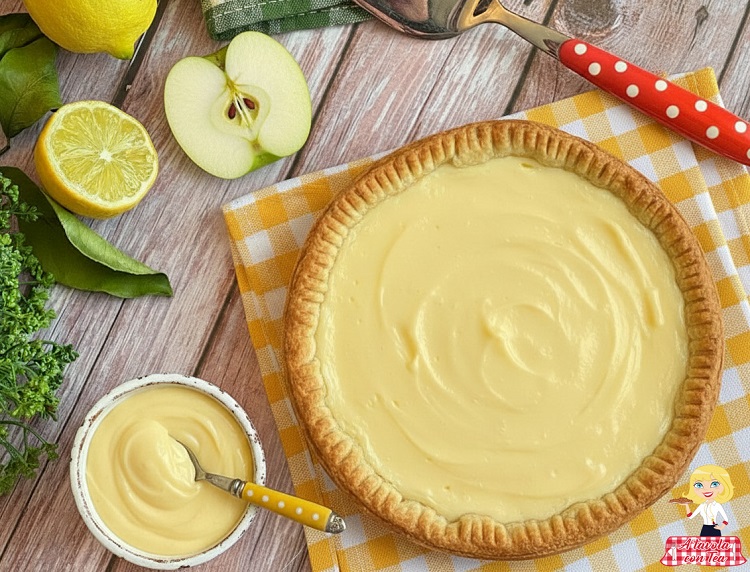
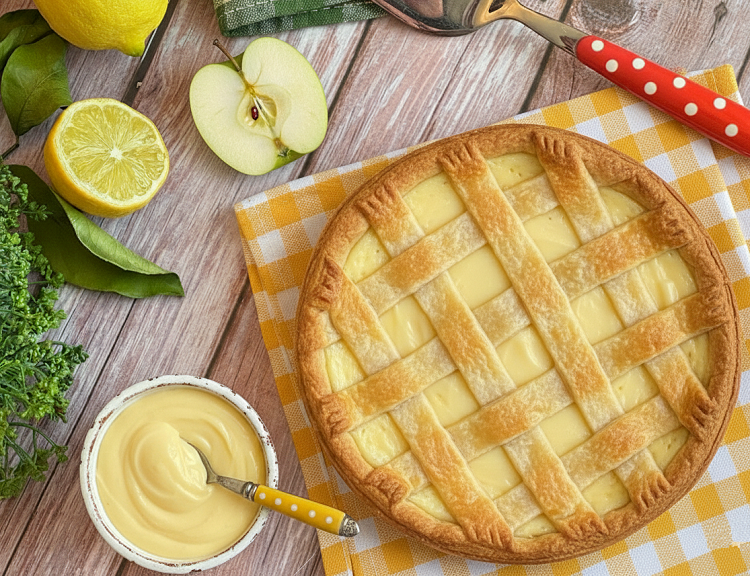
Prepare the shortcrust pastry using your preferred method (by hand or with a stand mixer): rub the cold butter into the flour until you obtain a “sandy” texture, add the sugar, then the whole eggs and the yolks. Work quickly until you form a smooth dough ball. Let it rest in the refrigerator for at least 1 hour, wrapped in plastic wrap. I’ve chosen not to decorate the tart with the classic lattice but leave that decision to you. Take the dough back and if you want to make a lattice set aside about one third. Roll all (or the remaining) dough into a disk about 1/8 inch thick and use it to line a tart pan with removable bottom (9.5 in). Pull the dough up over the edges as well. Return the pan to the refrigerator.
In a saucepan, bring the milk to a gentle simmer with the lemon zest (use only the yellow part!). Turn off the heat, remove the zest and let the milk cool to room temperature. In a second saucepan, whisk the yolks with the cornstarch until smooth. Then add the sugar and continue whisking. Add a few tablespoons of the cooled milk and whisk until you have a smooth paste. At this point add the remaining milk while continuing to whisk and stir in the vanilla extract. Put over low heat and, stirring constantly with a whisk, cook gently until the custard thickens. Attention: it must never boil! Turn off as soon as it coats the spoon.
It will take about 10–15 minutes. When the custard is ready, remove from the heat and pour into a bowl, covering the surface with plastic wrap so it touches the custard until ready to use.Wash, peel and cut the apples into dice about 3/8 inch. In a skillet, melt the butter with the sugar. Add the diced apples and caramelize over medium-high heat, stirring often. Remove from the heat as soon as they are just golden and still slightly firm (about 5 minutes).
Remove the pan from the fridge. Spread the caramelized apple dice on the bottom. Cover the apples with the custard. I baked the tart like this, but if you prefer the classic lattice, roll out the reserved dough thinly, cut strips with a pastry cutter and arrange them as a lattice on top. Bake in a preheated conventional oven at 347°F and cook for about 1 hour. The crust should be well golden. Remove from the oven, wait at least 10 minutes, then carefully unmold the tart onto a serving plate.
Serve the Custard and Caramelized Apple Tart cold or warm. Here are photos of both versions.
Ingredient Notes and Substitutions
The choice of ingredients makes a difference. For the shortcrust, the butter must be very cold (just taken from the fridge) to guarantee flakiness. For the custard, whole milk gives incomparable richness and flavor.
Possible Substitutions:
Butter (in the pastry): alternatively use neutral seed oil or mild extra-virgin olive oil. Use 160 g of oil in place of 200 g of butter. The pastry will be softer.
Lemon (in the custard): alternatively use vanilla (1 pod or 1 teaspoon of extract) for a classically flavored custard.
Granny Smith apples: or Fuji or Renetta apples. Fuji is sweeter, Renetta breaks down more during baking and is excellent.
Granulated sugar: you can also use fine brown sugar. For the pastry and the caramelization it gives a slightly more rustic aroma.
Storage
The custard and apple tart stores very well! Once completely cooled, you can cover it and keep it at room temperature (if cool) for 1–2 days or refrigerate for 3–4 days. I recommend removing it from the fridge at least half an hour before serving to enhance all its aromas. It is not suitable for freezing once filled and baked.
Decadent Alternatives and Variations
Rustic Tart with Nuts: Add 50 g of pine nuts or sliced almonds scattered over the caramelized apples before pouring the custard.
Grandma’s Cake (Orange Custard Version): Replace the lemon zest in the custard with the zest of two unwaxed oranges. Add pine nuts on the final lattice.
Spiced Addition: Add a pinch of ground cinnamon (1/2 teaspoon) to the caramelized apples for a warmer, wintery flavor.
Serving Suggestions and Pairings
This tart is an ideal dessert for any occasion:
Evening Dessert: Serve it warm with a dusting of powdered sugar.
Snack or Breakfast: Perfect to enjoy cold, perhaps accompanied by a cup of black tea or coffee.
Wine Pairing: Pair this dessert with an Italian dessert wine such as a slightly sparkling, aromatic Moscato d’Asti, or a Tuscan Vin Santo; their oxidative notes marry beautifully with caramel and baked fruit.
Origins and History of the Tart and the Custard
The tart is one of the oldest desserts in the Italian tradition, with roots tracing back even to the Renaissance. A symbol of hospitality and simplicity, its preparation using shortcrust pastry and a filling has given rise to countless regional variations. Pastry custard was perfected in France, but its older variant, the “English” custard, is the lighter preparation from which our version derives, perfect to soften the pastry and create a delicate contrast with the apples. In short, this tart is an homage to classic European pastry, simplified.
Your Tart, Step by Step: Tricks No One Tells You!
For a pastry that doesn’t shrink during baking, give it the right thermal shock! After lining the pan, let it rest in the fridge or even in the freezer for 10 minutes before baking. Also, for the custard, use a kitchen thermometer: the critical point is about 180–185°F. If you exceed this temperature you risk the yolks “curdling” and breaking. If you see it thickening too quickly, remove it immediately from the heat and put it into a cold bowl to stop the cooking!
FAQ (Questions and Answers)
1. The custard has curdled, can I fix it?
If the custard has slightly curdled (you see small lumps), try blending it quickly with an immersion blender. Sometimes you can recover a smooth texture, although you may lose some thickness.
2. How do I roll the pastry without it breaking?
After resting, work the dough on a lightly floured surface, but above all use two sheets of parchment paper. Roll it between the two sheets: this will allow you to handle and lift it without breaking it, and flip it directly into the pan.
3. Can I replace the butter in the pastry with margarine?
You can, but the result in terms of flavor and flakiness will change significantly. Margarine tends to make the pastry tougher and less flavorful. If you want a lighter dough, use the oil substitution indicated in the ingredient notes, but for a classic flavor butter is irreplaceable.
