
Fish Carpaccio 5 Recipes (Classic and Creative) for a Chic Appetizer
Today I’ve decided to talk to you about one of the most refined, healthy, and scenic appetizers: Fish Carpaccio.
This choice comes from a very practical need: I want to prepare a beautiful, scenic appetizer without spending too much time in the kitchen, so I can enjoy my friends when they visit. Carpaccio is the ideal solution because it allows you to do almost everything in advance.
I’ll guide you through the basic technique for preparing a classic carpaccio, starting with a simple marinade that enhances the freshness of the fish without overpowering its flavor.
The secret, as you know, is always the primary ingredient: super fresh fish and, crucially, frozen beforehand (or frozen to reduce bacterial loads, as per regulations). Once safety is ensured, you’re all set!
The challenge in this preparation is the marinade: if you leave the lemon or lime too long, the fish “cooks” chemically and loses its texture. The trick, which applies to the classic version, is to sprinkle the fish with the marinade just a few minutes before serving. This ensures freshness and a non-aggressive taste.
In this post, we won’t stop at the basic version. I’ve prepared 5 variations that will show you how a simple change of marinade can completely transform the dish: from the Sicilian touch with olives to the mint sauce that adds freshness.
Remember: when working with raw fish, the attention to ingredient quality makes the difference. Ready to marinate? Let’s start with the version that never disappoints: the Classic Mixed Carpaccio!
- Difficulty: Very Easy
- Cost: Expensive
- Rest time: 30 Minutes
- Preparation time: 20 Minutes
- Portions: 4
- Cooking methods: No Cooking
- Cuisine: Italian
FISH CARPACCIO 5 RECIPES Ingredients
- 7 oz sea bass (fresh frozen in slices)
- 7 oz salmon (fresh frozen in slices)
- 3.5 oz tuna (fresh frozen in slices)
- 1 lemon zest
- 2 oz extra virgin olive oil
- 1/2 tsp salt
- 1 pinch pepper
- A few leaves thyme (fresh)
- 10.5 oz snapper (fresh frozen in slices)
- 2 tbsps lemon juice
- 1.5 oz extra virgin olive oil
- 1 tbsp salted capers
- 1 oz crumb (white bread)
- 2 tbsps white wine vinegar (to soften the bread crumb)
- 2 anchovies in oil
- 1 tbsp chopped parsley
- A few leaves mint
- 14 oz swordfish (fresh frozen in slices)
- 1.5 oz lemon juice
- 1 oz black olives
- 1 oz green olives
- 2 oz extra virgin olive oil
- 1 pinch pepper
- to taste salt
- 3 oz baby spinach (for serving)
- 14 oz salmon (fresh frozen in slices or Sea Bass or Sea Bream)
- 3.5 oz carrots (Julienned)
- 3.5 oz fennel (Julienned)
- 1 oz salmon roe (or Caviar or Grated Bottarga)
- 2 oz extra virgin olive oil
- 1.5 oz lime juice
- 1/2 tsp salt
- 17.5 oz swordfish (thinly sliced)
- 1 cup cup whole milk (for marinating)
- 1.5 oz extra virgin olive oil
- 0.2 oz pink peppercorns
- 0.4 oz green peppercorns
- 0.2 oz Himalayan salt (pink)
Tools
- Little bowls
Fish Carpaccio: the classic recipe and 5 creative marinades
A basic marinade that celebrates the flavor of the fish, adding just a touch of acidity and aroma.
Preparation of the Marinade (The Sauce)
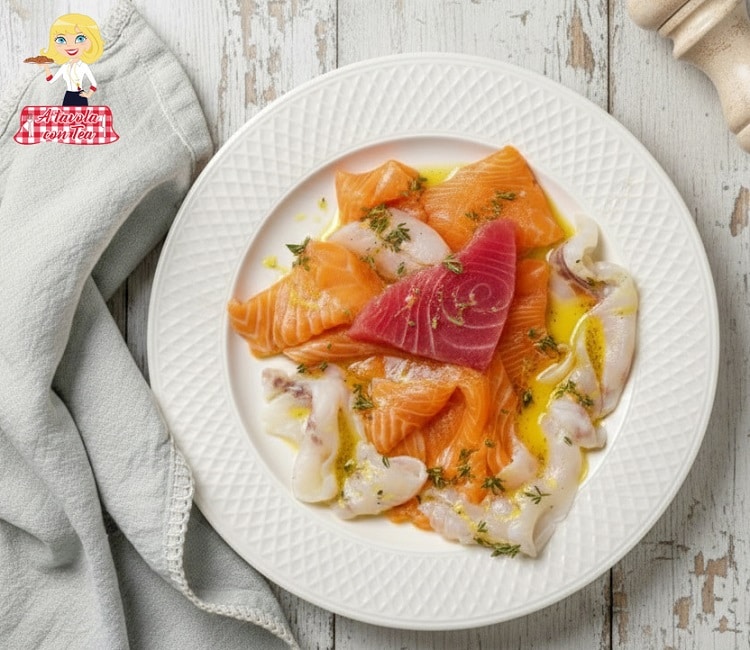
In a small bowl, combine the extra virgin olive oil, fresh thyme leaves, a pinch of salt, and pepper. Grate the zest of an untreated lemon directly into the bowl. Mix well to combine and let rest for a few minutes.Assembly and Serving
Arrange the fish slices (sea bass, salmon, and tuna) on a serving plate, alternating colors for a pleasing visual effect. Drizzle with the prepared sauce a few minutes before serving. The lemon in this light marinade should be added last to avoid “cooking” the fish too much.Drizzle the snapper slices with lemon juice and leave them in the fridge. Prepare the sauce: soften the bread crumb in vinegar, squeeze it. In a mortar, mince the crumb with anchovies, capers, sugar, oil, parsley, and fresh mint. Let the sauce rest for 30 minutes. Season the snapper with the mint sauce and leave it in the fridge for an hour before serving.
Season the swordfish with lemon juice, oil, salt, and pepper. Pit the olives, coarsely chop them with a knife, then distribute them over the fish slices. Cover with plastic wrap and let rest in the fridge for an hour. When serving, create a bed of baby spinach seasoned with oil and salt, and arrange the swordfish and olive slices on top. Serve with crostini.
Arrange the fish slices on a plate where you have placed julienned carrots and fennel. Prepare the sauce: oil, lime juice, and a pinch of salt (blend if you prefer a thicker emulsion). Season the carpaccio, cover with plastic wrap, and let marinate in the fridge for 30 minutes. Just before serving, generously distribute the salmon roe over the carpaccio.
ATTENTION: This variant requires an oven step, it is not a raw carpaccio.
Marinade: Emulsify in a bowl milk, oil, green pepper, pink pepper, and pink salt. Place the swordfish slices in a baking dish, pour the marinade over, and cover. Let marinate in the fridge for at least 4 hours. Slightly drain the swordfish slices from the marinade, place them in an oven dish, and bake at 350°F for no more than 5 minutes. Serve the carpaccio warm, after the fish has released the absorbed marinade.
Notes on Ingredients and Suggested Substitutions
In a carpaccio, quality is everything. Investing in excellent EVO oil is a must.
Fish: The fundamental ingredient is that the fish is fresh and frozen. If you are unsure if it has already been frozen, you can freeze the fillets at -0.4°F for at least 96 hours (4 days) and then slowly thaw them in the refrigerator.
Generic substitutions: Sea bass can be replaced with sea bream (same quantities). Tuna pairs well with stronger marinades like the green pepper one.
Lemon vs. Lime: Lime (as in variant 2.3) is less acidic than lemon and gives a more exotic and citrusy touch. Use it in the same quantities as lemon.
Aromas: For the classic marinade, you can replace thyme with marjoram or dill (the latter perfect with salmon).
Storage
Fish carpaccio, once marinated and seasoned, should be consumed within a few hours. If prepared in advance, it can be stored in the refrigerator (tightly covered) for a maximum of 12 hours (for raw versions with light marinades like the classic). The version with milk and cooking also keeps for a maximum of 12 hours, but it is advisable to serve it warm immediately.
Recommended Uses and Pairings
Carpaccio is the elegant appetizer par excellence, but it can become:
Summer Main Course: Serve it on a bed of mixed greens or arugula with some Parmesan shavings (if it complements the flavor).
Pairing: It requires a wine that cleanses the palate from the richness of the fish and the oil: a Vermentino di Sardegna or a Fiano di Avellino for the raw versions. For the green pepper version (cooked), try a more structured white, like an unoaked Chardonnay.
Origins and History of the Recipe
The term “carpaccio” didn’t originate with fish, but with meat! It was invented in 1950 at Harry’s Bar in Venice by Giuseppe Cipriani in honor of Countess Amalia Nani Mocenigo, for whom a recipe was created with very thin slices of raw sirloin. The name was chosen inspired by the Renaissance painter Vittore Carpaccio, known for his intense reds reminiscent of the color of raw meat. The idea of applying this ultra-thin slicing technique to fish like tuna and salmon is a modern evolution, typical of fusion and health-conscious cuisine.
The Secret of the Perfect Cut
A small chef’s trick to get super thin and perfect fish slices, like the ones you see in the photos: put the fish fillet in the freezer for about 30-60 minutes before slicing it (this applies even if it has already been frozen). The slight hardening will compact the flesh and make the cutting much easier, resulting in uniform and almost transparent slices. Always remember to use a long, very sharp knife!
FAQ (Questions and Answers)
Is it necessary for the fish to be frozen?
Yes, it is essential for food safety. Freezing (or home freezing for 96 hours at -0.4°F) eliminates the potential presence of Anisakis and other parasites. Never take risks with raw fish.
Can I prepare the carpaccio many hours in advance?
Better not, especially for acidic marinades. Acids (lemon/vinegar) “cook” the flesh, and after too long, the fish loses freshness and texture. Maximum preparation: 1-2 hours before (as per recipe), for the more delicate versions.
Why is milk used in the green pepper variant?
In the cooked green pepper variant, milk is used to soften the swordfish meat before the short oven step. The pepper and pink salt aromatize it deeply, while the milk helps keep the meat tender and juicy during the brief cooking.
