
FRIED GNOCCO RECIPE WITHOUT LARD
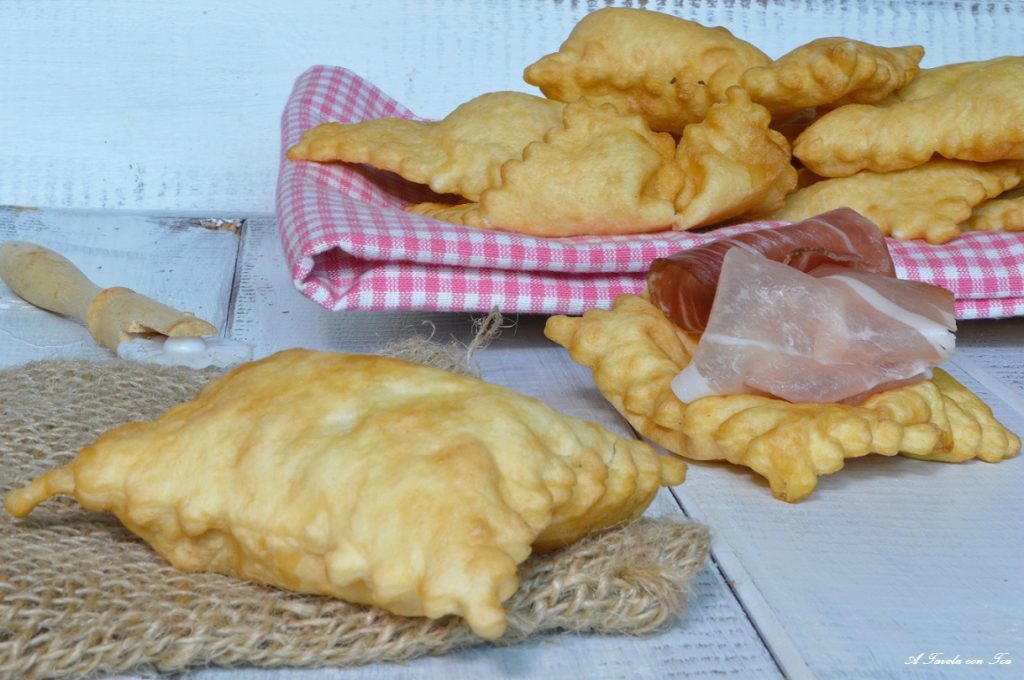
Fried gnocco or crescentina is … a “drug” in the sense that once you start eating it you can’t stop.
For those who don’t know it, it’s a leavened dough that, cut into lozenges, is fried and used to accompany cured meats and cheeses, typical of Emilia.
Perfect street food, it’s also ideal for standing dinners or for an aperitif buffet.
The original recipe calls for the use of lard both in the dough and for frying, an ingredient that isn’t exactly light and in some cases not so easy to find.
So I looked for an equally good version without lard that uses oil instead. If you’re preparing a board of cured meats and cheeses to accompany them try also
- Difficulty: Easy
- Cost: Very inexpensive
- Preparation time: 20 Minutes
- Cooking time: 12 Minutes
- Portions: about 20 gnocchi
- Cuisine: Italian
- Energy 267.53 (Kcal)
- Carbohydrates 46.05 (g) of which sugars 1.72 (g)
- Proteins 7.58 (g)
- Fat 7.01 (g) of which saturated 0.71 (g)of which unsaturated 5.57 (g)
- Fibers 1.72 (g)
- Sodium 584.65 (mg)
Indicative values for a portion of 50 g processed in an automated way starting from the nutritional information available on the CREA* and FoodData Central** databases. It is not food and / or nutritional advice.
* CREATES Food and Nutrition Research Center: https://www.crea.gov.it/alimenti-e-nutrizione https://www.alimentinutrizione.it ** U.S. Department of Agriculture, Agricultural Research Service. FoodData Central, 2019. https://fdc.nal.usda.gov
Ingredients
- 4 cups Type 00 flour (all-purpose)
- 3/4 cup Water
- 3 tbsp + 1 tsp Sunflower oil
- 2 tsp Salt
- Sugar (1 teaspoon)
- 0.4 oz Fresh baker's yeast ((about 12 g; or about 1 1/4 tsp active dry yeast))
- as needed Peanut oil (for frying)
Tools
- Bowl
FRIED GNOCCO STEP BY STEP RECIPE
First, take a bowl and crumble in the fresh baker’s yeast. Add 1 tbsp + 1 tsp of warm water (taken from the total amount) and the tip of a teaspoon of sugar. Stir with a spoon to help the yeast dissolve. Then add a bit of flour (2 tablespoons are enough) and mix well. Let this “starter” rest for about 15 minutes until the yeast activates. You’ll see a little foam appear on the surface.
At this point add the rest of the flour and gradually the remaining water, beginning to mix. Add the oil and finally the salt. Continue kneading vigorously for about 10 minutes. Form a ball, cover with a cloth and let rise for at least 2 hours.
Once it has risen, take the dough, place it on a floured work surface and roll out a fairly thin sheet with a rolling pin. When you have the sheet, cut it with a ravioli wheel (a pizza cutter works too) into many diamonds or rectangles.
Meanwhile heat plenty of oil and when it reaches the right temperature fry your gnocchi a few at a time. Turn them halfway through cooking (they will need about 3–4 minutes).
As they are ready place them on a plate lined with paper towels to remove excess oil. Serve strictly hot accompanied by cured meats and cheeses.
STORAGE
Like all fried preparations, FRIED GNOCCO should be eaten just after cooking and still warm. I do not recommend keeping it in the refrigerator because it would become soggy. However, the raw dough can be frozen. In that case, thaw it in the refrigerator and then bring it to room temperature for a couple of hours before rolling it out and frying.
NOTE
For good cooking the oil must be very hot but not boiling. Check it by dipping a small piece of dough: it should sizzle and brown but not burn.
SERVING SUGGESTIONS FOR FRIED GNOCCO
Needless to say, the ideal accompaniment for fried gnocco is all kinds of cured meats (prosciutto, coppa, mortadella, salami and other typical Emilian products) and of course cheeses from Parmigiano to squacquerone, to wheels of more or less aged cheeses, mozzarella or whatever you prefer.
ORIGINS AND HISTORY OF FRIED GNOCCO
Fried gnocco is particularly widespread especially in Emilia Romagna although under different names. The origin of this specialty is very ancient and seems to date back even to the arrival of the Lombards in Italy. Indeed, the cuisine of this people was rich in animal meats and in particular pork, from which lard was obtained, a fundamental ingredient in the preparation of fried gnocco. This allowed not only to use pork fat, but also to make the bread nourishing, tasty and particularly energy-rich.
Fried gnocco then spread and became a staple of the Emilian culinary tradition, becoming a specialty of this region.
VARIANTS OF FRIED GNOCCO
Between Lombard influences and Emilian origins, this recipe has taken root in the provinces of Modena, Reggio Emilia and Bologna, so much so as to obtain recognition as a “traditional agri-food product” (PAT). But beware, because between one area and another there are some small differences that are also reflected in the different names by which it is called. Curious to discover all the variants of fried gnocco?
MODENA AND REGGIO EMILIA – FRIED GNOCCO
Gnocc frett, al gnocch frètt, ‘l gnoc: there are many dialect versions to call fried gnocco, especially in the provinces of Modena and Reggio Emilia. According to the Confraternity of the Golden Gnocco, the original recipe uses very simple ingredients, such as flour, sparkling water, salt and lard. No yeast, therefore: it puffs up naturally thanks to the effect of sparkling mineral water. Also, no oil for frying but only lard.
BOLOGNA – CRESCENTINA
In Bologna and its province, fried gnocco is also known as “crescentina fritta”. Unlike the Modenese or Reggio recipe, this preparation includes yeast, extra virgin olive oil, warm water and whole milk among the ingredients.
PARMA – TORTA FRITTA
Throughout the Parma area it is called “torta fritta”. Why this particular name? It seems that in those areas, before serving it at the table, it was customary to dust it with sugar and eat it as a perfect end to the meal. Therefore, at first it was considered a sort of sweet: only over time was it discovered that it could also be enjoyed savory, paired with cold cuts and cheeses. For its preparation flour, oil, salt, yeast, water and finally lard for frying are used.
FERRARA – PINZINI
Here fried gnocco or fried crescentine are called “pinzini”. Originally, the shape was smaller and round, pricked on the surface with the tines of a fork, while now they can also be found cut into diamonds. As for the dough, it is always a leavened pastry that can be fried in either way, in lard or oil.
PIACENZA – CHISOLINO
We conclude our journey through the variants of fried gnocco in the lowlands of Piacenza, on the border between Parma and Cremona: here, this fried dough specialty is called in the local dialect chisulé n and then Italianized as “chisolini”. It is a product that belongs to the “poor” cuisine, because it was meant to serve as a substitute food for bread in case of sudden shortages in the pantry.
A sweet variant is the one filled with Nutella or jam.
If you like “street food” dishes also check out Finger Food: 20 different ways to prepare them
Follow me on Instagram by clicking the following link https://www.instagram.com/atavolacontea_/
What is the difference between tigella and fried gnocco?
While the tigella/crescentina from Modena is loved for its simplicity and versatility, fried gnocco stands out for its unique crunchiness, perfect to pair with vegetables, cured meats and cheeses.
