
GASTRONOMIC PANETTONE Perfect: 30 Filling Ideas + The Trick to Slice It Without It Collapsing
Whether you decide to make the leavened bread at home or buy it ready-made, it is definitely a winning idea, sure to please, and very versatile — a chance to let your creativity run wild with the fillings.
But what is the real fear with the Gastronomic Panettone?
Not the filling – that’s a matter of imagination – but the moment of slicing the layers and the wedges! How many times have you seen your masterpiece collapse or ended up with uneven-thickness slices?
Preventing the panettone from falling apart, breaking or becoming impossible to handle is the first challenge this show-stopping appetizer poses to anyone who prepares it.
It looks easy, but cutting the panettone into 8 precise slices and then turning them into sandwich wedges that don’t fall apart is an art!
That’s why I gathered in this guide all the secrets for a structurally perfect Gastronomic Panettone. The savory panettone is an indispensable must-have during the holidays, from Christmas Eve dinners to New Year’s buffets. Using “Pan Canasta” or a neutral pan brioche gives you a soft base to unleash your creativity.
Below you’ll find not only 30 different ideas and recipes to fill your panettone with cured meats, cheeses, fish and vegetables, but I’ll also reveal my slice-saving trick and the golden rule for the layers (filled and not) to achieve a super-delicious panettone that’s still easy to eat.
The 8 Most Loved Fillings for Gastronomic Panettone (Holiday Appetizers)
- Difficulty: Medium
- Cost: Expensive
- Rest time: 3 Hours
- Preparation time: 30 Minutes
- Cooking time: 45 Minutes
- Portions: 2.2 lb
- Cooking methods: Oven
- Cuisine: Italian
Ingredients for Gastronomic Panettone (Pan Canasta)
in case you decide to make it at home
- 5 cups flour (Mix of type "0" flour (about 4 1/6 cups – 500 g) and Manitoba flour (about 7/8 cup – 100 g) for good rising.)
- 1 cup milk (Warm, not hot.)
- 0.35 oz fresh yeast (Or about 1 tsp active dry yeast (3-4 g).)
- 6 tbsp butter (Soft, at room temperature.)
- 2 eggs (Large, at room temperature.)
- 3 tbsp granulated sugar (Plus 1 tsp (about 40 g) to help with rising and give a neutral sweetness.)
- 1 2/3 tsp fine salt
- 1 tsp honey
Tools
- Stand mixer
PAN CANASTA RECIPE – TRICKS TO SLICE AND FILL IT BEST
Let’s start with the instructions to prepare Pan Canasta or Gastronomic Panettone at home in case you want to tackle this preparation entirely. Below you’ll find all the tricks to slice and fill the gastronomic panettone assuming you bought the Pan Canasta ready-made. Plus over 30 different fillings to make your CHRISTMAS or NEW YEAR’S APPETIZER the best ever.
Activating the Yeast: Slightly warm the milk (it should be warm, not hot). Dissolve the fresh yeast in it and add one teaspoon of the total sugar. Let rest for 5-10 minutes until a light foam forms.
Dough (Stand Mixer): In the bowl of the stand mixer, mix the flours, the remaining sugar and the honey (if used). Add the eggs lightly beaten and the milk with the yeast.
Mixing: Knead with the dough hook at low speed. When the dough starts to come together, add the salt and continue working.
Adding the Butter: Add the softened butter (room temperature) in pieces, a little at a time, waiting for each piece to be completely absorbed before adding the next.
Gluten Development: Work the dough for at least 15-20 minutes total, until it is smooth, elastic and no longer sticks to the bowl (well developed).
First Rise: Shape into a ball, place it in a lightly buttered bowl and cover with plastic wrap. Let rise in a warm place (oven off with the light on) for about 2 hours or until it has doubled in volume.Deflating: Gently turn the risen dough onto the work surface and deflate it, giving it a light fold.
Shaping: Shape the dough into a regular ball.
In the Pan: Butter and flour a 1 kg panettone mold (or use a paper mold). Place the dough ball inside.
Second Rise: Cover the mold with plastic wrap (or a damp cloth) and let rise again in a warm place for another 1-2 hours, or until the top has almost reached the edge of the mold.Preheating: Preheat the oven to 356°F (conventional).
Baking: Bake the Gastronomic Panettone for about 40-45 minutes.
Check: If the surface browns too quickly, cover it with foil halfway through baking. The panettone is done when a long skewer inserted in the center comes out dry.
Cooling: Remove from the oven and let the panettone cool. It is essential that it is completely cool before attempting to slice it. The recommendation is to let it cool completely on a rack or even wrapped in a clean cloth to keep it soft. The correct thickness of the slices is 3/8 in: if they are too thin the little sandwiches are too delicate, if too thick the filling is lost. From a whole panettone you should get about 8 slices that can be filled (plus the decorative top).THE SLICE-SAVING TRICK! To prevent the panettone from collapsing or the layers from shifting when slicing into wedges, pierce it vertically with 4 wooden skewers before you start cutting. This will hold it steady during assembly. Use a long, sharp knife and mark the outer layers first as a guideline.
How to FILL the gastronomic panettone: The Golden Rule of the Layers!
Filling every layer makes the panettone impossible to eat because the layers don’t separate properly.
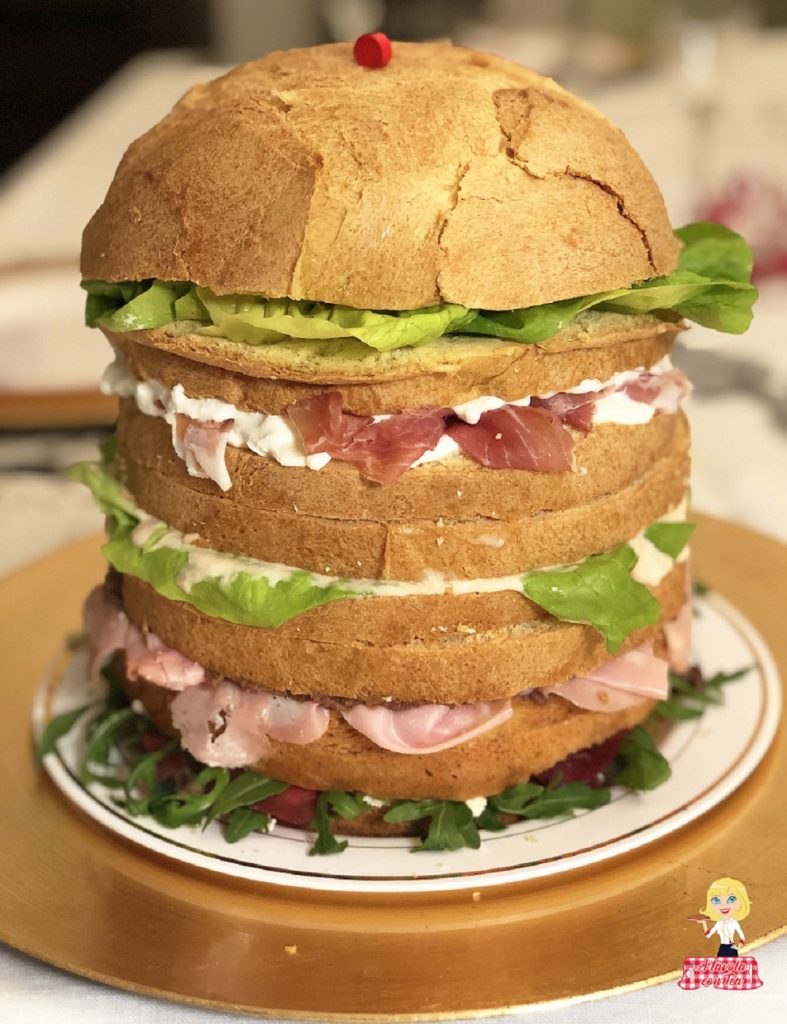
THE GOLDEN RULE: It is essential to always alternate filled and empty layers. The correct procedure is: pan brioche, filling, pan brioche – UNFILLED LAYER – pan brioche, filling, pan brioche and so on. The unfilled layer is what allows you to separate the small sandwiches without problems.
Order: I usually start with firmer mixtures at the bottom and finish with softer ones on top to ensure greater stability for the panettone.It may sound trivial but slice thickness matters: if too thin the sandwiches are fragile and may break; if too thick the little sandwich will be mostly bread and the filling layers will be lost.
The correct slice thickness is 3/8 in, so from a gastronomic panettone you should obtain about 8 slices (so 4 fillings) + the top dome which is decorative and not filled.
To cut it use a long, sharp knife and first make small marks all around the panettone to create cutting guidelines. Once the layers are cut and only after filling them, the gastronomic panettone should be cut into wedges to form many triangular sandwiches.
First I recommend piercing the panettone from top to bottom with 4 wooden skewers so it doesn’t collapse once divided into wedges. Then remove the dome and, starting from the center of a slice, divide it into 6 parts: you should thus obtain about 24 small sandwiches.
I don’t know about you, but the first time I made a gastronomic panettone I made the mistake of filling every single layer … it was definitely delicious but impossible to pick up and eat.
In fact, when filling it is important to leave some layers empty to separate the little sandwiches. To be clear, the correct procedure is: pan brioche, filling, pan brioche – unfilled layer – pan brioche, filling, pan brioche – unfilled layer, and so on.
The empty space should not be spread with sauces or anything else, otherwise you won’t be able to separate the sandwiches from each other. Obviously, to fill you’ll start from the base disk and fill it with the chosen mixture, then continue up with the other layers. I usually start with firmer mixtures and finish with softer ones so my panettone remains more stable.
Once you have finished filling the panettone place the dome back on, tie it with a pretty colored ribbon and put it in a prominent place in the center of your table. If you prepared it in advance, wrap it with plastic wrap and store it in the refrigerator. In that case, take it out to return to room temperature before serving (about 30 minutes).
And now here are 30 quick ideas to fill it.
Mortadella slices with Philadelphia cream cheese and chopped pistachios. Or make a mortadella mousse (for the recipe click here Mortadella mousse ready in 5 minutes) and add chopped toasted pistachios.
Prosciutto crudo, sliced with robiola cheese and sweet-and-sour onions.
Roast beef, thinly sliced with marinated artichokes in oil (for the recipe click here Perfect roast beef recipe).
Cooked ham with mushroom pâté and slices of Emmental.
Salami and stracchino cheese
Speck and brie
Prosciutto crudo and squacquerone cheese
Cooked ham and smoked scamorza
Bresaola, goat cheese and arugula
Chicken roasted and shredded, tomato and tuna-style sauce
1. Smoked salmon with cottage cheese, chives and arugula.
2. Canned tuna made into a mousse with roasted peppers;
3. Smoked tuna slices with fresh goat cheese and capers.
4. Shrimp sautéed in brandy with julienned zucchini flavored with curry.
5. Smoked swordfish with robiola cheese, chopped parsley and toasted pine nuts.
6. Lumpfish roe or caviar with butter.
7. Tonnato sauce (for the sauce recipe click here Tonnato sauce – many ways to prepare it) and salad.
8. Shrimp, cocktail sauce (for the recipe click here Cocktail sauce) and lettuce.
9. Pan-seared shrimp with chopped garlic and parsley on a bed of hummus (for the recipe click here Homemade chickpea hummus with tahini).
10. Bernese sauce and mini fish burgers (for the recipe click here Fish Burger
1. Scrambled eggs with spring onion and mayonnaise.
2. Cannellini bean hummus with oil-packed sun-dried tomatoes.
3. Fresh spinach sautéed and brie finely sliced by hand.
4. Roasted eggplant with goat cheese, sliced tomatoes and basil.
5. Olive pâté and Philadelphia. You can either mix the spreadable cheese with the pâté to make it creamier or create two separate layers—Philadelphia first and olive pâté on top.
6. With sun-dried tomatoes and goat cheese.
7. Gorgonzola and walnuts.
8. Mascarpone, brie and pistachios
9. Mushroom pâté and sliced scamorza cheese
10. Artichoke pâté and Parmesan shavings.
STORAGE
Once filled, the gastronomic panettone should be sealed with plastic wrap and stored in the refrigerator for up to 2 days. Before serving, I recommend removing it from the fridge and letting it come back to room temperature.
It is not suitable for freezing.
Follow A Tavola con Tea on Instagram https://www.instagram.com/atavolacontea_
More ideas for your Christmas menu can be found in the dedicated section of the home page
Here are some examples
LOW GENOESE PANDOLCE without leavening with step-by-step photos
HOMEMADE PANETTONE simple recipe without a mixer
What is the ideal thickness for slices of a gastronomic panettone?
The ideal slice thickness is 3/8 in. From a whole panettone you usually get 8 filled slices which, cut into wedges, make about 24 small sandwiches.
How do you slice the gastronomic panettone so it doesn’t collapse?
Before cutting, pierce the panettone vertically with 4 wooden skewers. Use a long knife and mark the layers first to obtain precise slices of 3/8 in.
How many layers should I fill in the gastronomic panettone?
It is essential not to fill every layer. Always alternate: pan brioche, filling, pan brioche – UNFILLED LAYER – pan brioche, filling, pan brioche and so on. The empty layer separates the small sandwiches.
How long before can I fill the gastronomic panettone?
The gastronomic panettone can be filled at most 2 days before. Seal it with plastic wrap and keep it in the refrigerator, but it’s crucial to remove it at least 30 minutes before serving to bring it back to room temperature.
