
Dark Rye Bread: Trick for a Soft Crumb (Never Chewy Bread Again!)
Bread is an indispensable food on my table; I love it in all its forms, and that’s why I’ve already published many articles on how to make bread at home, including sourdough variations.
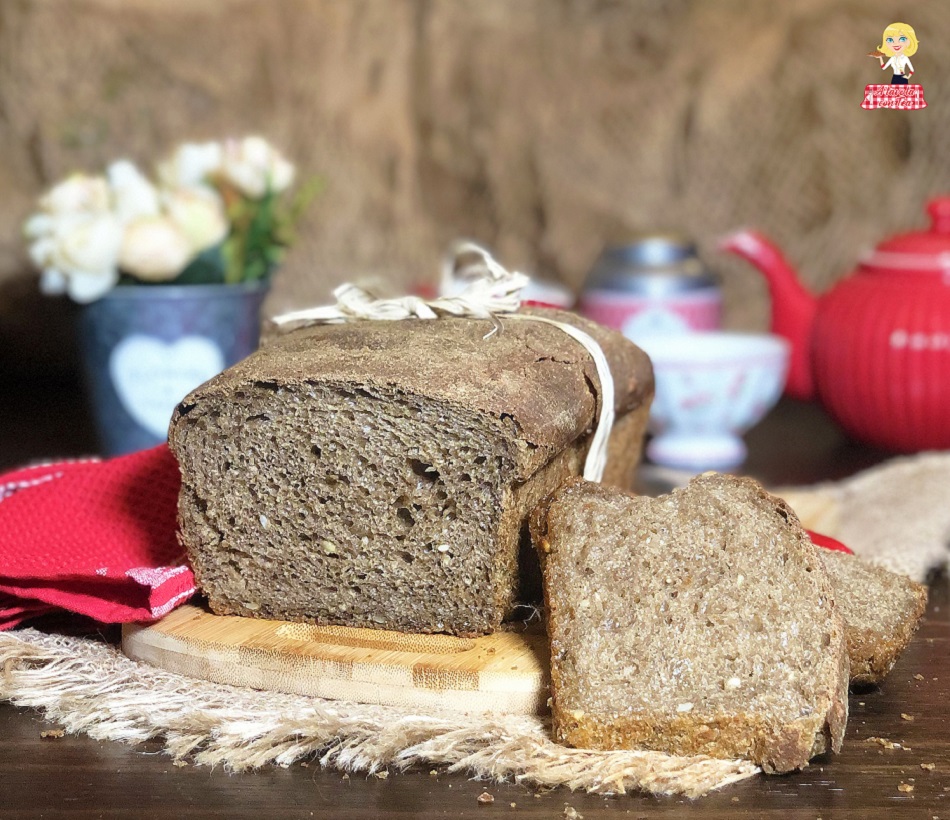
Today’s bread is a humble mountain loaf, once almost overlooked but recently rediscovered and revalued for its nutritional qualities and genuine flavor: dark rye bread.
Originating from Trentino-Alto Adige, it owes its typical color to rye flour, which also gives the bread a moist, compact crumb, a slightly tangy taste and a decidedly inviting aroma.
Now, let’s get to the recipe
No more dense rye bread! Have you tried making it at home but it turned out too dense and chewy?
This is the common mistake you absolutely must avoid.
This bread, once a “peasant mountain” loaf, is today loved for its extraordinary properties: it is high in fiber, has a genuine taste and is low glycemic index (GI ~45), perfect for diets and blood sugar control.
I’ll reveal the essential tricks for a soft dough, perfect baking and the secret to obtaining that moist, compact crumb without the dreaded “brick” effect.
In the recipe you’ll find detailed instructions for active dry yeast, fresh yeast and also for the bread machine.
- Difficulty: Very easy
- Cost: Very inexpensive
- Preparation time: 10 Minutes
- Cooking time: 25 Minutes
- Portions: 8
- Cooking methods: Oven
- Cuisine: Italian
- Energy 313.57 (Kcal)
- Carbohydrates 48.25 (g) of which sugars 0.07 (g)
- Proteins 9.04 (g)
- Fat 9.33 (g) of which saturated 1.15 (g)of which unsaturated 0.06 (g)
- Fibers 8.33 (g)
- Sodium 436.26 (mg)
Indicative values for a portion of 70 g processed in an automated way starting from the nutritional information available on the CREA* and FoodData Central** databases. It is not food and / or nutritional advice.
* CREATES Food and Nutrition Research Center: https://www.crea.gov.it/alimenti-e-nutrizione https://www.alimentinutrizione.it ** U.S. Department of Agriculture, Agricultural Research Service. FoodData Central, 2019. https://fdc.nal.usda.gov
INGREDIENTS FOR WHOLE RYE BREAD
- 4 1/4 cups whole rye flour (see note in TIPS AND VARIATIONS)
- 0.5 oz fresh baker's yeast (or 1 packet active dry yeast)
- 3 tablespoons extra virgin olive oil
- 1 1/6 cups warm water
- 1 1/2 tsp salt
Preparation
Below you will find instructions to prepare WHOLE RYE BREAD using active dry yeast, fresh yeast or sourdough starter.
Dough preparation
Put the rye flour, the yeast (as indicated), 3 tablespoons of extra virgin olive oil, 1 1/6 cups of warm water and the salt into a bowl or the mixer.
Knead until you obtain a soft, homogeneous dough without lumps.
Let rest until doubled in volume (depending on room temperature this will take from a minimum of 1 hour up to 2 hours), covered with a cloth or cling film.
Take the dough and, with a light press of your fingers, flatten it into a square without re-kneading. Fold the corners into the center, turn the dough over and place it directly on a baking tray lined with parchment paper or lightly oiled, then let it rise again until doubled (another 60–90 minutes approximately).
Bake in a preheated conventional oven at 410 °F for 30–35 minutes. Baking times are indicative and depend on the type of oven; check the bread after 30 minutes and be careful not to burn the crust. Once ready, remove from the oven and let cool on a rack before slicing.
In a cup dissolve the fresh baker’s yeast with 3 1/2 tablespoons of warm water (subtract this from the total water amount indicated in the recipe) and half a teaspoon of honey. Put the rye flour, the dissolved yeast, the extra virgin olive oil, the salt and the remaining water into a bowl or the mixer. Knead until the dough is soft, homogeneous and without lumps. From this point proceed as for the recipe with active dry yeast (starting from the first rising).
In a bowl pour 150 g (about 5.3 oz) of already-fed sourdough starter and mix it with 3 1/2 tablespoons of warm water (subtract this from the total water amount indicated in the recipe) and half a teaspoon of honey.
In a separate bowl (or in the mixer) add the rye flour, the dissolved starter, the extra virgin olive oil, the salt and the remaining water.
Knead until you obtain a soft, homogeneous dough without lumps.
From here proceed as for the recipe with active dry yeast (starting from the first rising).
1. Optimal Baking
Bake in a preheated conventional oven at 410 °F for 30–35 minutes.
2. Moisture Trick (Essential!)
For a soft, not dry crumb, place a baking tray with about 3/4 inch (2 cm) of water on the lowest rack of the oven during the first part of baking. The heat will cause evaporation and create the right humidity for perfect bread.
3. Cooling and Storage
Remove from the oven and let cool completely on a rack before slicing. It keeps at room temperature for up to 2 days. If it remains, I recommend freezing it already sliced to preserve freshness.
HOW TO MAKE DARK RYE BREAD WITH A BREAD MACHINE
INGREDIENTS:
4 1/4 cups Spadoni 7-grain flour (500 g), 1 1/6 cups water (280 ml), 2 tablespoons olive oil, 10 g active dry yeast (about 1/3 oz, already present in the package).
PROCEDURE FOR RYE BREAD WITH A BREAD MACHINE
Remove the bread machine pan. Pour the ingredients into the pan in this order: water, oil, flour and yeast.
Replace the pan in the bread machine, close the lid and activate the whole-grain bread program, setting the loaf weight to 750 g (about 1.65 lb).
Let it cool completely before removing it from the pan. This is the result with the bread machine.
STORAGE
Once ready, homemade dark rye bread keeps at room temperature for a maximum of 2 days. If you have leftovers, I recommend freezing it already sliced so it’s ready to use.
When you defrost it, heat it for 1 minute under the oven grill (watch it so it doesn’t burn) or use a toaster to regain its crispiness.
TIPS AND VARIATIONS
YEAST For this recipe you can use either active dry yeast (e.g. one packet), fresh baker’s yeast (15 g) or sourdough starter (150 g already fed).
RYE FLOUR After several experiments with different brands, the one I prefer is Molino Spadoni for its balanced characteristics (I swear they don’t pay me to say this).
SEED VARIATION If you love oilseeds you can sprinkle the surface of the bread before baking with sesame, sunflower, pumpkin seeds or others to your liking.
You can also add them to the dough but no more than about 1 oz (30 g) otherwise they will weigh it down too much and impair the rising.
BREAD BAKING TIP For optimal baking place a tray with about 3/4 inch (2 cm) of water on the lowest rack of the oven; as it heats it will evaporate and create the right humidity for perfect bread.
WHAT TO SERVE WITH RYE BREAD Rye bread is excellent with aged cheeses and cold cuts like speck, and it’s great for crostini and to accompany winter soups of legumes, potatoes, cabbage or vegetables.
Of course the simplest way, and my confessioned favorite, to enjoy it is to lightly toast it, spread a thin layer of butter and pair it with blueberry jam or orange marmalade.
Follow A Tavola con Tea on Instagram by clicking the following link https://www.instagram.com/atavolacontea_
To discover more recipes return to the homepage by clicking here https://blog.giallozafferano.it/atavolacontea/
Rye Bread: Nutritional Properties and Benefits
Low Glycemic Index: With a GI of about 45, it is recommended for people with diabetes or those following a controlled diet.
High in Fiber: Suitable for regulating bowel activity and helping to control blood sugar and cholesterol levels.
Longer Freshness: It stays fresh longer than other types of bread because it dries out more slowly.
Why is rye bread the best?
Besides its taste, rye bread is highly appreciated because, drying much more slowly, it stays fresh longer than other types of bread.
Who is rye bread suitable for?
Low glycemic index: with a glycemic index of about 45, rye is certainly recommended for people with diabetes or those following a diet controlled for blood sugar metabolism.
What are the health benefits of rye?
Rye is rich in fiber, especially in its whole form, therefore it helps regulate intestinal activity and reduce the risk of colon cancer. It also helps keep blood sugar and cholesterol in check, reducing the risk of diabetes and atherosclerosis.
Which bread has the lowest glycemic index?
Whole rye bread (GI ~45). Whole grain crackers without added sugars (GI ~55). Chia-seed bread (GI ~45–50). Kamut bread (GI ~45)
