
How to cook yellow polenta: quantities, cooking times and tricks for a creamy texture
Homemade polenta: the guide to make it perfect and lump-free
The polenta dilemma: how to avoid lumps and a gummy texture
The main problem for those attempting traditional polenta is the formation of the much-hated lumps, which ruin the experience of a dish that should be a velvety comfort.
Many, out of fear of making mistakes or lack of time, opt for instant versions, giving up the intense toasted-corn aroma and the rich texture that only slow cooking can provide.
Another common obstacle is guessing the right proportion between water and cornmeal: polenta that is too loose won’t hold sauces, while polenta that is too firm becomes hard to work with and heavy on the palate.
Solving these doubts is simpler than it seems. The turning point is all in the initial moment of the “throw” of the cornmeal and patience during cooking.
Today I will explain why the “rain” technique and the use of a whisk in the first stages are fundamental to obtain a smooth and uniform mixture and why a heavy-bottomed pot is your best ally to spread heat evenly, avoiding that the polenta burns on the bottom before it is cooked.
Let’s prepare together this pillar of humble cooking that, with a few precautions, transforms into the noblest and most appetizing winter side dish!
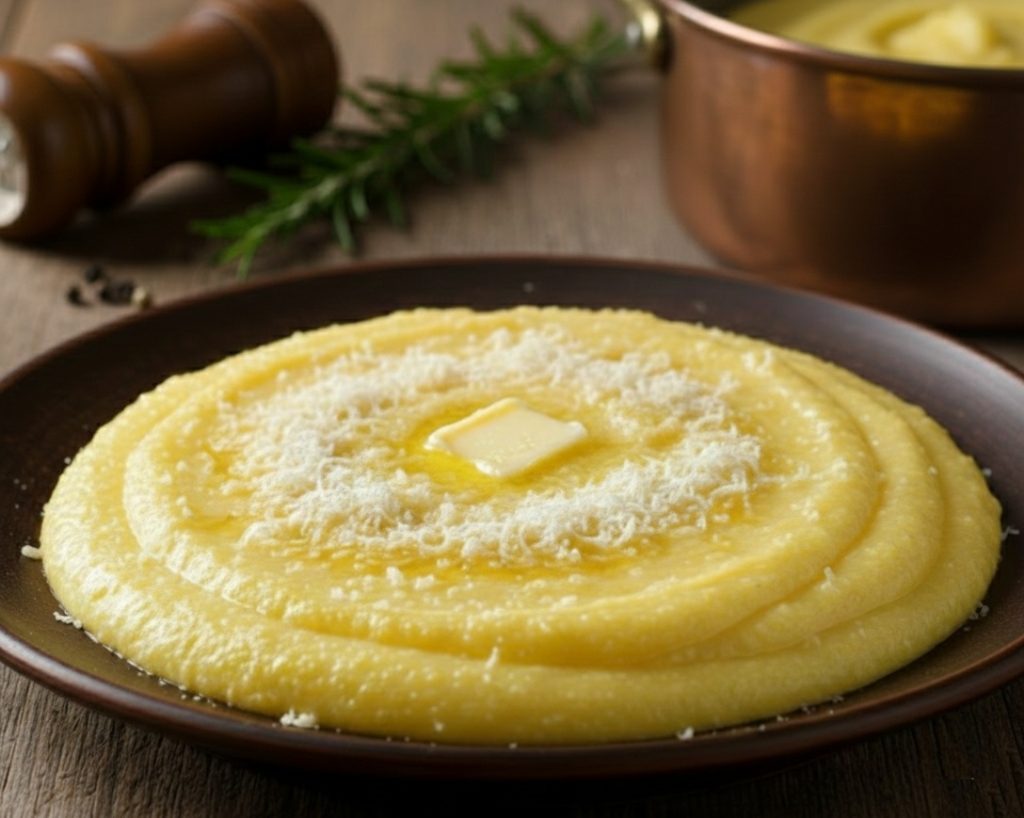
- Difficulty: Very easy
- Cost: Very inexpensive
- Preparation time: 5 Minutes
- Cooking time: 50 Minutes
- Portions: 4
- Cooking methods: Stovetop
- Cuisine: Italian
Ingredients — Homemade Polenta
- 3 1/2 cups (about 18 oz / 1.1 lb) cornmeal (coarse (bramata) for a rustic texture or fioretto for a finer texture)
- 8 1/2 cups water
- 1 tablespoon coarse salt
Tools
- Pot
- Hand whisk
- Spoon
How to cook polenta
To prepare flawless polenta, start by heating 8 1/2 cups of water in a heavy-bottomed pot (ideally a traditional copper polenta pot, but a good stainless-steel pot works well). Add the coarse salt and, as soon as the water comes to a boil, pour the cornmeal in a thin stream (the “rain” technique). Crucial step: whisk immediately and vigorously with a hand whisk. This quick motion prevents the cornmeal particles from clumping together and creating lumps.
Once the cornmeal is well incorporated and the mixture starts to thicken, lower the heat to the minimum. Continue to cook the polenta slowly for about 50 minutes. Although you don’t need to stir every second, it’s important to do so regularly with a wooden spoon, scraping the bottom and sides well to avoid sticking or burning. As time passes, you’ll notice the cornmeal fully absorbing the water and the mixture becoming firmer and more fragrant.
After about 50 minutes the polenta will be perfectly cooked. You’ll notice it because it will begin to come away easily from the sides of the pot as you stir. At this point, place a round wooden board on top, invert the pot with a firm move: the polenta will release as a single golden loaf. It’s ready to be served!
One of the most frequently asked questions concerns the final density: some like it so firm it can be cut with cotton thread as in the old days, while others prefer it almost loose, perfect to welcome a meat sauce or melted cheese. The secret to mastering these variations is not in the cooking technique, which remains the same, but exclusively in the ratio between water and cornmeal.
For firm, compact polenta: keep the classic ratio of 1:4 (for example, 8 1/2 cups of water for 3 1/2 cups of cornmeal). This version is ideal if you want to turn it out on a board and serve it in slices, or let it cool and then grill it the next day.
For soft, velvety polenta: increase the water to a ratio of 1:5 (about 10 1/2 cups of water for 3 1/2 cups of cornmeal). You’ll get a dense, enveloping cream, perfect for spoon dishes.
A small trick to keep in mind: if during the 50 minutes of cooking you realize the polenta is becoming too firm for your taste, don’t be afraid! Add one or two ladles of boiling water and continue to stir vigorously: the cornmeal will absorb it immediately and you can adjust the consistency on the fly until it’s perfect.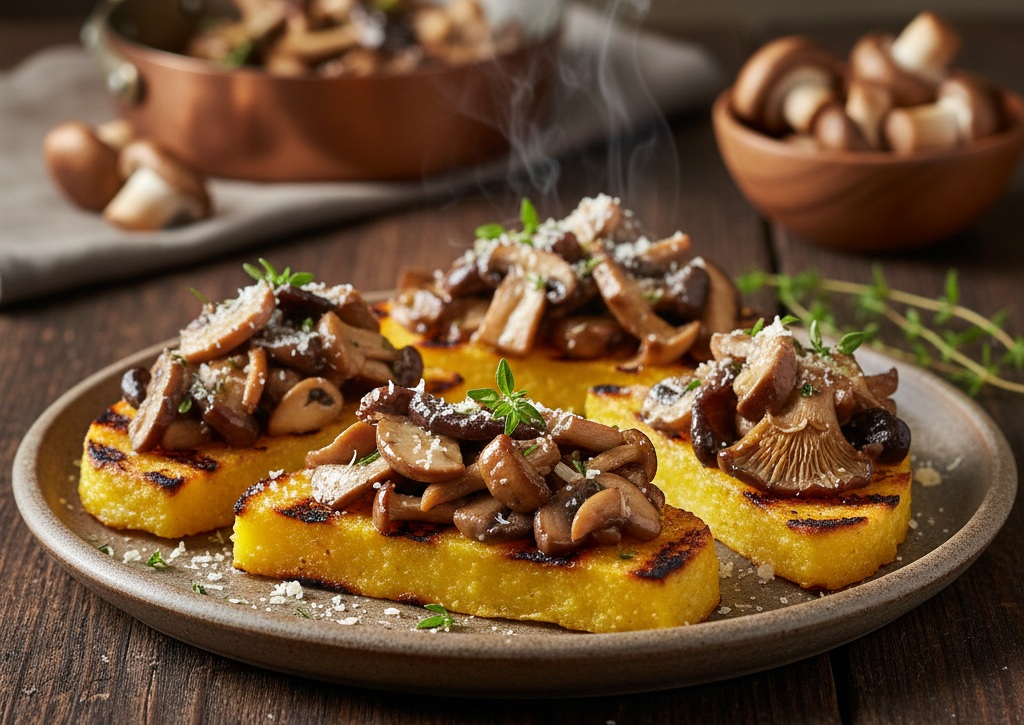
Notes on ingredients and substitutions
The Cornmeal: Coarse (bramata) cornmeal yields the classic grainy polenta; white cornmeal is typical of the Veneto region and pairs wonderfully with fish.
Enriching: For an even more indulgent polenta, you can replace a small portion of the water with milk or add a knob of butter at the end of cooking.
Storage
Polenta is amazing because it’s never wasted. It keeps in the refrigerator in an airtight container for 3-4 days. Once cold it becomes firm: slice it and pass it over a hot grill or in a pan with a drizzle of oil to obtain croutons that are crispy outside and tender inside.
Tips
If you want a “stringy” finish, add cubes of cheese (such as fontina or taleggio) in the last 5 minutes of cooking. If the polenta becomes too firm during cooking, always have a small pot of boiling water ready to add as needed.
FAQ (Questions & Answers)
How much water is needed for each kilo of cornmeal?
The standard proportion is about 17 cups of water (approximately 4 liters) for each kilogram (2.2 lb) of cornmeal. If you prefer a very soft polenta (spoonable), you can increase the water to about 19 to 21 cups (4.5 to 5 liters).
Can you make polenta without stirring all the time?
Yes, if you use a very heavy-bottomed pot and keep the heat at the absolute minimum, you can stir every 5-10 minutes. The important thing is that the temperature remains steady and low.
Why did my polenta remain gritty?
Polenta needs time for the corn grits to fully hydrate. If after 50 minutes it still feels too “sandy”, the flame was probably too high and the water evaporated too quickly: add a ladle of boiling water and continue cooking for another 10 minutes.
