
How to make walnut bread at home: a simple recipe with a crispy crust and a soft interior
Homemade walnut bread: the foolproof recipe for a fragrant, crunchy result
I confess I’m a walnut lover and, consequently, any recipe that includes them as an ingredient drives me wild. While browsing Fulvio Marino’s book I came across this Walnut Bread preparation and I couldn’t miss it.
The Walnut Bread recipe is simpler than it may seem and is suitable even for less experienced bakers. It can be made without a mixer or stand mixer, simply in a bowl, and only requires a little patience due to the dough’s resting times before you can taste it.
The ingredients are the classic ones for bread: flour, water, salt, yeast and chopped walnuts.
One of the most common problems when making walnut bread at home is that the dough can become too heavy or the walnuts can “sink” or, worse, the crumb can remain moist and compact.
Often you end up with a loaf that smells wonderful but is disappointing when sliced. The secret to avoid all this lies in the right balance between hydration and the flour’s strength, as well as a strategic incorporation of the nuts so they don’t break the gluten network during fermentation.
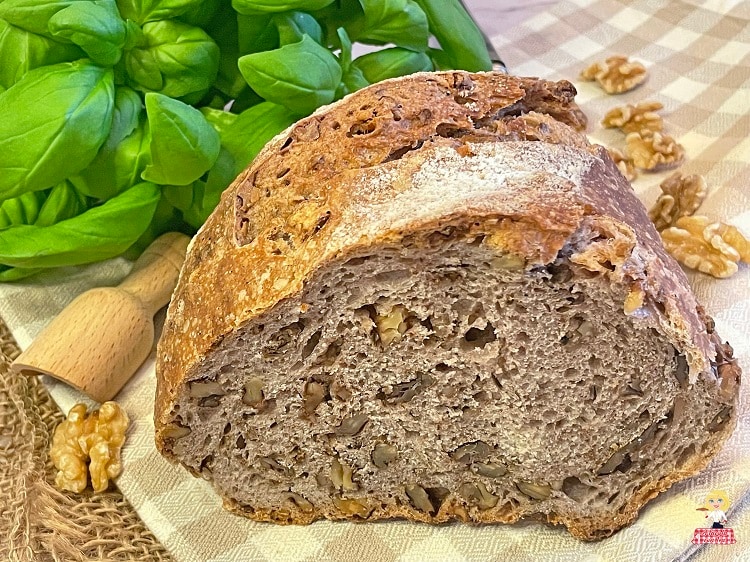
In this version, thanks to Maestro Marino’s advice, these issues are solved, guaranteeing you a loaf with a dark, crunchy crust that hides a soft interior dotted with walnuts that remain crunchy and well distributed.
It’s the ideal companion for aged cheeses or simply toasted with a smear of salted butter (perhaps the herb butter we saw together!). Making bread requires patience, but the sound of the crust “singing” as it comes out of the oven will repay every minute of waiting.
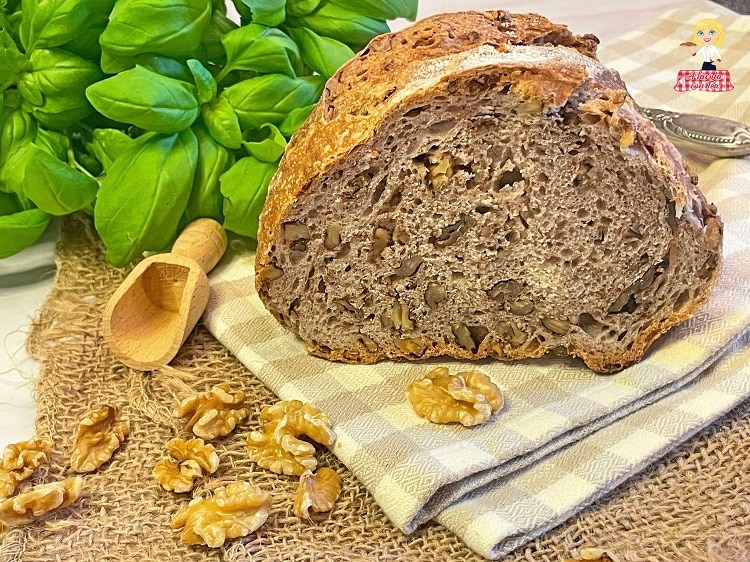
- Difficulty: Easy
- Cost: Budget-friendly
- Rest time: 4 Hours
- Preparation time: 30 Minutes
- Cooking time: 40 Minutes
- Portions: 6
- Cooking methods: Oven
- Cuisine: Italian
- Energy 1.87 (Kcal)
- Carbohydrates 0.23 (g) of which sugars 0.01 (g)
- Proteins 0.12 (g)
- Fat 0.06 (g) of which saturated 0.00 (g)of which unsaturated 0.00 (g)
- Fibers 0.04 (g)
- Sodium 277.83 (mg)
Indicative values for a portion of 50 g processed in an automated way starting from the nutritional information available on the CREA* and FoodData Central** databases. It is not food and / or nutritional advice.
* CREATES Food and Nutrition Research Center: https://www.crea.gov.it/alimenti-e-nutrizione https://www.alimentinutrizione.it ** U.S. Department of Agriculture, Agricultural Research Service. FoodData Central, 2019. https://fdc.nal.usda.gov
Ingredients for Homemade Walnut Bread:
- 2 1/2 cups whole wheat flour
- 1 1/3 cups spelt flour (whole)
- 1/3 cup buckwheat flour
- 1 cup walnut kernels, coarsely chopped (about 3.5 oz)
- 1.42 cups water (warm)
- 1 tsp active dry yeast
- 1 2/3 tsp fine salt
Tools
- Stand Mixer
- Baking Tray
Note
If you don’t have a stand mixer you can knead by hand following the same ingredient order.
Start by dissolving the yeast in the warm water together with the honey. In a large bowl (or in the stand mixer), pour the flour and gradually add the water. Begin kneading until the flour has absorbed the liquids. Let the rough dough rest for about 20 minutes: this will help the gluten network form.
Add the salt and extra virgin olive oil. Work the dough vigorously for at least 10-15 minutes until it becomes smooth, elastic and completely pulls away from the sides of the bowl. Only at this point, incorporate the coarsely broken walnut kernels by hand, distributing them evenly without stressing the dough too much.
First rise
Shape into a ball and place it in an oiled bowl. Cover with plastic wrap or a damp cloth and let rise in a sheltered place (the oven off with the light on is ideal) until doubled in volume. It will take about 2-3 hours depending on temperature.Take the dough, give it a couple of reinforcing folds and shape it into a loaf or bâtard. Place it on a baking sheet lined with parchment paper, score the surface with a cross cut and let it rise again for 45 minutes. Bake in a preheated static oven at 428°F for the first 10 minutes, then lower to 374°F and continue for another 30-35 minutes. For an extra-crispy crust, place a small pot of water on the bottom of the oven for the first minutes of baking.
TIPS
Rising times are indicative because they depend on the season and therefore on room temperature; consider the dough ready when it has doubled in volume.
To obtain a better loaf with an aerated crumb, I recommend placing a bowl with a little water on the lower rack of the oven at the start of baking and removing it after 20 minutes when you lower the oven temperature. This will create the right humidity inside the oven.
If you prefer, you can replace the walnuts with hazelnuts for a sweeter, more delicate bread or with olives for a more aromatic, flavorful loaf.
STORAGE
Once baked, walnut bread keeps at room temperature in a cool, dry place in a sealed bag for up to 3-4 days. Alternatively, slice and freeze it to use later; just thaw and warm slightly in the oven or microwave.
Recipe variations
Walnut and raisin bread: Add 50 g of soaked raisins for a sweet-salty contrast.
Multigrain bread: Replace part of the flour with a 5-grain flour mix.
No-knead: You can follow the no-knead bread technique by extending the fermentation times in the refrigerator.
Tips and Secrets
Toasted walnuts: For an even more intense flavor, lightly toast the walnuts in the oven for 5 minutes before adding them to the dough (let them cool!).
The honey trick: Don’t skip the teaspoon of honey; it’s not for sweetening, but to help trigger the Maillard reaction and give you that brown crust typical of professional ovens.
FAQ (Questions & Answers)
Why did my walnut bread turn purple inside?
It’s a natural reaction of the tannins in the walnut skins which, in contact with the dough’s moisture, can slightly color the crumb. Don’t worry, the taste doesn’t change!
Can I use sourdough starter?
Certainly. Replace the 10 g of baker’s yeast with 150 g of refreshed sourdough starter, remembering to remove 50 g of flour and 50 ml of water from the total recipe. Rising times will double.
The walnuts make the dough heavy — how can I get it to rise well?
Be sure to add the walnuts only at the end, when the dough is already well developed. If you add them too early, the sharp edges of the nuts could “cut” the gluten strands, preventing the bread from developing height.
