
Genovese focaccia, or Ligurian focaccia (“fugassa” in the Genoese dialect), is one of Liguria’s specialties, a hallmark and distinctive sign of our cuisine together with BASIL PESTO, so much so that it has even been called the “Ambassador of Liguria.”
We Genoese start eating it already at breakfast, dipping it into cappuccino or coffee, but also as a mid-morning snack, as an aperitif and as a substitute for bread.
In short, you got it: any excuse is good to eat a strip of focaccia.
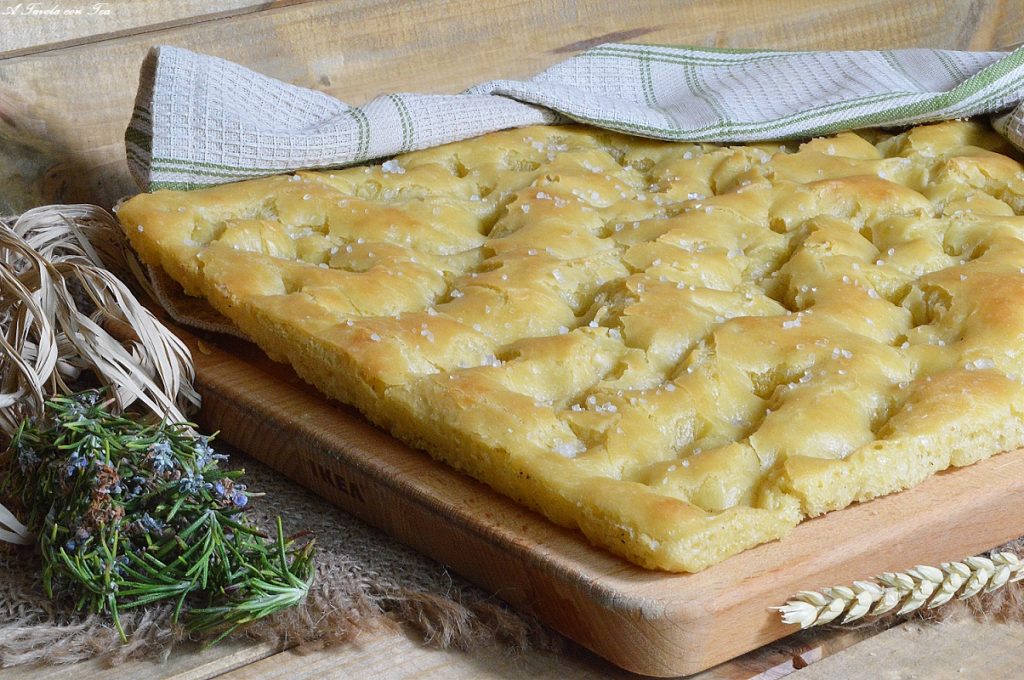
Genovese focaccia stands out for its characteristic “dimples” filled with seasoning that make it soft inside while crispy on the surface.
The secret to success lies in the dough, the quality of the flour, the use of extra virgin olive oil (although older recipes sometimes used lard) and above all the correct method of preparation.
To obtain the typical flavor, color and texture, long fermentation is very important – preferably with sourdough starter – the folding technique for the dough and the oil-water emulsion to get the characteristic dimples.
Finding a perfect, well-tested recipe wasn’t easy but after many attempts I finally succeeded, achieving a result I think is excellent for a homemade focaccia.
Of course the baker’s will remain the best because of the oven, but you can’t do much about that unless your boyfriend or partner is a baker!!!!
It’s needless to say that using a sourdough starter is by far better; nevertheless, knowing that you may not always have the time or desire to use it, I’ll explain in the tips at the end of the recipe how to prepare it with brewer’s yeast. If you’re looking for other LIGURIAN or GENOESE recipes, also check out
- Difficulty: Medium
- Cost: Economical
- Rest time: 10 Hours
- Preparation time: 50 Minutes
- Cooking time: 18 Minutes
- Cooking methods: Oven
- Cuisine: Italian
Ingredients
- 3.5 oz sourdough starter (to refresh)
- 3.3 tbsp water
- 3.5 oz Manitoba flour
- 5.8 cups type 00 flour
- 1.75 cups water
- 8.5 oz refreshed sourdough starter
- 1 tbsp salt
- 2 tsp malt (or 4 tsp sugar (16 g))
- 0.33 cups extra virgin olive oil
- 2 tbsp water
- 1 tsp fine salt
- 2 tbsp extra virgin olive oil
Tools
- Bowl
- Baking pan
Preparation
First of all, refresh the sourdough starter. Take it out of the fridge, bring it to room temperature, then use 3.5 oz (100 g) of it and mix with 3.5 oz (100 g) of Manitoba flour and 3.3 tbsp (50 ml) of water. Let the “crescent” rest until it doubles in volume (about 3 hours).
In a large bowl make a well with the flour, add the malt (or sugar), 2 tsp (10 ml) of extra virgin olive oil and begin mixing, adding the water little by little.
Finally add the salt, then transfer the dough to the work surface and continue kneading until it is smooth, soft and homogeneous.
Once the dough is ready, put it back in the bowl and let it rise until doubled in volume (about 6 hours).
When it has doubled in volume, place it on the work surface and, pressing with your hands, stretch it out, then fold it in three as if forming a package.
Stretch the dough again using the pressure of your hands and make additional folds; you should repeat this folding operation 4 times.
Finally shape the dough into a rectangle, cover with a damp cloth and let it rest for about 1 hour.
After the resting time, transfer the dough to a well-oiled baking pan (well greased with extra virgin olive oil) and, using your fingertips, spread the dough out on the pan; be careful not to stretch the dough, you should only press with your fingertips.
Brush the surface with an emulsion of water, oil and salt and create the characteristic dimples with your fingertips; let it rise for another 1 hour approximately.
Bake in a preheated conventional oven at 392°F (200°C) for about 18–20 minutes.
One minute before the end of baking, remove it from the oven, brush the surface with a little extra virgin olive oil and return it to the oven until fully cooked.
Once baked, place the focaccia on a rack to cool.
Dissolve 0.9 oz (25 g) fresh baker’s yeast in part of the water. Put the flour in a bowl, mix it with the sugar and add the oil, then pour in the water in which the yeast has been dissolved and start to knead. While kneading, add the salt and gradually all the remaining water. Transfer the dough to the work surface and continue working it until smooth, homogeneous and very soft. At this point put the dough back in the bowl and let it rest for about 2 hours (it should double).
Take the dough, spread it by pressing with your fingertips, then fold the edges inward forming a little package. Using the pressure of your hands, stretch it again and make more folds; repeat this procedure 3 times. Finally shape the dough into a rectangle, cover it with a damp cloth and let it rise for another 2 hours. Transfer the dough to a well-oiled baking pan and spread it out on the pan with your fingers. Let it rise until doubled in volume (about 1 hour and 30 minutes). Once risen, make the characteristic dimples with your fingertips.
Sprinkle the surface with an emulsion prepared with 2 tbsp (30 ml) of extra virgin olive oil, 2 tbsp (30 ml) of warm water and 1 tsp (5 g) of fine salt, then let it rest one last time (about 30–45 minutes). Bake in a preheated conventional oven at 392°F (200°C) for about 18–20 minutes. One minute before the end of baking, remove it from the oven, brush the surface with a little extra virgin olive oil and return to the oven until fully cooked.
STORAGE
Genovese focaccia should be eaten still warm, just out of the oven. In any case it’s delicious cold too, but it should be consumed the same day otherwise it becomes dry and hard.
If you have leftovers you can safely freeze them; when needed just let them thaw at room temperature and put them back in the oven or toaster for 2–3 minutes to crisp them up again.
TIPS AND VARIATIONS
This recipe is calibrated for a rectangular baking pan measuring approximately 12 x 16 in (30 x 40 cm); if you use larger or smaller pans adjust accordingly, always keeping in mind that the dough thickness for an optimal result should be about 3/8 in (1 cm) raw.
Classic Genovese focaccia is plain, without any topping, but nowadays there are many variations. Among the most popular are focaccia with onions, with sage and with potatoes.
See all the different variations in this collection https://blog.giallozafferano.it/atavolacontea/speciale-focaccia-tante-versioni-tutti-gusti-deliziosi-abbinamenti/
TABLE WITH TEA ON INSTAGRAM https://www.instagram.com/atavolacontea_/?hl=it
