
MARGHERITA PIZZA
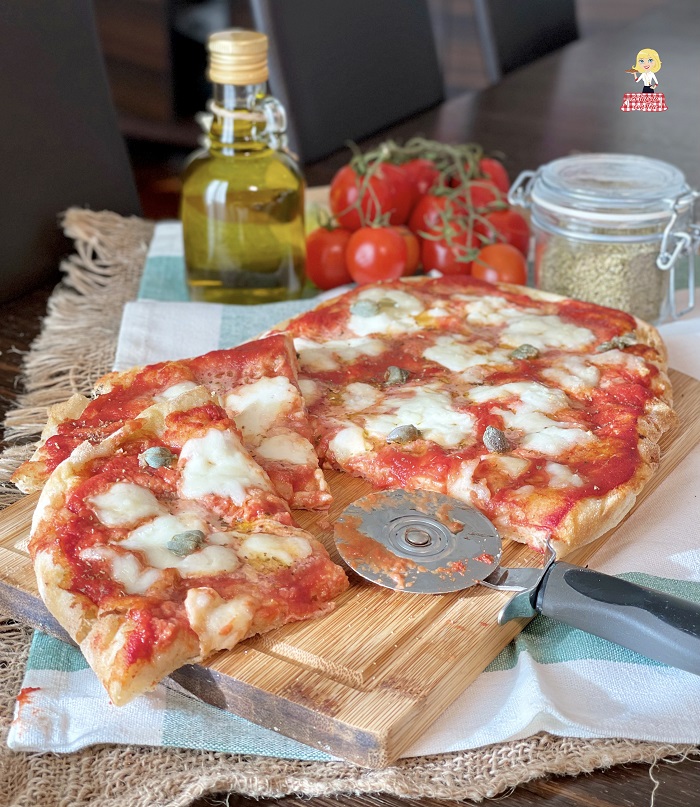
The Neapolitan Margherita Pizza, an icon of Italian cuisine, is a hymn to simplicity and flavor. With its soft dough, fresh tomato and melting mozzarella, this pizza is irresistible comfort food. On the occasion of Pizza Day, I will reveal the secrets to making a perfect homemade margherita pizza, with a light dough and a richly flavored topping.
The original Margherita Pizza recipe has its roots in the Neapolitan tradition, where quality ingredients and high-temperature baking are essential. In this guide I will give you detailed tips on preparing the dough, from choosing flours to fermentation, and how to make a tomato sauce that enhances the flavor of the mozzarella.
You will discover how to stretch the dough to obtain a pizza with the typical crispy rim, and how to bake it in a home oven for a result similar to a pizzeria. I will guide you step by step through the preparation, revealing the tricks for an authentic Neapolitan margherita pizza that will win over all your guests.
Whether you are an experienced pizzaiolo or a beginner, this recipe will allow you to prepare a homemade margherita pizza that will make you feel like you’re in a real Neapolitan pizzeria. And don’t forget, simplicity is the key to an unforgettable margherita pizza!
- Difficulty: Very easy
- Cost: Very inexpensive
- Rest time: 5 Hours
- Preparation time: 30 Minutes
- Cooking time: 15 Minutes
- Portions: 3 pizzas (11 in diameter)
- Cuisine: Italian
- Energy 1,022.48 (Kcal)
- Carbohydrates 126.34 (g) of which sugars 2.71 (g)
- Proteins 40.49 (g)
- Fat 42.20 (g) of which saturated 14.77 (g)of which unsaturated 6.38 (g)
- Fibers 5.43 (g)
- Sodium 2,122.67 (mg)
Indicative values for a portion of 400 g processed in an automated way starting from the nutritional information available on the CREA* and FoodData Central** databases. It is not food and / or nutritional advice.
* CREATES Food and Nutrition Research Center: https://www.crea.gov.it/alimenti-e-nutrizione https://www.alimentinutrizione.it ** U.S. Department of Agriculture, Agricultural Research Service. FoodData Central, 2019. https://fdc.nal.usda.gov
Ingredients
- 2 1/3 cups 00 flour ((300 g))
- 1 2/3 cups Manitoba flour ((200 g))
- 1 1/4 cups water (at room temperature (300 ml))
- 1/2 tsp active dry yeast (or 4 g fresh yeast)
- 1 2/3 tsp salt ((10 g))
- 2 2/3 tbsp extra virgin olive oil (plus more to grease the pan (40 ml))
- 1 1/4 cups tomato passata ((300 g))
- 9 oz mozzarella (fior di latte; drained (250 g))
- 1 1/3 tbsp extra virgin olive oil ((20 ml))
- to taste salt
- basil (or oregano)
- capers (optional)
Tools
- 1 Stand mixer G3Ferrari IMPASTATRICE PLANETARIA
Steps
Take the fresh yeast and crumble it into a bowl, then pour in 20 ml (about 1 1/3 tbsp) of lukewarm water (taken from the total amount in the recipe) and stir with a teaspoon to help it dissolve. Let it rest for about ten minutes.
After the time has passed, put the two flours in a bowl or in the mixer and add the yeast dissolved in the water, then add the remaining water in which you have previously mixed the oil and the salt.
Start kneading by hand or with the hook if you are using a mixer and continue until you obtain a smooth and homogeneous dough.
With these quantities you will obtain a dough weighing about one kilogram, enough for three pizzas of 11 in diameter.
Let it rest covered with a kitchen towel in a warm, dry place until it has more than doubled in volume (depending on room temperature it will take about 5–6 hours).
After the rising time, the dough should be puffy; you can then transfer it to a lightly floured work surface and divide it into 3 pieces.
Take one of the three pieces of dough and proceed to ‘pirlare’ it until you obtain a smooth, regular ball: to ‘pirlare’ means to rotate the dough with your hands on the work surface and move it back and forth (bringing it toward you and then away repeatedly).
Proceed the same way with the remaining portions of dough.
Put the balls back to rest covered with a towel for another 30 minutes.
Once risen, stretch each one into an 11 in pan greased with a drizzle of extra virgin olive oil. If you like, leave the rim a bit thicker.
Pour the tomato passata into the center, spread it with the help of a spoon, lightly salt, add a drizzle of oil and then bake in a preheated oven at 482°F for about 10 minutes.
After 10 minutes, take the pizza out, being careful not to burn yourself, and arrange the mozzarella on the surface which you have previously cut and left to drain.
Bake for another 5 minutes to allow the mozzarella to melt and to finish cooking the crust.
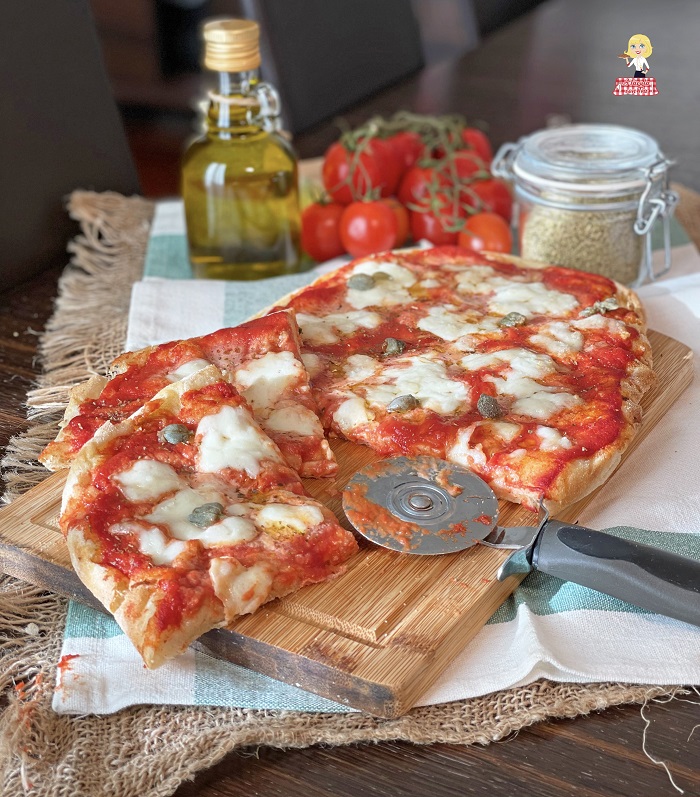
Serve your freshly baked margherita pizza and finish to taste with basil or, as my son loves, with a sprinkle of oregano.
STORAGE
Although I strongly doubt you’ll have any pizza left, it is possible to store it in the refrigerator for up to one day or freeze it.
Tips for the Perfect Dough:
Choice of flours: 00 flour is the most used for Neapolitan pizza thanks to its ability to absorb water and develop gluten, which gives the dough elasticity.
Manitoba flour, which is stronger, can be used in combination with 00 to obtain an even more elastic and resilient dough.
Hydration: Dough hydration is fundamental to obtain a soft and light pizza. The amount of water varies depending on the type of flour and environmental conditions, but generally ranges around 60–70% of the flour weight.
Fermentation: Fermentation is the process that allows the dough to develop the desired aromas and texture. A long fermentation (at least 24 hours) at a controlled temperature (about 39°F) produces a more digestible and flavorful pizza. Fermentation can take place either in the fridge or at room temperature.
Secrets for a Flavorful Tomato Sauce:
Choice of tomatoes: San Marzano DOP tomatoes are considered the best for pizza sauce because of their sweet and intense flavor. Alternatively, high-quality peeled tomatoes can be used.
Cooking: The tomato sauce should be simmered over low heat for at least 30 minutes to concentrate flavors and achieve a thick, creamy consistency. Add fresh basil only at the end of cooking to preserve its aroma.
Seasoning: A pinch of sugar can be added to the sauce to balance tomato acidity. Extra virgin olive oil should be added raw, before baking the pizza.
Variations of the Margherita Pizza Recipe:
1 – Margherita with Buffalo Mozzarella: Use buffalo mozzarella for a more intense flavor and creamier texture.
2 – Margherita with Fresh Cherry Tomatoes: Replace the tomato sauce with halved fresh cherry tomatoes dressed with oil and salt.
3 – Margherita with Pesto: Add a drizzle of fresh pesto after baking for an aromatic touch.
4 – Whole Wheat Margherita: Replace 00 flour with whole wheat flour for a more rustic version.
5 – Gluten-Free Margherita: Replace 00 flour with a gluten-free flour blend specifically for pizza.
6 – Margherita with Capers and Olives: Add capers and black olives for a bolder flavor.
7 – Margherita with Anchovies: Add anchovy fillets for a savory touch.
History and Origins of the Margherita Pizza:
The Margherita Pizza is a symbol of Neapolitan and Italian cuisine around the world. Its history dates back to 1889, when pizzaiolo Raffaele Esposito from Pizzeria Brandi in Naples created a special pizza in honor of Queen Margherita of Savoy during her visit to the city.
Esposito used ingredients that recalled the colors of the Italian flag: the red of the tomato, the white of the mozzarella and the green of the basil. The queen liked the pizza so much that the pizzaiolo decided to call it “Margherita” in her honor.
FAQ (Questions & Answers)
What is the secret to a light and easily digestible pizza dough?
Use high-quality flour, hydrate the dough well and let it ferment for a long time (at least 24 hours).
How do you make a tomato sauce that isn’t acidic?
Use ripe San Marzano tomatoes, simmer the sauce slowly and add a pinch of sugar if necessary.
What is the ideal temperature to bake pizza in a home oven?
Preheat the oven to the maximum temperature (482°F or more) and use a baking stone for even cooking.
