
Nuns’ Breasts Original: The Recipe Without Africano Mix for a Perfect Sponge Cake
The Secret of the Sponge Cake
The most critical problem when preparing Nuns’ Breasts is that the batter, since it does not contain chemical leavening, can break down and collapse before entering the oven, resulting in flat and gummy pastries rather than puffed and airy ones. The softness depends entirely on the air incorporated into the eggs.
Added to this is the difficulty of finding Africano Mix, a dry mix specifically made for this type (and others) of pastry. Today we’ll solve both problems.
The trick I’ll reveal to you (and the secret of the lightness): Success lies in the whipping and the joining of the masses. It is essential:
Whip the egg whites “softly” (foamy) and not to stiff peaks so they can be blended more easily and slowly with the yolks.
When you add the flour and then the egg whites to the yolks, the movement must be very slow, gentle and always from the bottom up, so as not to collapse the incorporated air.
Attention: If the two masses are not well whipped and the ingredients are not incorporated well and slowly, the batter collapses and becomes liquid.
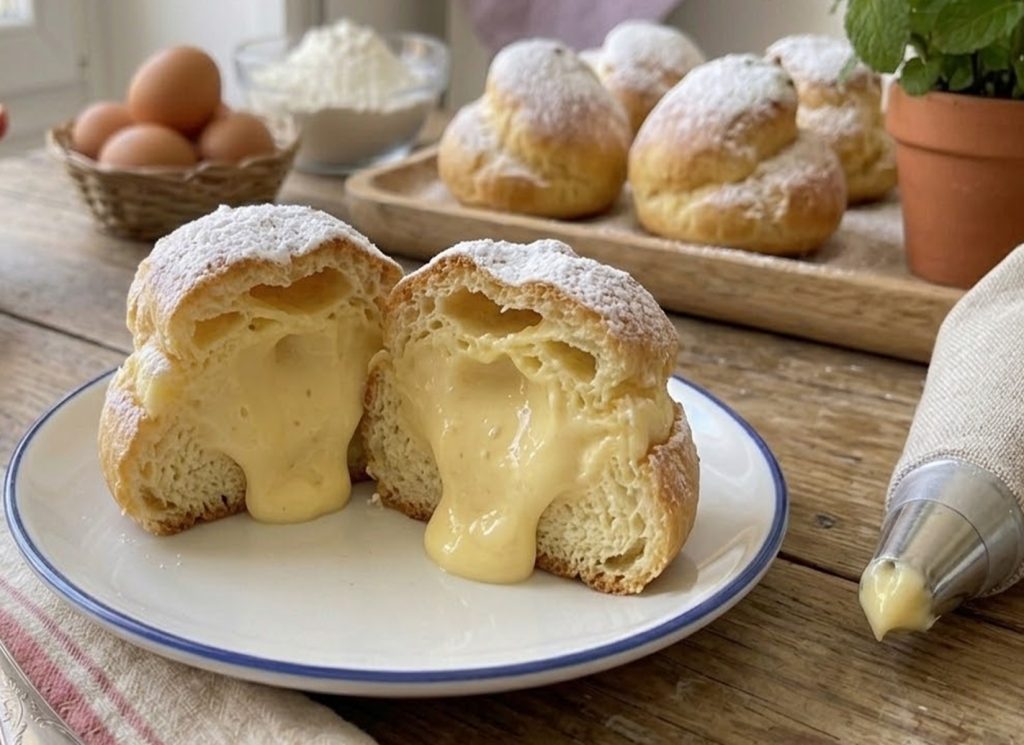
- Difficulty: Medium
- Cost: Inexpensive
- Preparation time: 50 Minutes
- Cooking time: 20 Minutes
- Portions: 20 pieces
- Cooking methods: Oven
- Cuisine: Italian
Ingredients NUNS’ BREASTS WITHOUT AFRICANO MIX
- 6 eggs (separate yolks from whites)
- 1/3 cup granulated sugar (to add to the yolks)
- 1 cup all-purpose flour (sifted twice)
- 2 1/4 tbsp granulated sugar (to add to the egg whites)
- 1/2 lemon juice (to add to the egg whites)
- 2 cups whole milk
- 1/3 cup flour or cornstarch (for the custard)
- 2/3 cup granulated sugar
- 4 egg yolks
- 1 vanilla bean (seeds)
How to prepare Nuns’ Breasts
In a bowl, mix the 4 egg yolks with 2/3 cup of granulated sugar. Add 1/3 cup of all-purpose flour. Mix quickly with a whisk. If desired, add the seeds from 1 vanilla bean.
Gently heat the milk (about 2 cups). Add it to the mixture, whisking by hand to avoid lumps.
Transfer the mixture to a saucepan and cook over heat, stirring continuously until the custard thickens and becomes firm.
Remove the custard from the heat and transfer it to a bowl, cover with plastic wrap touching the surface, and let it cool completely.Separate the egg whites from the yolks.
Whip the Yolks: Place the 6 egg yolks and 1/3 cup of granulated sugar in a stand mixer (or bowl) and whip until they become pale and frothy. Transfer them to a large bowl.
Whip the Egg Whites: Separately, whisk the 6 egg whites with 2 1/4 tbsp of granulated sugar and the juice of 1/2 small lemon. Important: The egg whites should be whipped “softly” (foamy).Fold in the Flour: Add the 1 cup of sifted all-purpose flour to the yolk mixture in several additions, gently folding with a spatula using movements from the bottom up.
Fold in the Egg Whites: Start by adding part of the foamy egg whites to the yolks and blend with the spatula, adding slowly in small portions. The final batter should be well combined.
Shape: Line a baking sheet with parchment paper. Transfer the batter into a piping bag fitted with a plain tip. Pipe small domes spaced slightly apart (or use molds/paper cups).
Bake: Bake in the oven at 329°F for 15–20 minutes (use conventional or fan-assisted mode depending on your oven).Let the little cakes cool completely before removing them from the mold and filling them.
Place the cooled pastry cream into a piping bag with a nozzle.
Turn each little cake upside down, make a hole in the center and fill completely with the custard.
Generously dust with powdered sugar.
Notes on Ingredients
Eggs: The 6 whole eggs must be separated. It’s better to whip the yolks first, because the whites tend to deflate more quickly in the meantime.
Flour: All-purpose flour should be sifted twice to ensure maximum aeration and incorporation without deflating the batter.
Lemon: A splash of lemon juice helps stabilize the egg whites and removes the eggy taste from the sponge.
Africano Mix Replacement: The recipe is designed to be without chemical leavening; the lightness comes solely from the whipping technique.
Uses, Pairings and Storage
Suggested Uses and Pairings
Traditional Pastry: Perfect for anyone looking for a light and creamy pastry, ideal for buffets or as a dessert to end a meal.
Pairing: They go well with lightly sweet dessert wines such as a light passito or a glass of sweet sparkling wine.
Storage
Ideal Storage: Nuns’ Breasts filled with pastry cream should be stored in the refrigerator.
Duration: Store them in an airtight container in the refrigerator for up to 2–3 days.
Freezing: The sponge cake (without filling) can be frozen, but pastry cream is not suitable for freezing.
FAQ (Questions and Answers)
How can I prevent the batter from collapsing?
Make sure the egg whites are whipped “softly” (foamy) and that the incorporation of flour and egg whites is done with a spatula, using extremely slow and gentle movements from the bottom up.
Can I use a muffin tin?
Yes, paper muffin liners or a silicone mold are a great alternative if you can’t pipe the perfect dome with a piping bag.
Why does the pastry cream have lumps?
Lumps form if the yolk-and-flour mixture was not well mixed before adding the hot milk, or if the custard was not stirred continuously during cooking on the stove.
