
Nutella Tart with Soft Center using the double-cover trick: a foolproof recipe
Do you have the problem that when you bake a Nutella tart the filling becomes dry and hard after baking? From today it’s SOLVED!
When you make a Nutella tart, the most common failure is one: the filling dries out and hardens, turning a delight into a brick.
This happens because the sugar in the cream can burn during long baking.
The solution is twofold:
Isolate the Filling: We will create a double layer of shortcrust (the base + a full cover) that thermally isolates the Nutella.
Baking Technique: We use the “trick” of freezing/resting and baking with foil to keep moisture and softness in the center.
With these precautions, you’ll get a tart with a guaranteed soft, creamy center!
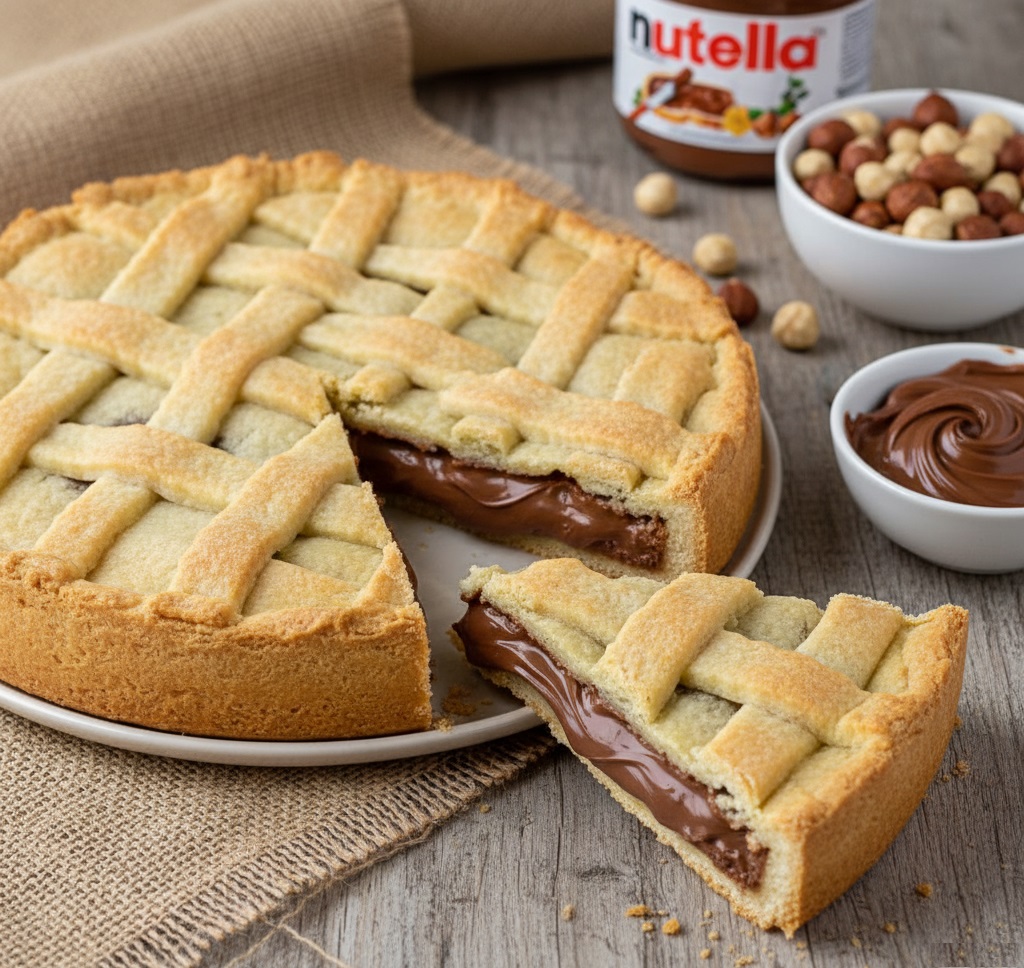
- Difficulty: Very easy
- Cost: Medium
- Rest time: 3 Hours
- Preparation time: 20 Minutes
- Cooking time: 45 Minutes
- Portions: pan 10/11 in
- Cooking methods: Oven
- Cuisine: Italian
Ingredients (Pan 10/11 in)
Proportions for Different Diameters
Pan diameter – Shortcrust dose – Nutella grams (approx) – Servings
18/20 cm (7.09 / 7.87 in) – 1/2 dose – 270 / 330 g (9.5 / 11.6 oz) – 6-8
22/24 cm (8.66 / 9.45 in) – 3/4 dose – 400 / 480 g (14.1 / 16.9 oz) – 10-12
26/28 cm (10.24 / 11.02 in) – 1 full dose – 550 / 650 g (19.4 / 22.9 oz) – 14-16
- butter
- 3/4 cup + 2 tbsp (6.3 oz / 180 g) granulated sugar
- 4 egg yolks (about 75–80 g (2.6–2.8 oz))
- all-purpose flour
- lemon zest
- 1 pinch salt
- Nutella® (or another spreadable cream)
Tools
- Planetaria
- Pellicola per alimenti
- Mattarello
- Carta da forno
- Teglia a cerniera
Preparation: NUTELLA TART WITH SOFT CENTER
Take the butter out of the fridge only 5 minutes before you start, weigh it and cut it into cubes. Put it immediately into the mixer (with the paddle or hook) or on the work surface, adding sugar, lemon zest and a pinch of salt.
Work the dough until everything is homogeneous, but without letting the butter warm up. The goal is to obtain a mixture that resembles coarse sand.
Add the egg yolks and continue mixing only until they are completely incorporated into the mass.
Add the flour and knead only the strictly necessary time so that the flour is fully absorbed. Stop as soon as the dough is homogeneous; this will prevent gluten development.
Remove the shortcrust from the mixer or bowl. Work it by hand for just a few seconds, just enough to form a flat rectangular loaf. This shape drastically reduces cooling time.
👉 The Secret: Wrap the loaf in cling film and put it immediately in the refrigerator for at least 1 hour. Cold resting is essential to relax the gluten and ensure the shortcrust does not shrink during baking.Divide the dough into two parts: 2/3 for the base and the full cover and 1/3 for the lattice and scraps. Put the 1/3 back in the fridge.
Work quickly the larger portion of the dough to soften it. Flour the work surface and roll it to a thickness of about 3/16 in (4 mm).
Line the pan (previously buttered and floured) with the dough. Prick the bottom with a fork.
Soften the Nutella by placing it in a bain-marie for a few minutes.
Spread the softened Nutella over the shortcrust base, creating a generous layer (about 1 cm thick).Take the scraps of shortcrust and add them to the portion you had set aside (the initial 2/3). Roll it again, always to 3/16 in (4 mm).
Cut a disc the same size as the pan. This will be your “cover” layer.
Apply the shortcrust disc over the Nutella and seal the tart edges well to trap the filling.
Freezer Rest: Put the entire tart in the freezer for 15 minutes. This is the secret to prevent the Nutella from drying out!Take the last 1/3 of the dough kept in the fridge. Work it quickly, roll it to 3/16 in (4 mm) and cut strips (about 1/2 in wide).
Arrange the strips on the sealed cover disc, creating the classic lattice/diamond effect. Seal the edges.
Bake with Foil: Cover the entire tart with a sheet of aluminum foil and bake in a preheated static oven at 356°F for 35 minutes (lower rack). The foil keeps internal moisture.
Final Browning: Remove the foil, move the tart to the middle rack and bake for another about 10 minutes, until the shortcrust is golden.
Remove from the oven and let cool completely before unmolding. Can I skip the freezer?
Yes, as an alternative to 15 minutes in the freezer, you can opt for 30–40 minutes resting in the refrigerator. Cold is vital.
How do I unmold the tart without breaking it?
Use a springform pan. If you use a normal tart pan, place a round of parchment paper only on the base before lining it.
What can I use instead of Nutella?
You can replace it with any spreadable cream (pistachio, almond, dark chocolate), ensuring a generous layer.
How should it be stored?
The tart keeps for 4–5 days at room temperature, under a cake dome.
Can I prepare it in advance?
Yes! You can freeze the assembled raw tart in the pan. Thaw in the refrigerator the night before and bake directly the next day.
Storage
The Nutella Tart keeps perfectly at room temperature, under a glass dome or well sealed in an airtight container, for about 3–4 days. If it’s very hot, you can store it in the refrigerator, but in that case it’s advisable to remove it at least 30 minutes before serving to allow the Nutella to return to its ideal creamy consistency. We do not recommend freezing the baked tart, as the shortcrust may lose its characteristic crispness once thawed.
Ingredient Notes and Recipe Variations
Preparing the Pan (Solution to Sticking)
To avoid the tart sticking to the base once cooled, don’t rely only on butter and flour. Butter the entire pan, press a round of parchment paper the exact size of the pan base and flour only the sides. Once cold, run a knife around the edge and invert the pan with the help of two plates and it will release without problems.
Shortcrust Thickness (Solution to Nutella Hardening)
It is crucial to roll the shortcrust thin, with a thickness not exceeding 3/16 in (4 mm). This way, the baking time will be shorter, preventing the Nutella from drying out.
Filling Variations
Jam: The shortcrust base is perfect for any type of jam. If you use very runny jams, add 1 teaspoon of cornstarch to the filling before baking to stabilize it.
Ricotta and Chocolate Chips: You can mix well-drained ricotta with sugar and chocolate chips for a classic, fresher filling.
Alternative Tip for an Extremely Creamy Center (Frozen Disk Method)
If you want an even creamier center and want to avoid putting the whole pan in the freezer, follow this method:
Create a Nutella disk on parchment paper the exact size of the inner pan cavity.
Move the Nutella disk to the freezer and let it freeze completely.
Once frozen, insert the disk into the raw shortcrust base and lay the lattice strips on top.
Cover the tart with aluminum foil and proceed with the baking indicated in the recipe. The frozen disk will ensure a molten center.
Baking Tips (The Aluminum Foil Trick)
Initial Protection: To prevent the Nutella from drying out, it is essential to cover the tart with aluminum foil for the first part of baking.
Cold Rest Time: After filling and assembling the tart, it is crucial to give it 15 minutes of rest in the freezer before baking, so that the Nutella cools well. If you don’t have space, replace the freezer rest with 30–40 minutes in the refrigerator.
Monitoring: Baking time may vary depending on your oven. Once you remove the foil, watch the tart closely, trying not to let it become too dark or over-browned, otherwise the creaminess of the Nutella will be compromised.
FAQ (Questions and Answers)
Why does my Nutella dry out and harden?
This happens because the oven’s heat evaporates the fats and water present in the cream. To prevent this, you need to add an element that stabilizes under heat: mixing the Nutella with a couple of tablespoons of milk, cream or mascarpone before pouring it in is the secret to keep its creaminess.
How can I prevent the shortcrust from shrinking during baking?
Shrinkage is caused by overworking the dough (which develops gluten) and by the dough being too warm. The solutions are: work the dough as little as possible and make sure it stays very cold, both during preparation and during the mandatory resting time in the refrigerator.
Can I prepare the shortcrust in advance?
Absolutely yes. You can keep the raw shortcrust loaf wrapped in cling film in the refrigerator for up to 3 days. If you prepare it much earlier, you can also freeze it for 1–2 months; in that case, let it thaw in the refrigerator overnight before using.
