
HOMEMADE PANDORO QUICK FOOLPROOF RECIPE WITH VIDEO
Every year at my house the big question comes up: Panettone or Pandoro? To be honest — living in Genoa — it’s more of a Pandolce or Pandoro debate for me… But who can say which is better? Both are the undisputed protagonists of Christmas.
To be frank, while I produce industrial quantities of Genovese Low Pandolce every year (I even won the World Championship with THIS recipe), I used to always buy Pandoro ready-made from the pastry shop or supermarket.
It seemed an incredibly difficult preparation, almost impossible and reserved only for Master Pastry Chefs — until I came across a recipe almost by chance.
What attracted me most was the description: it promised a soft, well-leavened Pandoro made with brewer’s yeast and a guaranteed result. Obviously I couldn’t pass it up!
And so I discovered that making Pandoro at home is within everyone’s reach — I’m not exaggerating. The only thing it asks for is patience for the rising times, which are not outrageous (about 5 to 7 hours) during which you don’t have to hover over it like an egg — you can do whatever you want, even leave the house!
Everything is transferred into the proper Pandoro mold (I bought mine on AMAZON at this LINK), left to rise for a period that ranges from 5 up to 7 hours and then baked for 55 minutes in the oven, where it will immediately release an intoxicating vanilla aroma!
Pandoro Quick and Foolproof: Complete Procedure in 6 Steps
You will find the ingredient list both for preparing the PANDORO using a 750 g mold and for the PANDORO using a 1 kg mold (see notes at the end).
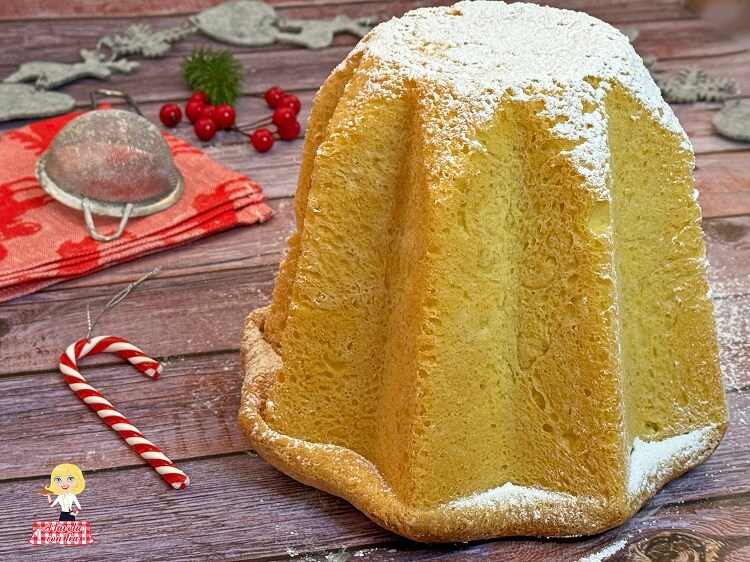
- Difficulty: Medium
- Cost: Inexpensive
- Rest time: 5 Hours
- Preparation time: 40 Minutes
- Cooking time: 55 Minutes
- Portions: 8
- Cooking methods: Oven
- Cuisine: Italian
- Seasonality: Christmas, New Year's Eve
- Energy 270.68 (Kcal)
- Carbohydrates 32.95 (g) of which sugars 11.48 (g)
- Proteins 6.21 (g)
- Fat 12.83 (g) of which saturated 7.58 (g)of which unsaturated 4.87 (g)
- Fibers 0.78 (g)
- Sodium 118.97 (mg)
Indicative values for a portion of 70 g processed in an automated way starting from the nutritional information available on the CREA* and FoodData Central** databases. It is not food and / or nutritional advice.
* CREATES Food and Nutrition Research Center: https://www.crea.gov.it/alimenti-e-nutrizione https://www.alimentinutrizione.it ** U.S. Department of Agriculture, Agricultural Research Service. FoodData Central, 2019. https://fdc.nal.usda.gov
INGREDIENTS LIST FOR PANDORO (750 g mold — 750 g ≈ 1 lb 10 oz)
For a 1 kg Pandoro the scaled ingredient list is as follows:
Biga: 60 g Manitoba flour (about 1/2 cup), 40 ml water (about 2 3/4 tbsp), 5 g dry baker’s yeast (about 1 3/4 tsp) or 15 g dry
Dough: 400 g Manitoba flour (about 3 1/3 cups), 170 g butter (3/4 cup), 150 g sugar (3/4 cup), 50 ml water (about 3 1/2 tbsp), 2 whole eggs, 3 yolks, 5 g salt (about 1 tsp), 1 packet vanillin, zest of lemon and orange
- 3/8 cup Manitoba flour
- 2 tbsp water
- 1 1/4 tsp dried baker's yeast (or about 0.4 oz fresh yeast (12 g))
- 2 1/2 cups Manitoba flour
- 9 tbsp butter (softened)
- 1/2 cup granulated sugar (about 110 g (approx. 1/2 cup + 1 tbsp))
- 2 3/4 tbsp water
- 1 egg (whole, about 50 g)
- 3 egg yolks (about 70 g)
- 1 packet vanillin (or vanilla extract)
- 1/2 tsp salt
- 1 orange zest (or lemon)
Tools
- Bowl
- Stand mixer
- Mold
Steps
Put 30 ml of water and the brewer’s yeast in a bowl and mix with a spoon. Add 45 g of Manitoba flour and mix well. The mixture will be fairly firm and sticky. Cover with plastic wrap and let it rise for 1 hour.
In a bowl beat 1 whole egg and the 3 yolks quickly with a fork. Set aside. Put the biga in the stand mixer bowl, add the Manitoba flour and start mixing with the paddle hook. Pour in half the water, half the sugar and half of the beaten eggs. Continue mixing at medium speed.
When the dough becomes homogeneous and well ‘in cord’ (you will notice because it will cleanly pull away from the sides of the bowl), add the other half of the sugar and the remaining eggs, continuing to mix for about 10 minutes. Continue mixing until the dough is well developed.
As soon as the dough is ready and completely detached from the sides, add the softened butter at room temperature, continuing to mix but a little piece at a time. In this phase it is very important to follow the instructions and not rush before adding the next piece. Make sure the butter just added has been well absorbed by the dough. I usually add the butter in 4 steps. In total this step will take about 20 minutes. At the end add the grated orange or lemon zest, the salt and the vanillin.
Transfer the dough to a lightly floured work surface, stretch it with your hands (not a rolling pin) to form a rectangle. The dough will be very elastic at this point and won’t tear. Fold the ends toward the center one at a time and then flip the dough over, shaping it into a ball.
Butter and flour a Pandoro mold, then place the dough inside with the seam of the “ball” facing up. Let the pandoro rise away from drafts, covered with a cloth or in a turned-off oven with the light on. I took about 5 hours to get a perfect rise but it may take up to 8 hours.
Bake the pandoro in a preheated static oven at 293°F (145°C) for 55 minutes on the middle shelf. Let the pandoro cool before removing it from the mold. Dust with powdered sugar before serving and … Merry Christmas!
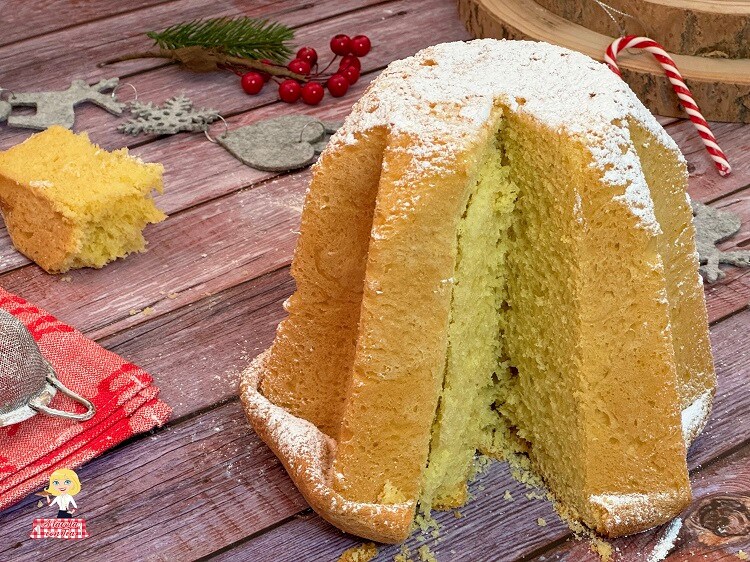
NOTES
BUTTER Use butter with a soft, spreadable consistency. Take it out of the fridge at least 1 hour before to soften to room temperature and do not use the microwave because it should not be liquid or warm.
EGGS All ingredients, including the eggs, should be at room temperature. In this case the weight of the eggs is also important because commercial sizes vary.
FLOUR For this preparation the suitable flour is Manitoba flour, more appropriate for doughs requiring long leavening. Do not replace it with common all-purpose flour (00) as you won’t get the same result.
CITRUS ZEST The aroma and fragrance they provide give homemade pandoro an extra boost: you can use orange zest, lemon zest, or a mix of both.
VANILLIN Instead of one packet of vanillin, one teaspoon of vanilla extract also works well.
LEAVENING Always let doughs rise covered with plastic wrap in a warm place away from drafts. Depending on ambient temperature, rising times vary: pay attention to how the dough behaves more than to the clock.
DECORATION before dusting the pandoro with powdered sugar, wait until it is completely cool or the sugar will melt.
SERVING TIPS Pandoro is delicious as is, but you can serve it with a MASCARPONE CREAM or with PASTRY CREAM or slice it and fill it.
INGREDIENTS LIST FOR PANDORO (1 KG MOLD)
The scaled ingredient list is as follows:
biga: 60 g Manitoba flour (about 1/2 cup), 40 ml water (about 2 3/4 tbsp), 5 g dry baker’s yeast (about 1 3/4 tsp) or 15 g dry
dough: 400 g Manitoba flour (about 3 1/3 cups), 170 g butter (3/4 cup), 150 g sugar (3/4 cup), 50 ml water (about 3 1/2 tbsp), 2 whole eggs, 3 yolks, 5 g salt (about 1 tsp), 1 packet vanillin, zest of lemon and orange
STORAGE
Air is the enemy of all leavened products, so once ready my advice is to seal the homemade Pandoro immediately by placing it, without powdered sugar, in a food bag (like the ones you buy) or wrap it tightly in plastic wrap. Once sliced, always reseal perfectly each time if you want it to stay soft.
FAQ (Questions & Answers)
My dough won’t develop a good ‘in cord’ stage — what should I do?
Development (incordatura) is essential. If the dough remains sticky, continue kneading at medium speed; mixing time in the mixer may vary depending on the flour and humidity. Do not add flour! Another common mistake is not having used all ingredients (butter, eggs, etc.) at room temperature.
After 5 hours nothing has risen — how can I speed up the rise?
Rising depends on temperature. Make sure the environment is warm (ideal 26–28°C, about 79–82°F) and free of drafts. If your oven has a “proof” function, use it. Otherwise, try leaving it to rise for another 1–2 hours, trusting the volume (it should approximately triple) more than the clock.
Can I make Pandoro without a stand mixer?
This recipe is designed for a mixer, but it’s possible to do it by hand. It will require much more time and effort to achieve the necessary development and gluten structure for softness.
My Pandoro turned out dry. What went wrong?
This is often caused by overbaking or moisture loss. Check the exact temperature with an oven thermometer and do not exceed 55 minutes. Also, after cooling, seal it immediately in a food bag (without powdered sugar) as advised in the Storage section.
