
PASTA Carbonara
April 6 this year for lovers of cooking and good food will be an “important” date: the Pasta alla Carbonara recipe turns 70!
For some time now this date has been nicknamed CARBONARA DAY, a day in which this very famous dish is celebrated with pan battles, disputes between purists and innovators, “NO pancetta YES guanciale” committees, only yolks or whole eggs, cream or no cream, spaghetti or rigatoni…
This recipe, if you haven’t guessed, has always been a source of discussion because everyone claims their own version; everyone agrees when it’s time to celebrate it but they are divided when it comes to preparing it.
For this year’s celebrations I was chosen together with other bloggers to pay tribute to this renowned dish that the whole world envies us for: 70 food bloggers for the 70 years of Pasta alla Carbonara will post video recipes throughout the week dedicated to the festivities.
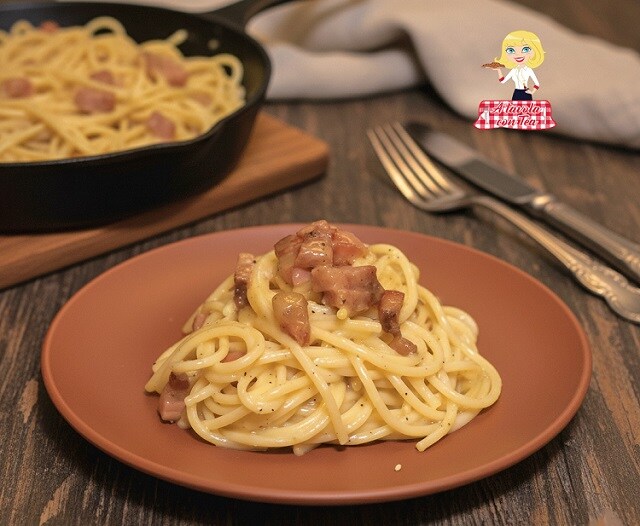
Honored by this assignment, today I propose the Pasta alla Carbonara Recipe which, at least in the choice of ingredients, tries as much as possible to be traditional: guanciale (cured pork jowl), Pecorino Romano PDO, eggs, freshly ground black pepper.
How do I deviate from the original recipe? In the pasta shape, which I purposely chose in a heart shape for this particular occasion, and I hope Romans won’t crucify me for this poetic license.
But how does the magic of carbonara arise? The secret for a perfect result — a creamy Carbonara where all the ingredients are perfectly bound together without creating a scrambled-egg effect — is first to make a balanced cream of yolks, cheese and pasta cooking water and then a few little tricks that I will reveal in the procedure.
Follow me and you’ll see that you will cook one of the best PASTA Carbonara dishes you have ever prepared: creamy, enveloping and full of flavor!
Other iconic recipes of the Italian tradition
- Difficulty: Easy
- Cost: Medium
- Preparation time: 15 Minutes
- Cooking time: 15 Minutes
- Portions: 4
- Cooking methods: Stovetop
- Cuisine: Italian
- Energy 676.01 (Kcal)
- Carbohydrates 24.86 (g) of which sugars 0.45 (g)
- Proteins 21.43 (g)
- Fat 54.00 (g) of which saturated 18.43 (g)of which unsaturated 22.31 (g)
- Fibers 1.57 (g)
- Sodium 1,601.30 (mg)
Indicative values for a portion of 100 g processed in an automated way starting from the nutritional information available on the CREA* and FoodData Central** databases. It is not food and / or nutritional advice.
* CREATES Food and Nutrition Research Center: https://www.crea.gov.it/alimenti-e-nutrizione https://www.alimentinutrizione.it ** U.S. Department of Agriculture, Agricultural Research Service. FoodData Central, 2019. https://fdc.nal.usda.gov
Ingredients
- 11 oz pasta (spaghetti or rigatoni)
- 7 oz guanciale (cured pork jowl)
- 3.5 oz Pecorino Romano (PDO)
- 4 pasteurized egg yolks
- 2 eggs (whole, pasteurized)
- to taste black pepper
Tools
- Bowl
- Pan
- Pan
Before you start
IMPORTANT. To eat Pasta Carbonara completely safely use only pasteurized eggs. You can buy yolks already pasteurized or proceed at home with pasteurization (see the NOTE at the end of the recipe for the Egg Pasteurization method).
Carefully clean the guanciale, removing all rind by scraping away some of the pepper from the surface with the knife blade. Cut it into slices about 3/8 in (1 cm) thick and then into cubes about 3/8 in (1 cm). Put the guanciale to toast in a very hot pan over high heat, WITHOUT oil or butter. Wait, without stirring, until the first fat has melted, then lower the heat, stir and let the fat finish melting completely. The guanciale should become crispy (this will take about 15 minutes). Drain the guanciale, reserving the rendered fat in a bowl and the cubes on a plate, and let both cool.
For EGG PASTEURIZATION see the note at the bottom of the recipe.
Once the eggs are pasteurized, put the yolks and the whole eggs in a bowl and beat them with a fork or a whisk. Add the cooled rendered fat from the guanciale, a generous grind of black pepper and finally the grated Pecorino. Mix everything well with the fork: it must become a thick, homogeneous cream.
Meanwhile cook the pasta in plenty of water, not too salty since the seasoning is already quite flavorful. At halfway through cooking, remove two ladles (about 1 cup / 240 ml) of the cooking water and put them in a bowl to cool — you will need them later to emulsify the pasta (the water is taken halfway through cooking so it has time to cool; otherwise in contact with the eggs it would create a nice omelet!). Drain the pasta al dente.
Pour the reserved pasta cooking water into the bowl with the egg cream and mix quickly. Transfer the just-drained pasta into the bowl with the seasoning and toss quickly with a spoon to combine. Add the warm guanciale and mix again. It is important to perform this operation quickly to avoid the yolk coagulating and taking on the texture of scrambled eggs. Serve immediately on very hot plates.
REMEMBER: The magic of a perfect carbonara lies in that intense minute of emulsifying the eggs, cheese and guanciale fat with the pasta cooking water and the pasta’s gluten.
CHOOSING INGREDIENTS AND MISTAKES TO AVOID
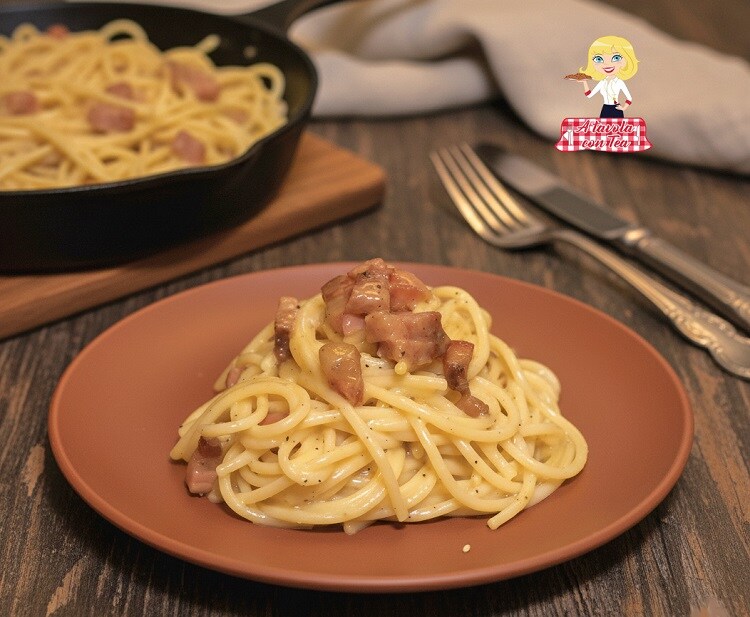
GUANCIALE: For the traditional recipe, pancetta or bacon should not even be considered; that said, the choice of guanciale is important. First of all buy it in a single piece, not already cut into cubes or slices. In theory, the amount of guanciale should be about the same weight as the pasta (for example: 200 g pasta = 200 g guanciale, roughly 7 oz of each). Remove the rind and scrape away some of the aromas (pepper and spices) on the surface because they can make it too salty. Then cut the guanciale into cubes of about 3/8 in (1 cm).
PECORINO Romano PDO: it is an indispensable ingredient because of its typical rustic and salty flavor.
YOLKS: In this recipe I used 4 yolks and 2 whole eggs for 4 people; I know it seems like a lot but I assure you it’s needed. If you don’t buy pasteurized eggs you can pasteurize them at home simply by heating them in a bowl over a bain-marie, taking care that the egg temperature does not exceed 140°F/149°F otherwise it may curdle.
TYPE OF PASTA: Whatever shape you choose, obviously use high-quality pasta; you can opt for Spaghetti or Rigatoni, preferably bronze-drawn so they hold the cooking perfectly.
PEPPER: Black or white pepper! Freshly ground on the plate or added to the eggs.
MISTAKES TO AVOID:
Please note: to make your carbonara more substantial you DO NOT need to add cream! Simply a little pasta cooking water, rich in starch, will give you the right consistency.
NEVER add the egg sauce into a boiling pan or, even worse, into a pan on the heat, otherwise you will ruin all the work done so far and you will end up with a nice omelet effect!
HOW TO PASTEURIZE EGGS
Pasteurization is the process that reduces the bacteria present inside raw eggs, such as salmonella. It is an essential procedure for those who want to prepare carbonara, but also for all other recipes with raw eggs like tiramisù. It is important to know that pasteurizing eggs does not alter their characteristics but simply allows them to be used safely.
How to pasteurize whole eggs
Heat the eggs in a bain-marie to 149°F (65°C) for about 5 minutes. Then cool them immediately by placing them in the refrigerator until ready to use.
How to pasteurize only the yolks
For carbonara it is sufficient to pasteurize only the yolks. To do this, add two or three tablespoons of warm water (the water you will later use to boil the pasta works fine) to the yolks and pasteurize them in a bain-marie at 140°F (60°C), whisking them lightly for a couple of minutes. At this point the yolks are ready to use.
VARIATIONS (only one allowed!)
TYPE OF PASTA In addition to the classic spaghetti, you can also use rigatoni or mezze maniche. I, just for today forgive me, for this special birthday of the recipe gave in to the “rubacuori” (heart-stealing) format.
STORAGE
Pasta Carbonara must be eaten immediately. Any form of storage is discouraged also because if reheated later the egg would cook!
