
Peperonata is the classic summer side dish made with a few fresh, genuine ingredients such as bell peppers, onion and tomatoes.
Probably every Italian family keeps its own recipe; in fact, there are many different versions.
A quick recipe with an intense, savory flavor and a creamy texture — an absolute delight.
What I propose today is the PEPERONATA recipe passed down from my grandmother: simple and colorful, ideal to accompany countless dishes. Great warm but also served at room temperature to accompany mixed cold cuts and cheeses.
A quick and delicious summer side made with fresh, genuine ingredients; moreover, bell peppers are a source of potassium, very low in calories and rich in vitamins such as vitamin C and B.
Peperonata can also be enjoyed as a pasta sauce, to top bruschetta, as a base for a soup or as an ingredient in a chicken main course.
This recipe can be a quick and healthy solution for lunch or dinner: a tasty, colorful dish rich in nutrients.
When buying peppers, I recommend choosing firm peppers with bright color and smooth skin — all signs of freshness. As always, try to consume them as soon as possible.
Ready to prepare PEPERONATA Grandma’s recipe? I almost forgot — at the end of the recipe I leave you all the TIPS to make the peperonata easier to digest!
Below I leave some recipes I’m particularly fond of from my grandmother’s recipe book.
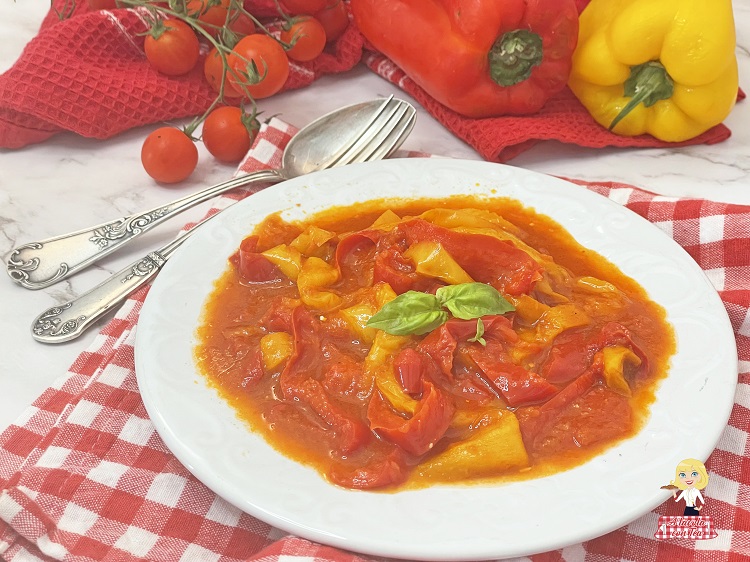
- Difficulty: Very easy
- Cost: Economical
- Preparation time: 15 Minutes
- Cooking time: 20 Minutes
- Portions: 4
- Cooking methods: Stovetop
- Cuisine: Italian
- Energy 91.41 (Kcal)
- Carbohydrates 10.73 (g) of which sugars 3.17 (g)
- Proteins 1.90 (g)
- Fat 5.17 (g) of which saturated 0.72 (g)of which unsaturated 0.19 (g)
- Fibers 2.57 (g)
- Sodium 337.68 (mg)
Indicative values for a portion of 100 g processed in an automated way starting from the nutritional information available on the CREA* and FoodData Central** databases. It is not food and / or nutritional advice.
* CREATES Food and Nutrition Research Center: https://www.crea.gov.it/alimenti-e-nutrizione https://www.alimentinutrizione.it ** U.S. Department of Agriculture, Agricultural Research Service. FoodData Central, 2019. https://fdc.nal.usda.gov
WHAT YOU NEED TO MAKE PEPERONATA
- 2 cups tomato purée
- 2 bell peppers (red)
- 1 bell pepper (yellow)
- 2 yellow onions (medium)
- 1 clove garlic
- 2 tablespoons extra virgin olive oil
- to taste salt
Tools
- Frying pan
HOW TO PREPARE PEPERONATA
Wash the peppers, dry them with a cloth, then remove the core and the white inner part that contains the seeds. Cut the peppers into strips and do the same with the onions.
In a non-stick pan add 2 tablespoons of extra virgin olive oil, heat it, then add the onion and the garlic clove. Cook over medium heat for about 7–10 minutes, then add the peppers and a pinch of salt. Stir and continue cooking for another 5 minutes.
Lower the heat, add the tomato purée, stir and continue cooking the peperonata over low heat with the lid on for about 20 minutes, until the peppers have softened. Remove the lid, adjust the salt and finish cooking for another 5 minutes so the peperonata reduces a little. Serve the peperonata hot, warm or cold depending on how you want to use it — it will be delicious in any case and you may want to mop up the sauce with bread at the end.
Follow my Instagram page by clicking HERE
NOTES
BELL PEPPERS There is no strict rule for choosing the peppers; using different colors depends solely on the dish’s appearance. Feel free to choose the type of pepper you prefer.
TOMATOES Instead of tomato purée you can use peeled canned tomatoes or fresh tomatoes, provided they are ripe.
SPICES This recipe does not call for spices, but if you like spicy flavors you can add a little chopped fresh chili pepper.
STORAGE
Once ready, peperonata can be stored in the refrigerator in a closed container for 2–3 days. Alternatively, it can be frozen for up to 1 month.
TIPS TO MAKE PEPERONATA EASIER TO DIGEST
I love the Peperonata made with my grandmother’s recipe, but let’s be honest — it isn’t the easiest to digest, at least for me.
Some ingredients contain compounds that are harder to digest: peppers contain solanine, onions have fibers and garlic contains allicin. Nevertheless, peperonata remains one of the most appreciated dishes of our Italian cuisine. So the question is: can peperonata be made easier to digest? The answer is yes, and now I’ll explain all the tricks to make peperonata more digestible.
FIRST TIP: remove the pepper skin. You can peel them raw with a vegetable peeler — this not only makes them less indigestible, but they will also cook in half the time. Alternatively, roast them in the oven or over a flame to char the skin and remove it more easily. Also remember to remove all the white inner filaments and seeds because those are indigestible as well.
SECOND TIP: If you really cannot give up the onion because you love the traditional flavor, use Tropea red onion instead of white. Alternatively, you can replace it with leek. If you keep the onion, cut it diagonally instead of parallel to the fibers to avoid leaving the fibers intact, which makes them harder to digest.
THIRD TIP: Garlic in peperonata. You can cook the garlic whole with the skin on and remove it before serving, or split the cloves and remove the inner green germ that slows digestion. Finally, in some regional versions of peperonata garlic is not used at all — feel free to omit it if you don’t like it, without fear of being judged.
PEPERONATA FREQUENT QUESTIONS AND ANSWERS
I’m almost certain that if you were in a group of friends discussing peperonata recipes, many variants, procedures and interpretations would come up — as many as there are participants, leaving you bewildered. That’s normal in cooking, especially for home-tradition recipes. So I decided to list common doubts and questions about the PEPERONATA RECIPE and offer possible answers and solutions.
What COLOR peppers should you choose for peperonata?
Some might say a pepper is a pepper, but color matters. Yellow peppers are sweeter, red peppers — especially deep red — have a more intense, almost spicy flavor, and green peppers can be slightly bitter. When preparing peperonata I recommend mixing red and yellow peppers for a balanced taste, and adding green peppers (perhaps in smaller quantities) if you like more intense flavors.
How to CUT the peppers for peperonata?
The choice is between cutting peppers into strips, wedges or cubes. Cubes are just square pieces, larger or smaller; strips are slices about 1/2 inch wide and as long as the pepper; a wedge is the slice that runs the length of the vegetable and is about 2–3 finger-widths wide (about 1–1.5 inches).
If you want a chunkier dish that requires more cooking time, cut the peppers into wedges. If you prefer a versatile peperonata that can be used both as a side and as a pasta sauce, cut the peppers into strips. Personally, I avoid cubes because they reduce the perceived “volume and texture” of the peperonata, but to each their own…
Should peperonata be made with GARLIC or ONION?
There’s no definitive answer: it’s a matter of taste and you can use both. The only thing to watch is how you add them. If you like garlic’s flavor but don’t want it too strong, keep it whole and crushed or at most halved. If you finely chop garlic, the peperonata will take on a stronger garlic flavor that not everyone likes.
I prefer to slice the onion into rings and then halve them to obtain strips similar to the peppers. Choose the type of onion — yellow, white, red or shallot — according to taste.
Should peppers in peperonata be WITH or WITHOUT skin?
This is more a question of digestibility than taste. If you have no digestion problems, you can leave the skin on — it gives the peperonata structure and prevents the pepper strips from falling apart. If you are like me and have difficulty digesting them, I recommend peeling the peppers before preparing peperonata. You can char them briefly over a high flame or blanch them in water and then peel them. Don’t cook them twice, otherwise they will become too soft.
FAQ (Questions and Answers)
How do you freeze peppers?
You can freeze peppers: wash them, remove seeds and inner filaments, dry them well, cut them into strips or wedges and put them in freezer bags.
Why are peppers hard to digest?
What makes them hard to digest is the fibrous complex that lines the flesh — the transparent membrane commonly (and incorrectly) called the “skin.” By removing it before cooking, peppers are no less digestible than other vegetables.
