
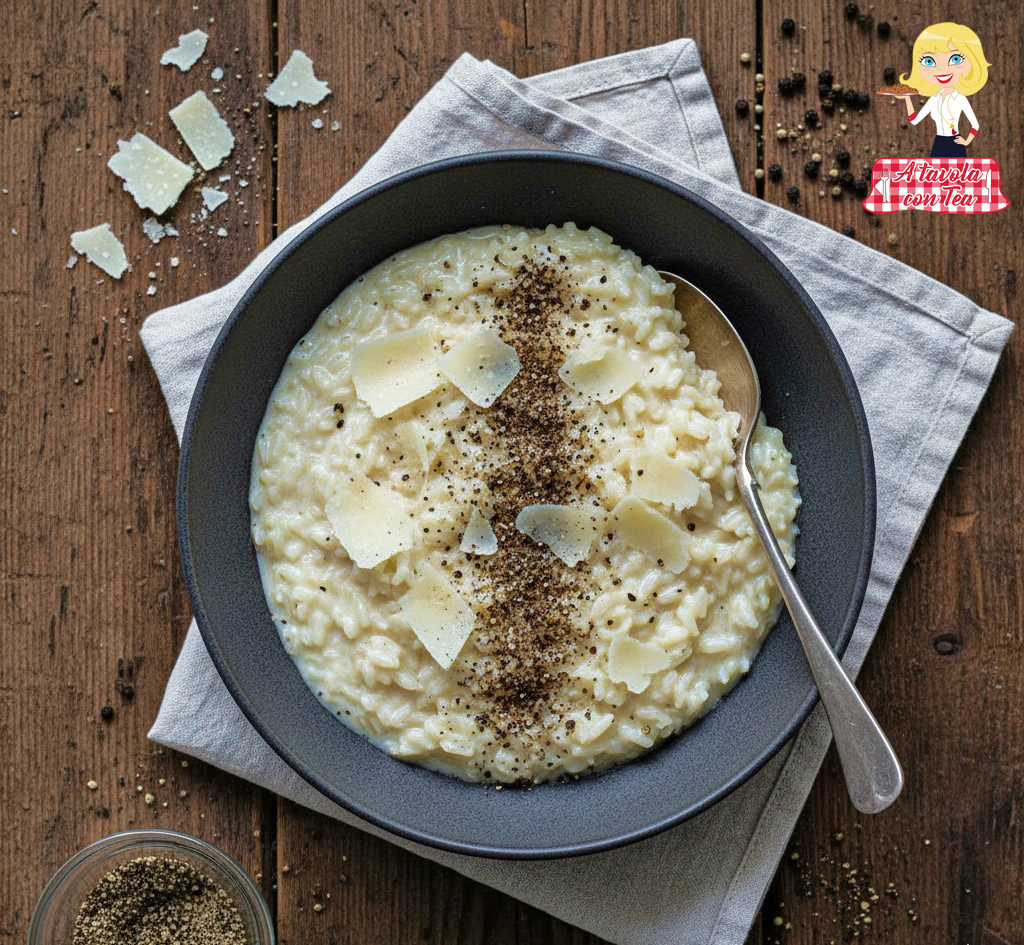
Perfect Cacio e Pepe Risotto: The Secret of the Creamy Wave
Cacio e Pepe Risotto epitomizes simplicity, yet it is also one of the most feared dishes. Why?
Because if you get the creaming wrong, instead of achieving the famous and delicious “wave” creamy texture, you end up with a sticky mass.
The real difficulty lies not so much in the ingredients (few and essential), but in managing the starch released by the rice and the fat from the Pecorino cheese.
The secret to achieving a tasty yet balanced flavor for cacio e pepe risotto lies in two often overlooked steps.
The first is using a “reinforced” broth with Pecorino crust: this broth, which has the cheese’s flavor, enhances the final taste. The second is toasting the pepper, which releases an unmistakable aroma.
But the real trick to achieving a risotto with a creamy consistency is in the final stage: the creaming off the heat with the gradual addition of fats and Pecorino cheese.
With my method, I will guide you through all the steps, from preparing the aromatic broth to the exact moment to turn off the heat and bring to life the magic wave.
A simple dish, but of absolute precision!
- Difficulty: Easy
- Cost: Economical
- Preparation time: 15 Minutes
- Portions: 4
- Cooking methods: Stovetop
- Cuisine: Italian
Ingredients for Cacio e Pepe Risotto (4 Servings)
- 6 cups water
- 1 shallot
- to taste Pecorino Romano (crust to enrich the broth to be discarded)
- to taste coarse salt (use sparingly due to high saltiness of other ingredients)
- to taste whole black peppercorns (To flavor the broth to be discarded)
- 11.3 oz Carnaroli rice
- 3.5 oz Pecorino Romano
- 3.2 tbsp butter
- 1 tbsp whole black peppercorns (Toasted and crushed)
- Pecorino Romano (in flakes)
- whole black peppercorns (Coarsely ground)
Tools
- Food scale
- Pot
- Pan
- Mortar
- Pot
- Sieve
PERFECT CACIO E PEPE RISOTTO The Secret of the Creaming Wave
Crust and Shallot: Remove the Pecorino crust and set it aside (for the broth). Peel the shallot and cut it in half.
Toasting and Broth: Toast the shallot at the bottom of a large pot to intensify its aroma. Then add water, whole peppercorns (to taste for the broth), coarse salt, and the Pecorino crust.
Broth Cooking: Let it simmer for 30-40 minutes. Using a fine-mesh skimmer, remove the shallot, pepper, and Pecorino crust. Keep the broth warm.Pepper Toasting: Toast the tablespoon of whole black peppercorns in a non-stick pan for a couple of minutes, without adding fat and moving them continuously to prevent burning.
Grinding: Transfer the toasted pepper to a mortar and crush it into a powder. Set a pinch aside for the final garnish.
Pecorino: Finely grate the 3.5 oz of Pecorino Romano DOP and set aside.Dry Toasting: Pour the Carnaroli rice into a hot pot and dry-toast it (without fats) for about 2-3 minutes, until the grains are hot to the touch.
Cooking: Begin to wet with the hot broth, covering the rice. Continue cooking, adding more hot broth as needed, as the previous is absorbed. The rice will be cooked after about 15-18 minutes.Turn Off: When the rice is al dente and still has a little broth, turn off the heat.
Cold Butter: Add the butter (3.2 tbsp) in cubes and let it melt by stirring vigorously.
Pecorino and Pepper: Immediately add the grated Pecorino and almost all the crushed pepper. Stir very quickly and with energy, creaming off the heat for about a minute. The movement should be energetic to create the emulsion (the wave).
Rest and Serve: Let it rest for 1 minute, then serve immediately.Plating: Pour the risotto into the bowl with a decisive movement so that it spreads naturally creating the wave.
Decoration: Decorate with the reserved ground pepper and some Pecorino flakes. Serve immediately.
Notes on Ingredients and Substitutions
Rice: Carnaroli is essential. It has a high starch content and excellent cooking hold, indispensable for the Cacio e Pepe emulsion. Replacing it with common rice would compromise the creaming.
Pecorino: It must be Pecorino Romano DOP and grated very finely. If coarsely grated, it will struggle to melt. Do not add alternative cheeses, it would alter the taste and emulsion.
Broth: The secret to keeping the risotto from being too salty is to add salt to the broth after adding the Pecorino crust (which is already very salty).
Storage and Reheating
Storage: Cacio e Pepe Risotto is a dish that should never be stored. Once cold, it loses its creaminess and the wave cannot be recovered.
Advance with the Broth: If you need to prepare in advance, you can make the broth up to 2 days before and store it in the refrigerator.
Perfect Use and Pairings
Wine Pairing: A dry white wine, such as a Frascati or Fiano, pairs perfectly with the saltiness and the spicy note of the pepper.
Second Course Pairing: Being a very rich dish, it pairs well with fresh vegetables or a light second course, such as a slice of grilled white meat.
FAQ (Questions and Answers)
1. Why did my risotto come out “sticky” instead of “creamy”?
A: You probably creamed it over heat or didn’t allow resting time. The creaming should be done off the heat to prevent the starches from cooking too much and becoming sticky. Excessive heat sets the starch too quickly.
2. The Pecorino formed lumps during creaming. What did I do wrong?
A: This happens when the Pecorino is too cold or the rice is too hot. The secret is to ensure that the Pecorino is at room temperature and that the creaming occurs off the heat. If necessary, you can add a little cold broth to slightly lower the temperature of the mass before adding the Pecorino.
3. Can I use Parmesan instead of Pecorino?
A: While it’s possible, it’s not the authentic recipe. Pecorino Romano is essential for the saltiness and intensity that characterize the dish. Moreover, it behaves differently from Parmesan in emulsion. I recommend sticking with Pecorino for the original result.
