
PERFECT OVEN ROAST BEEF foolproof EASY recipe
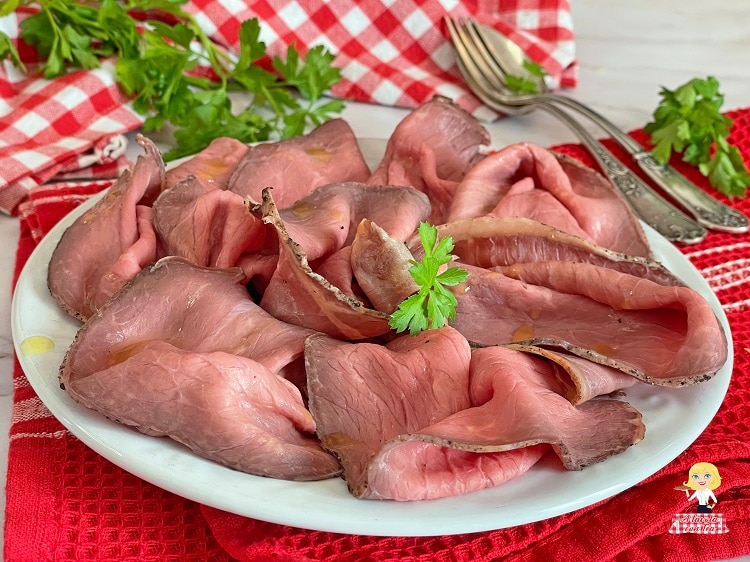
Perfect Roast Beef in the Oven: the foolproof recipe for tender, juicy meat with a golden crust.
The recipe I had been waiting for and finally found
I admit I was never particularly good at preparing roasts and roast beef — to be honest I was always hopeless.
Once married, both my husband and my son clearly let me know they love meat and especially roast beef. I tried several times to make it but with poor results.
You have no idea how many attempts I made but nothing worked: it was either too rare, overcooked, or tough as a shoe sole… I was almost ready to give up when I stumbled almost by chance on this recipe and it was a revelation.
I can finally say that after many years I cooked a perfect roast beef! I followed the recipe exactly and it turned into the best roast I have ever tasted.
A foolproof recipe, and if I could do it, believe me anyone can. A few simple tricks to obtain a flavorful and succulent roast beef, with little fat, slightly golden on the surface, worthy of the best delis.
If you too have never managed to make good roast beef and were about to throw in the towel, don’t do it!
- Difficulty: Easy
- Cost: Medium
- Rest time: 30 Minutes
- Preparation time: 15 Minutes
- Cooking time: 40 Minutes
- Portions: 8
- Cooking methods: Oven
- Cuisine: Italian
- Energy 315.71 (Kcal)
- Carbohydrates 8.83 (g) of which sugars 0.02 (g)
- Proteins 42.53 (g)
- Fat 13.39 (g) of which saturated 3.12 (g)of which unsaturated 0.01 (g)
- Fibers 0.17 (g)
- Sodium 3,160.83 (mg)
Indicative values for a portion of 200 g processed in an automated way starting from the nutritional information available on the CREA* and FoodData Central** databases. It is not food and / or nutritional advice.
* CREATES Food and Nutrition Research Center: https://www.crea.gov.it/alimenti-e-nutrizione https://www.alimentinutrizione.it ** U.S. Department of Agriculture, Agricultural Research Service. FoodData Central, 2019. https://fdc.nal.usda.gov
Ingredients
- 4 lbs Beef (cut for roast beef)
- 4 tbsp Extra virgin olive oil
- 1 tbsp Rosemary (fresh, chopped)
- 1 tbsp Thyme (fresh, chopped)
- 4 tsp Fine salt (for coating)
- 1 tsp Black pepper (freshly ground)
Tools
- Bowl
- Casserole
- Thermometer
Preparation
MEAT REST BEFORE COOKING Recommended but optional.
Place the meat on a rack set over a baking tray and leave it uncovered in the refrigerator for at least 1 hour. This little trick helps achieve a great crust and better browning. The circulating air in the fridge dries the surface of the meat slightly before the roast goes into the oven, so it browns much faster. I know it may seem silly, but it works. In any case this step is optional, but I highly recommend it.
Preheat the oven to 374°F. While the oven is coming to temperature, prepare the marinade for the meat. Mix the olive oil, garlic, rosemary, thyme, salt and pepper in a small bowl. Pour it over the meat and massage it all over the surface. Keep in mind the golden rule: 1 teaspoon of salt per 2.2 lbs of beef and adjust according to the size of your roast.
When the oven reaches temperature, roast the meat but place it on a rack that sits over a baking tray, not in direct contact with it so there is space between the rack and the pan.
If you have a probe to measure the internal temperature of the meat, this is the time to insert it; otherwise any instant-read kitchen thermometer will do — or none at all!
As for cooking times, a rule of thumb is about 9 minutes per pound of meat in a convection oven at 374°F. I still prefer to check doneness with a probe. The internal temperature at the center should be between 140°F and 149°F.
Cooking on a rack in a convection oven lets you skip the searing step in a pan, but if you prefer you can sear first and then finish cooking in a conventional oven.At this point you might be tempted to slice the meat and serve it straight out of the oven. Don’t: the juices will escape. Instead, wrap the roast in aluminum foil and let it rest for 30 minutes to allow the juices to redistribute inside the roast. Transfer the roast to a cutting board and slice it across the grain into thin slices. And there you have it: tender roast beef with a beautifully deep golden crust.
Perfect Roast Beef: What Is the Best Cut of Meat for Roast Beef? (And How to Cook It)
One of the most common mistakes is choosing a cut that is too lean or not suitable for quick roasting. For a roast beef that stays tender and doesn’t dry out, it’s essential to opt for cuts from the loin or rump with good marbling (intramuscular fat) or with a layer of external fat that protects the meat.
The top choice is undoubtedly the Sirloin (or Loin), which guarantees juiciness and intense flavor. Other excellent alternatives are the Rump or the Eye of Round: these are leaner cuts but can be equally tender, provided you monitor the internal temperature carefully and ensure it does not exceed 126–131°F (rare) to avoid drying the fibers. Always ask your butcher for a piece with a uniform shape, at least about 2.2 lbs, to ensure even cooking.
TIPS:
TYPE OF MEAT: I use beef. Also, for a good roast beef you need to buy a large cut around 4–4.4 lbs, lean and with a uniform shape. My favorite is the Sirloin (or Loin) but the Eye of Round or Rump are also fine. If in doubt, always ask your butcher — they will advise you on the best cut available that day.
OLIVE OIL: A bit of oil is necessary to turn the garlic and herbs into a paste that can be spread over the roast. Oil also conducts heat, helping form the crust.
GARLIC: Garlic is important to give flavor to your roast beef, but if you really can’t stand it or don’t digest it, you can omit it — just don’t forget the herbs.
HERBS: I chose the classic combination of thyme and rosemary, but feel free to swap in one of your favorite herbs (sage, parsley, oregano, etc.) or use dried herbs if you prefer.
SALT: Large cuts of meat require a generous amount of salt. A good practical rule is to use 1 teaspoon of salt per 2.2 lbs of beef.
BLACK PEPPER: Use freshly ground black pepper — it has a much better aroma and flavor than pre-ground pepper.
STORAGE
Leftover roast beef can be stored in an airtight container in the refrigerator for 3 to 4 days. To help the meat retain moisture, leave leftovers un-sliced until you’re ready to reheat them. To freeze, wrap leftovers in plastic wrap and store them in a freezer bag for up to 3 months.
Tips for the Perfect Roast Beef
Preparing an impeccable roast beef isn’t difficult, but it requires attention to a few fundamental details. Here are my secrets for meat that’s always tender, juicy and with the golden crust everyone loves.
Internal Temperature: The Real Secret to Perfect Roast Beef
Forget generic cooking times! The real secret to a perfectly cooked roast beef, exactly how you want it, is to monitor the internal temperature of the meat with a kitchen thermometer. Every degree counts to get the ideal result.
Resting the Meat: An Indispensable Step
Never underestimate the importance of resting! Once out of the oven, your roast beef is not yet ready to be sliced. Letting it rest wrapped in foil allows the juices to redistribute evenly inside the meat, making it incredibly more tender and juicy. This step prevents all the precious liquids from pouring out when you cut it and leaving the meat dry.
Initial Searing: For a Golden, Flavorful Crust
Before roasting, a quick, intense sear in a hot pan is essential to seal in the meat’s juices and create that delicious exterior crust that adds flavor and texture to your roast beef. Make sure the pan is very hot and the meat is dry for perfect browning.
Slicing the Meat: Cut with Skill
To serve your roast beef at its best, it’s important to slice it correctly. Use a sharp knife and always cut against the grain in thin slices. This will ensure maximum tenderness in every bite.
What is the best cut of beef for roast beef?
There isn’t a single perfect cut for roast beef. The most commonly used cuts come from the leaner parts of the animal. These include the round, top side and bottom side muscles. Recommended cuts for roast beef typically are sirloin (top loin), eye of round, rump and top round. If you’re unsure, ask your butcher — they’ll point you to the best cut available that day for preparing roast beef!
How long should I cook my roast beef?
It depends on two things: the size of your roast and the desired doneness. My roast of about 4 lbs after 1 hour and 30 minutes was well done for about the outer 0.4″ and pink in the rest. If you want it medium, keep it in the oven (same weight) for about 1 hour and 45 minutes. Roast beef should not be overcooked — it should still retain some pink.
How do I use a thermometer to measure the internal temperature of the meat?
The best way to get an accurate reading is to insert the thermometer deeply enough to reach the center of the roast beef. For rare it should reach about 129°F; for medium the internal temperature should be around 144–145°F.
What can I do with leftover roast beef?
One of my favorite ways to use leftover roast beef is in a classic sandwich with tartar sauce or tuna sauce and a few leaves of lettuce.
How can you tell when roast beef is cooked to perfection?
The most reliable method is to use a probe kitchen thermometer. Insert it into the thickest part of the meat, avoiding bone. The internal temperature will indicate the desired degree of doneness (see our temperature guidelines).
Can I prepare roast beef in advance?
Yes, you can prepare it in advance and keep it in the refrigerator. It’s also excellent cold, thinly sliced. If you want to serve it warm, you can gently reheat it in the oven for a few minutes before serving.
How do you store leftover roast beef?
Leftover roast beef keeps in an airtight container in the refrigerator for 3–4 days. To keep it juicier, it’s best to slice it only when you’re ready to eat. It can also be frozen, preferably already portioned, in a freezer bag for up to 3 months.
