
Pesto with Celery Leaves: The Ingenious Zero-Waste Recipe That Will Win You Over!
Dear blog friends, today I bring you into the kitchen with one of those ideas I particularly love: a delicious, healthy, and, above all, super zero-waste condiment!
Who among us hasn’t had a nice celery stalk in the refrigerator, maybe used for a soffritto, and then ended up “ignoring” or, worse, throwing away its leaves? Well, get ready to change your perspective completely!
Often we consider celery leaves a simple waste, but that’s a big mistake! This part of the plant is not only incredibly flavorful — with an aroma more intense and fresher than the stalk — but it’s also rich in nutritional properties.
Yes, you read that right: more than the stalk! So, in the spirit of “nothing is thrown away in the kitchen,” today I’ll reveal how to turn them into a fantastic pesto.
This pesto with celery leaves is a true revelation. It’s the perfect idea for a last-minute “save-dinner,” because it’s ready in the time it takes to cook the pasta, turning into a healthy and genuine sauce.
But that’s not all! It’s also delicious spread on crispy bruschetta, to enrich crostini, or to add an extra touch to steamed vegetables.
Personally, I’ve tried several variations — with walnuts, with pine nuts — but I must say my heart beats strongest for the version with almonds, which add a creaminess and sweetness that’s truly special.
Are you ready to give celery leaves a new life and bring a unique and surprising flavor to the table?
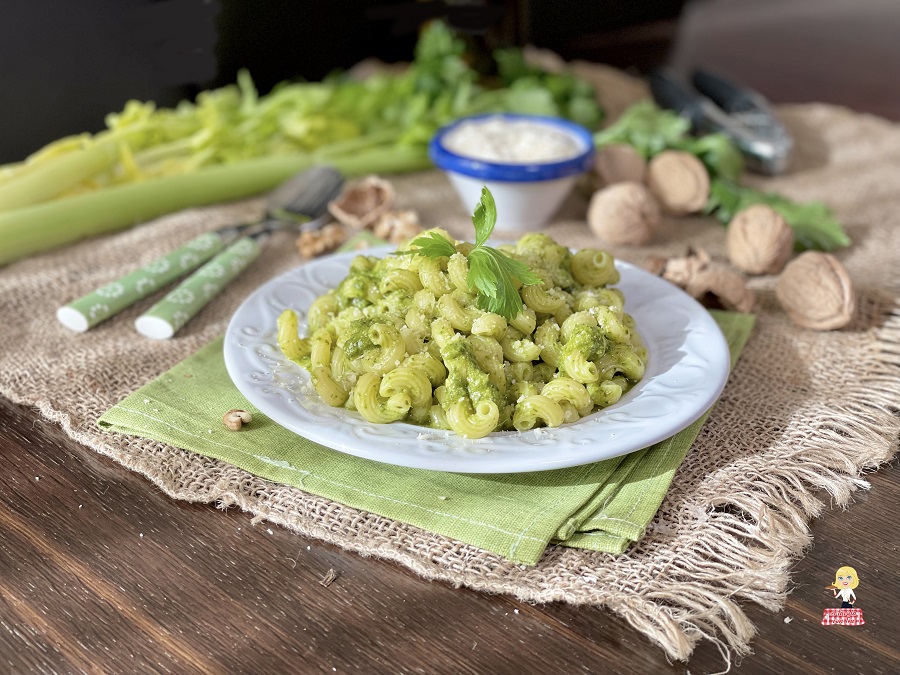
- Difficulty: Very easy
- Cost: Very inexpensive
- Preparation time: 15 Minutes
- Portions: 4
- Cooking methods: No-cook
- Cuisine: Italian
- Energy 266.88 (Kcal)
- Carbohydrates 4.01 (g) of which sugars 0.90 (g)
- Proteins 5.07 (g)
- Fat 27.01 (g) of which saturated 4.77 (g)of which unsaturated 5.52 (g)
- Fibers 2.00 (g)
- Sodium 1,044.90 (mg)
Indicative values for a portion of 50 g processed in an automated way starting from the nutritional information available on the CREA* and FoodData Central** databases. It is not food and / or nutritional advice.
* CREATES Food and Nutrition Research Center: https://www.crea.gov.it/alimenti-e-nutrizione https://www.alimentinutrizione.it ** U.S. Department of Agriculture, Agricultural Research Service. FoodData Central, 2019. https://fdc.nal.usda.gov
Ingredients for PESTO with CELERY LEAVES
- celery (about 3.5 oz total (approximately 3.0 oz leaves and 0.7 oz tender stalk))
- almonds (about 1.8 oz (approximately 1/3 cup) peeled almonds)
- Pecorino cheese (about 1.4 oz (≈1/3 cup) grated Pecorino)
- garlic (1 clove)
- to taste salt
- extra virgin olive oil (4–5 tbsp)
Tools
- Kitchen scale
- Blender
How to prepare Pesto with Celery Leaves
First of all, wash the celery very thoroughly, both the leaves and the tender central part of the stalk. Dry it well.
Coarsely chop the celery so it’s easier to blend.
In the blender jar (or food processor), place the chopped celery, the peeled almonds and the garlic clove (if you don’t like a strong garlic flavor, you can remove the central germ or use only half).Now add 4–5 tablespoons of extra virgin olive oil and a pinch of salt.
Start blending in short bursts.It is essential not to blend continuously to avoid overheating the pesto, which could alter its vivid color and flavor. Take short pauses.
Blend until you get a creamy, homogeneous texture, but not too runny. If necessary, add another drizzle of oil.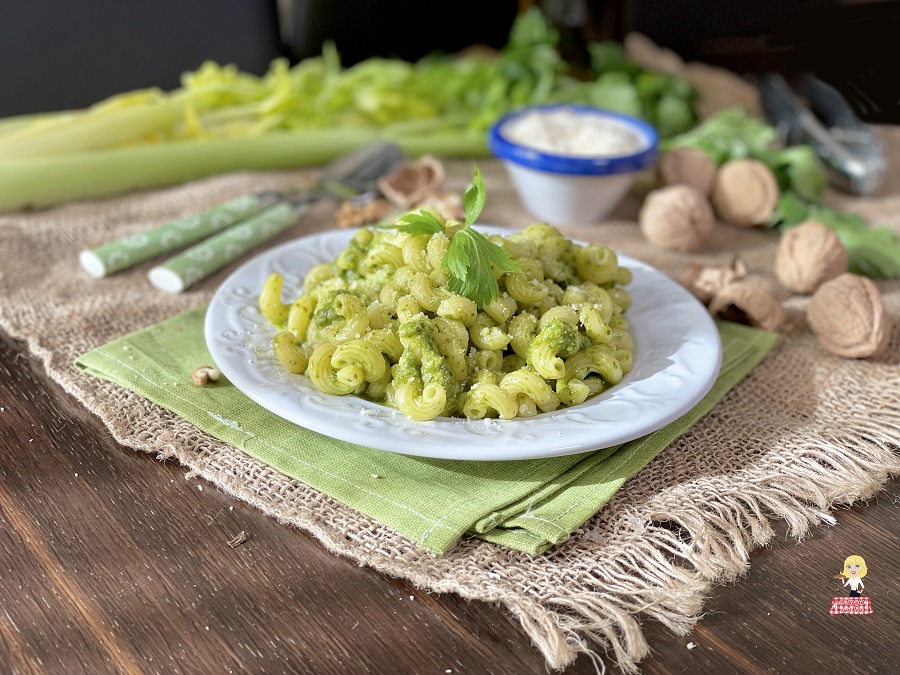
Finally, add the grated Pecorino cheese. Blend for a few seconds, just enough to incorporate the cheese into the pesto. This prevents the cheese from releasing too much oil or becoming bitter.
Your pesto with celery leaves is ready! Taste and, if necessary, adjust the salt.
Storage
The pesto with celery leaves keeps in the refrigerator in a well-sealed glass jar, covered with a thin layer of extra virgin olive oil on the surface (which creates a protective layer), for 3–4 days. You can also freeze it! I recommend putting it in small glass jars (do not fill them to the brim) or in ice cube trays. Once frozen, transfer the cubes to a freezer bag. It keeps in the freezer for 2–3 months. When using, simply thaw at room temperature or directly in a pan with a little pasta cooking water.
Notes on Ingredients and Possible Substitutions
This pesto with celery leaves is a hymn to simplicity, but every ingredient matters!
Celery: The key ingredient is the celery leaves, which must be fresh and fragrant. The stalk used is the tender central part. Do not use yellowed or too fibrous celery.
Almonds: The peeled almonds add creaminess and a sweet note that balances the celery flavor. You can substitute them with: Pine nuts: 30–40 g for a more classic and delicate taste.
Walnuts: 40–50 g for a more rustic and assertive flavor.
Cashews: (for a vegan version, see below) 90 g for extra creamy texture and a milder taste.
Pecorino: Grated Pecorino gives a salty and aromatic touch. If you prefer a milder taste, you can use Parmigiano Reggiano or Grana Padano (40 g).
Garlic: A small clove is enough to give aroma without covering other flavors. If you don’t like it, you can omit it or briefly blanch it to make it milder.
EVO oil: Choose a good-quality extra virgin olive oil; it is fundamental for the final flavor of the pesto.
Uses and Pairings
The pesto with celery leaves is a real kitchen wildcard, ready to transform a thousand dishes!
Pasta sauce: Its most classic and quick pairing! It’s excellent with short pasta shapes such as penne, fusilli, or with spaghetti. Add a little cooking water to emulsify.
Bruschetta and Crostini: Spread it on toasted bread slices for a tasty and colorful appetizer.
Sauce for Main Courses: It pairs perfectly with fish (salmon, steamed cod) or white meat (grilled chicken breast).
Boiled or Steamed Vegetables: A spoonful of pesto can turn simple boiled potatoes, green beans, cauliflower or broccoli into a gourmet side dish.
In Soups and Creams: A teaspoon of pesto added at the end of cooking will give soups and purees an extra touch of flavor and freshness.
To Enrich Sandwiches and Panini: A thin spread inside sandwiches instead of mayonnaise for a fresher, lighter touch.
The Roots of Flavor: The History of Celery and the Zero-Waste Pesto
Celery, with its unmistakable aroma, has been a pillar of Mediterranean cuisine since antiquity. The Egyptians and Romans already used it, not only in the kitchen but also for its medicinal properties. Over time, it became the indispensable ingredient of the Italian “soffritto,” the aromatic base of countless dishes. But its most precious part, the one we often discard, is precisely the leaves. Historically, nothing was wasted: the leaves were used for broths, to flavor roasts, or finely chopped as a seasoning.
The idea of turning herb or vegetable leaves into a pesto is an evolution of the Ligurian concept of pesto alla genovese, born to showcase basil. But the philosophy of “waste nothing” is a cornerstone of Italian peasant cooking, an art of recovery that is more relevant today than ever. This pesto with celery leaves is a perfect example of how culinary tradition teaches us to respect ingredients, transforming what at first glance might seem like “scraps” into a true gustatory resource. It’s a way to honor food, reduce waste and discover new and surprising flavors, with an eye on sustainability and on the budget!
FAQ (Questions and Answers)
Can I use only celery leaves or should I add a little stalk too?
For this recipe, I recommend using mostly the leaves, as they are the most aromatic and flavorful part. A small piece of the tender stalk (about 0.7 oz) can help with texture and add a slight freshness, but the important thing is that most of the mix is leaves to obtain that characteristic celery pesto flavor.
How can I prevent the pesto from darkening and losing its bright color?
The secret to maintaining the bright green color of the pesto with celery leaves is to blend in short bursts and avoid overheating the ingredients. Excessive heat generated by the blender can oxidize the leaves, making them dark. Also, covering the pesto with a thin layer of extra virgin olive oil before storing in the refrigerator helps preserve color and freshness by creating a protective barrier from air.
Can I use a different cheese instead of Pecorino?
Certainly! If the strong flavor of Pecorino isn’t to your liking, you can substitute it with grated Parmigiano Reggiano or Grana Padano (same amount, 40 g). These cheeses will give your celery pesto a milder but still flavorful taste. For a vegan version, you can omit the cheese or use nutritional yeast flakes for a savory touch.
