
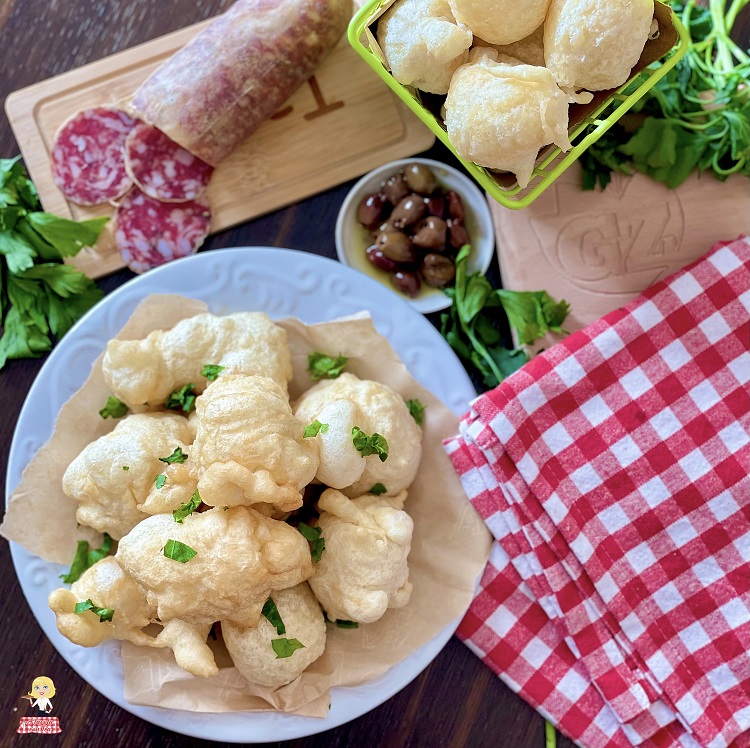
Today we’ll prepare the PETTOLE recipe together, also known as Pitulle: soft and delicious balls of leavened dough typical of Apulian cuisine but also common in Calabria and Basilicata.
They are made with a dough based on flour, water and fresh yeast that, once risen, is taken by spoonfuls and fried in hot seed oil until they become lightly golden.
Originally typical of Christmas tradition, they are now prepared all year round thanks to their versatility.
They can be enjoyed hot or at room temperature, savory or sweet: excellent as an appetizer served with cured meats, or as a decadent dessert when prepared sweet.
As with all traditional recipes, there are many regional variations. Today’s version is the Apulian Pettole recipe that I had the pleasure of tasting on a family trip and for which I got all the instructions.
It’s a very easy preparation: the dough can be made by hand simply with a spoon in a bowl: just pour all the ingredients into the bowl, stir for 2 minutes and wait for the dough to rise.
Once risen, they are fried by spoonfuls in oil, like zeppole, and as soon as they are golden they are drained and ready to serve.
The basic dough is neutral, so you can bake it “plain” or add small pieces of anchovies or olives for a savory version, or toss them in granulated sugar while still hot for a warm, soft and tempting sweet.
Crispy and irresistible, they cannot be missing from your party buffet!
- Difficulty: Very easy
- Cost: Very inexpensive
- Preparation time: 30 Minutes
- Cooking time: 20 Minutes
- Portions: 30 pettole
- Cuisine: Italian
- Energy 202.98 (Kcal)
- Carbohydrates 28.99 (g) of which sugars 0.68 (g)
- Proteins 4.77 (g)
- Fat 8.32 (g) of which saturated 1.37 (g)of which unsaturated 6.28 (g)
- Fibers 1.07 (g)
- Sodium 313.13 (mg)
Indicative values for a portion of 80 g processed in an automated way starting from the nutritional information available on the CREA* and FoodData Central** databases. It is not food and / or nutritional advice.
* CREATES Food and Nutrition Research Center: https://www.crea.gov.it/alimenti-e-nutrizione https://www.alimentinutrizione.it ** U.S. Department of Agriculture, Agricultural Research Service. FoodData Central, 2019. https://fdc.nal.usda.gov
Ingredients
- 4 cups 00 flour (tipo 00)
- 0.35 oz fresh yeast
- 2 1/8 cups water (lukewarm)
- 1 3/4 tsp fine salt
- peanut oil (for frying)
Tools
- 1 Bowl
- 1 Pan
Steps
Pour the flour into a bowl, crumble the fresh yeast inside, mix quickly with the pads of your fingers, then add the water at room temperature.
Stir with a spoon until the water is well absorbed. Finally add the salt and mix until it is fully incorporated into the dough.
It is normal for the dough to be a little sticky.
Cover the bowl with plastic wrap and let rest for about two hours, or at least until it has tripled in volume.
Rising times depend on the room temperature, which should be around 75°F; obviously in winter the times will be longer.
When the resting time is over, heat seed oil in a narrow, tall-sided pot until it reaches a temperature of 338°F.
If you don’t have a kitchen thermometer, simply drop a small piece of dough into the oil: if it immediately rises to the surface, the oil has reached the right temperature.
Start frying the balls a few at a time so they don’t stick together.
To form the balls use two spoons: with one spoon scoop the dough from the bowl and with the other let the dough slide from the spoon into the oil.
Cook the pettole for about 3 minutes until they are lightly golden, then drain them with a slotted spoon and transfer them to a plate lined with paper towels to remove excess oil.
Here are the PETTOLE, enjoy them while still hot!
Follow my Instagram profile by clicking HERE
STORAGE
Pettole should be eaten, like all fried foods, immediately after preparation and while still hot; refrigeration or freezing is not recommended.
NOTES
There are many variations of the Pettole recipe depending on the area where they are made.
For a savory version add about twenty sliced olives to the dough or small pieces of anchovies in oil.
You can also leave the classic dough, fry it and then dress it with tomato sauce.
For the sweet recipe toss the pettole in granulated sugar or honey right after frying.
If you want softer pettole you can replace 1/3 of the water with milk; it will also be essential to beat the dough several times in the bowl to incorporate air.
