
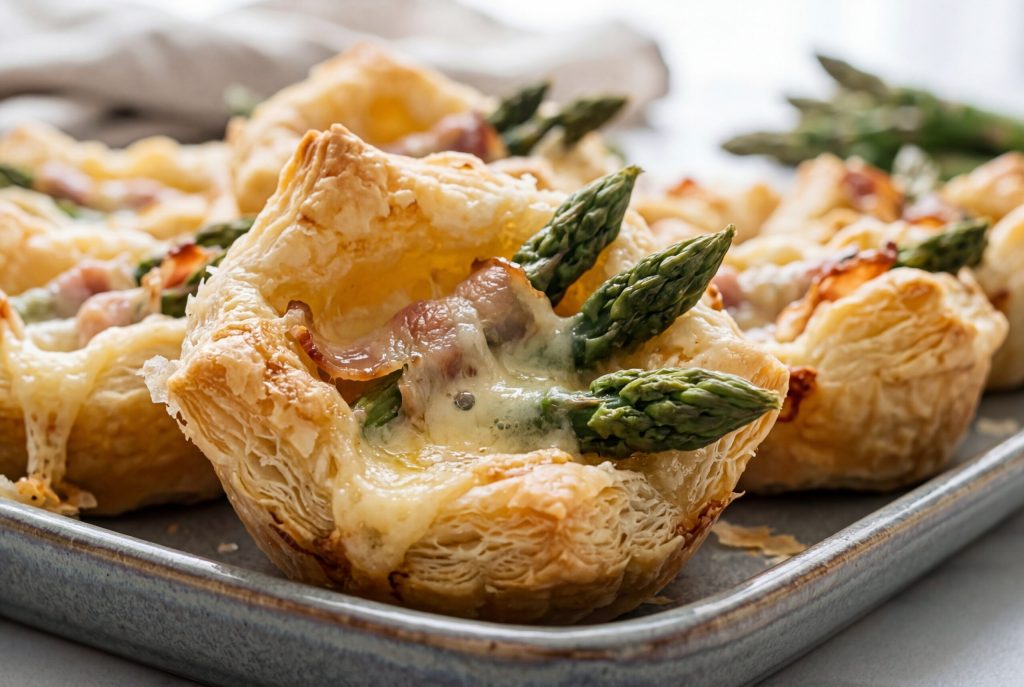
Puff pastry baskets filled with sautéed asparagus, crispy bacon and smoked provola
How to preserve the pastry’s flakiness
There’s nothing sadder than a puff pastry starter that, once out of the oven, reveals a wet, soggy, underbaked base.
It’s a common problem: the filling, especially if it contains vegetables like asparagus or cheeses that release whey, tends to “wet” the pastry and prevents it from properly puffing.
So you end up with a golden, inviting rim but a bottom that looks undercooked. The secret to avoiding this issue isn’t just oven temperature, but how we treat the ingredients before they touch the pastry.
In this recipe I’ll teach you how to manage textures to achieve a flawless result.
Get ready to serve a bite that cracks under the teeth and reveals a silky, melty heart.
Let’s get to work — your Easter table (and beyond) will thank you!
- Difficulty: Easy
- Cost: Inexpensive
- Preparation time: 20 Minutes
- Cooking time: 25 Minutes
- Portions: about 12 baskets
- Cooking methods: Stovetop, Oven
- Cuisine: Italian
Ingredients Puff Pastry Baskets with Asparagus and Bacon
- 1 roll puff pastry (fresh rectangular, high-quality)
- 1 bunch asparagus
- 12 slices bacon (thinly sliced)
- 7 oz smoked provola cheese (cut into cubes)
- 1 clove garlic
- to taste extra virgin olive oil
- to taste fine salt
- 1 pinch black pepper (ground)
Tools
- Muffin pan
- Pan
- Pastry wheel
- Parchment paper
Puff pastry baskets filled with sautéed asparagus, crispy bacon and smoked provola
Trim the asparagus, removing the woody ends, and cut them into pieces about 1¼–1½ in long. In a pan, heat a drizzle of olive oil with the garlic clove. Sauté the asparagus over high heat for a few minutes: they should remain turgid and bright green, but release their cooking water. Salt, pepper and — a crucial step — let them cool completely. Placing hot vegetables on the pastry would immediately compromise its airy structure.
Unroll the puff pastry cold from the refrigerator (the low temperature helps the pastry’s flakiness). Using a pastry wheel, cut 12 rectangles about 1½ x 2 in. Grease the muffin tins well and line them with the pastry rectangles, pressing gently on the bottom to create a basket shape. The pastry should look taut and slightly translucent at the edges.
Move on to filling. Place one slice of bacon in each basket: the salami’s fat, melting during baking, will flavor the pastry base. Add the cubes of smoked provola and finally the now-cooled asparagus pieces. Finish with a grind of pepper and a final, very light drizzle of oil.
Bake in a preheated oven at 392°F for about 20–25 minutes. The high temperature is necessary so that the water contained in the butter of the pastry evaporates instantly, creating crystalline, golden layers. Once out of the oven, let them cool in the tin for one minute so the cheese stabilizes, then serve immediately to enjoy maximum crispness.
Notes on ingredients and substitutions
The Pastry: I strongly recommend buying a good-quality puff pastry (fresh or frozen), preferably made with butter rather than hydrogenated vegetable fats. You’ll obtain a much better puff, higher and more crystalline.
The Cheese: If you don’t like smoked provola, you can use low-moisture pizza mozzarella or fontina for a silkier, sweeter result.
Storage
These baskets are best right out of the oven. If you have leftovers, store them in the fridge for one day and reheat in a hot oven (not the microwave!) for 5 minutes to restore the pastry’s crispness. Freezing is possible only when raw.
Variations
Vegetarian version: Replace the bacon with well-drained sun-dried tomatoes in oil to keep the savory note without meat.
Trick for the base: If you’re worried the bottom will stay soggy, sprinkle the pastry base with a pinch of very fine breadcrumbs before adding the filling: they will absorb any excess juices.
A bit of History and Curiosity
Puff pastry, with its incredible structure made of thousands of layers, is one of the most technical bases in pastry and international cuisine. Legend has it that it was perfected in France, but the idea of layering fat and dough goes back to very ancient times. In this recipe we use it as a “treasure chest” for asparagus, a symbol of spring renewal, creating a union between European technique and the bold flavors of our peasant tradition.
FAQ (Questions & Answers)
Can I use round puff pastry?
Yes, but you’ll have more waste. Rectangular pastry is ideal to optimize 12 rectangles without having to rework the scraps (an operation that would ruin the puffing).
Should asparagus be blanched?
No, sautéing them in a pan is better: they keep a firm bite and a more intense flavor compared to boiling.
Why did the provola come out of the basket?
Make sure you don’t overfill the baskets. When heated, the cheese becomes fluid and tends to expand.
