
Quick Homemade Panettone in 1 Day: Artisan Recipe (Ready with 5 Hours of Proofing)
The Challenge of a Quick Panettone: Problem and Solution
The main difficulty in making Panettone in just 24 hours (with a fast proof) is ensuring the gluten network develops properly (windowing) and that the dough is strong enough to support the large amount of butter and egg yolks.
If the windowing is not perfect, the dough sticks to the bowl, can’t hold the butter and will collapse.
The trick for a strong, glossy dough:
Soft Butter, But Not Melted: The butter should have the consistency of a pomade. Keep the butter softened in a small bowl next to the stand mixer.
Methodical Addition: Add the butter in very small pieces, one at a time. Move to the next piece only when the previous piece is completely invisible, worked in and absorbed by the dough.
This patience is the key to final windowing and the airy structure of your Panettone.
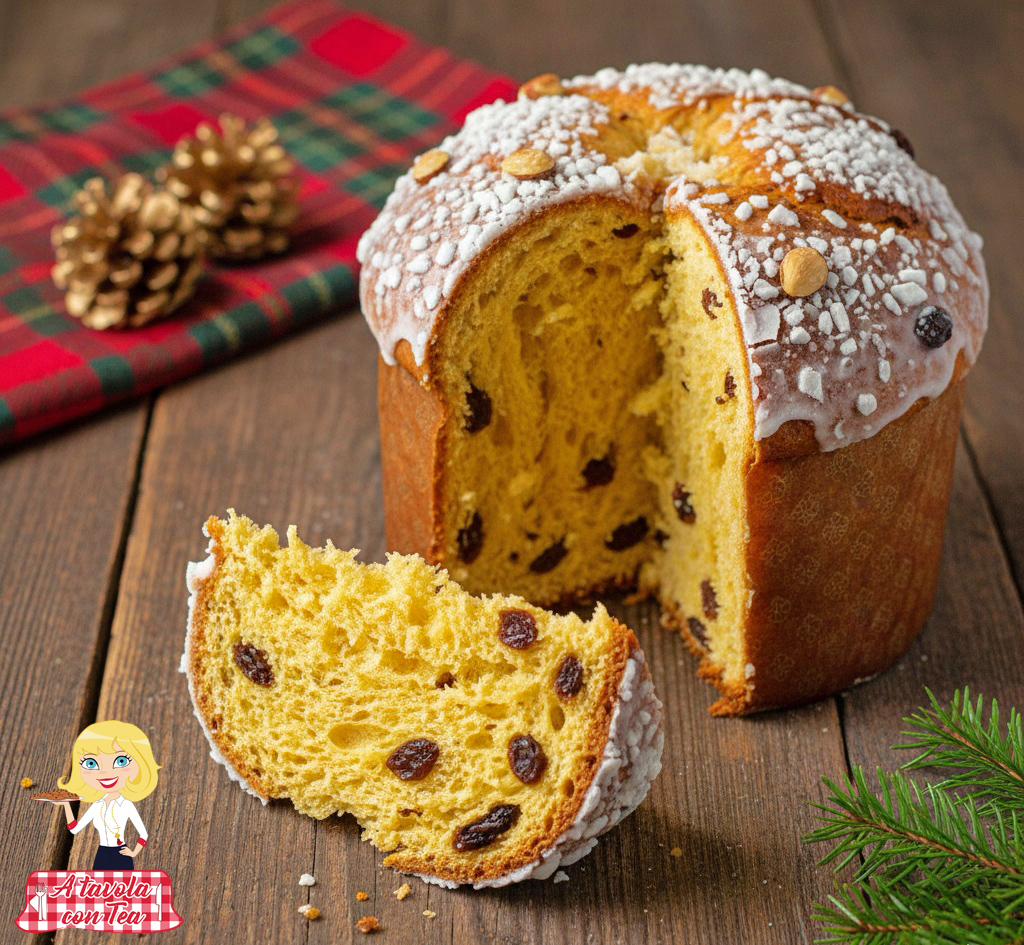
- Difficulty: Medium
- Cost: Medium
- Rest time: 5 Hours
- Preparation time: 30 Minutes
- Cooking time: 45 Minutes
- Portions: kg
- Cooking methods: Oven
- Cuisine: Italian
Panettone Ingredients
- 1/2 cup Manitoba flour
- 1/4 cup water
- 0.5 oz fresh baker's yeast (or about 1 2/3 tsp (5 g) active dry yeast)
- 3 1/3 cups Manitoba flour
- 1/2 cup water
- 1/2 cup granulated sugar (about 110 g)
- 4 egg yolks egg yolks (about 4)
- 1/2 cup butter (soft (about 110 g / ~3.9 oz))
- 1 tsp fine salt (Added at the end of windowing)
- 1 tbsp + 1 tsp honey (about 25 g)
- 2 orange zest
- 1 lemon zest
- 1 tsp vanilla extract
- 1 1/3 cups raisins (for the filling: soaked and dried)
- 1/3 cup almond meal (about 40 g)
- 3 tbsp sugar (about 40 g)
- 1 egg white egg white (about 1 (20 g))
- 8-10 whole almonds (for decoration (about 10 g))
- to taste pearl sugar
- to dust powdered sugar
Tools
- Kitchen scale
- Small bowl
- Stand mixer
Step-by-Step Preparation
Aromas and Butter: In a small container, combine the honey, the grated citrus zests (orange and lemon) and the vanilla extract or the seeds from a vanilla bean. Take the butter out to soften. Put the raisins to soak.
Prepare the Starter (Biga): In a bowl, mix 1/2 cup flour, 1/4 cup water and 0.5 oz fresh baker’s yeast (or the equivalent dry). Mix well, cover with plastic wrap and let rise for 1 hour.First Dough: Pour the risen starter into the stand mixer bowl along with 3 1/3 cups flour, 1/2 cup water and the aroma mix (citrus zests + honey + vanilla). Work with the flat beater for about 3-4 minutes on low speed.
Adding Yolks/Sugar: Add half of the granulated sugar and immediately after half of the egg yolks. Continue kneading. After absorption, add the remaining sugar and the remaining yolks.
Gluten Development: Work until the dough is completely windowed, glossy and pulls away from the bowl. If necessary, help detach it with a spatula, but only if it sticks too persistently.
Adding Butter (Crucial): Replace the flat beater with the hook. Add the 1/2 cup of soft butter piece by piece. The secret is not to rush: make sure each piece is absorbed before adding the next. This phase can take up to 20-25 minutes.
Salt: When the dough is perfectly glossy and elastic, add 1 tsp salt and let it work until fully absorbed.
Adding Raisins: Transfer the windowed dough to the work surface. Gently stretch it with your hands (no rolling pin) to form a rectangle of about 16 x 20 inches. Distribute half of the raisins, previously drained, squeezed and well dried.
Folds: Close the dough by bringing the edges inward (letter fold). Distribute the remaining raisins.
Rounding: Roll the dough to form a cylinder and tuck the ends underneath to create a regular ball. Perform a short rounding (circular motions) to slightly tighten the surface, without overdoing it.
Final Proof: Place the dough into a 1 kg panettone mold. Let rise in a warm but controlled environment (an unheated oven with a bowl of hot water is ideal). The temperature should not exceed 79°F-82°F. Proofing will be complete (reaching about 2 cm from the rim) in approximately 4 hours.Drying: Remove the panettone from the oven and let it air-dry for 30 minutes. It should come to the desired level.
Glaze: In a bowl, mix the almond meal and the sugar (3 tbsp each). Add the egg white (about 1) little by little until you obtain a dense but easily spreadable glaze.
Decoration: Gently spread the glaze over the dome. Decorate with whole almonds and plenty of pearl sugar and powdered sugar.
Baking: Bake at 338°F in a conventional oven for 45 minutes on the lower rack. If the surface darkens too much after 30 minutes, cover with aluminum foil.
Crucial Cooling: Remove from the oven, insert the proper skewer about 0.8 in from the base, turn it immediately upside down and let it cool completely in this position (for at least 2 hours or overnight).
Uses, Pairings and Storage
Suggested Uses and Pairings
Festive Tradition: Panettone is at the center of celebrations. Perfect for Christmas breakfast or as a dessert at the end of a meal.
Pairings: Serve it with a passito wine, a sweet sparkling wine (such as Moscato) or accompanied by a rich homemade mascarpone cream.
Storage:
After cooling, seal the Panettone in a food-grade plastic bag (like a freezer bag) to prevent the crumb from drying out.
Store at room temperature, in a cool dry place, for about 7-10 days.
FAQ (Questions & Answers)
My dough windowing has gone wrong, what do I do?
If the dough has “broken” (it has split or fat has separated), stop. Let the dough rest in the refrigerator for 15-20 minutes. The cold will help the dough re-cohere. Then resume kneading at low speed, optionally adding a tablespoon of flour to reabsorb the fats.
How can I be sure the proofing temperature is correct?
Using a kitchen thermometer is highly recommended to monitor the proofing environment. Never exceed 82°F so as not to exhaust the yeast’s strength.
Can I replace the raisins with chocolate chips?
Yes, you can replace the 1 1/3 cups of raisins with 1 1/3 cups of chocolate chips, taking care not to overheat them during mixing.
Why do I have to turn the Panettone upside down?
To prevent the still-warm, fragile crumb from collapsing under its own weight, thus preserving the height and dome shape.
