
Recipe ROAST BEEF in a PAN or SKILLET
The Roast Beef is a meat main course, a great classic of Anglo-Saxon cuisine, usually made with a piece of beef first seared in a pan and then roasted in the oven.
As with all traditional meat preparations such as Roast, Pork Loin or Vitello Tonnato, there are precise rules to obtain a tender and juicy result: slightly pink inside but at the same time with a light crust on the outside.
For roast beef lovers, the idea of making it in a pan may seem daring; in reality, cooking in a heavy pan, when done properly, can replace the classic oven method while keeping the meat delicate and flavorful just like the original recipe.
Reducing preparation times is definitely a huge advantage for people like me who are always in a hurry: roast beef in a pan (about 3.3 lb) is ready in around 30 minutes and for those who want it rare, 20 minutes might even be enough!
With these premises and after several attempts, today I present the ROAST BEEF in a pan recipe, with all the tips and tricks to guide you: from choosing the cut of meat, to the type of pan to use, to cooking times so you can serve a perfect roast beef even on your first try.
A light but flavorful main course, excellent both warm and cold — perfect when served with seasonal vegetables, roast potatoes or caramelized pearl onions.
Prepare roast beef in a skillet — an ideal recipe to present on holidays or for Sunday lunch and if you have leftovers even better: the next day it’s even tastier, perhaps in a sandwich!
Follow the recipe and tips and you’ll cook a textbook roast beef in a pan!
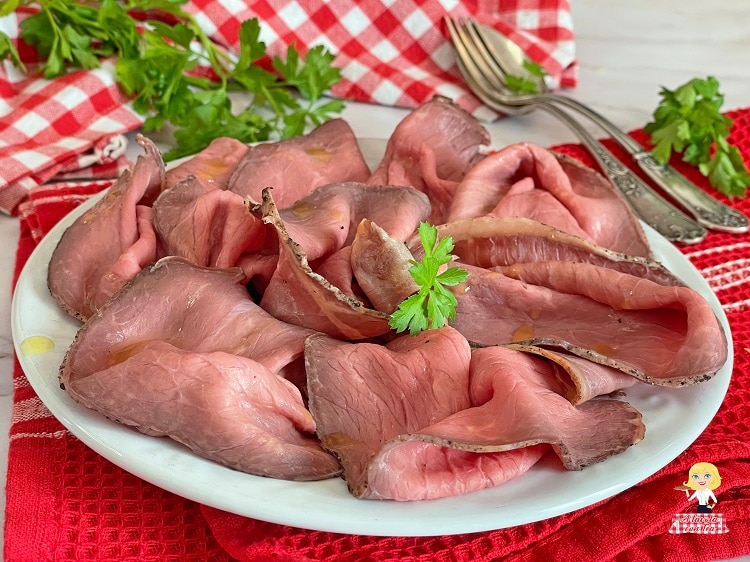
- Difficulty: Easy
- Cost: Medium
- Rest time: 20 Minutes
- Preparation time: 5 Minutes
- Cooking time: 30 Minutes
- Portions: 6/8
- Cooking methods: Stove
- Cuisine: Italian
- Energy 197.03 (Kcal)
- Carbohydrates 6.30 (g) of which sugars 0.44 (g)
- Proteins 25.62 (g)
- Fat 8.05 (g) of which saturated 1.88 (g)of which unsaturated 0.02 (g)
- Fibers 0.32 (g)
- Sodium 1,901.34 (mg)
Indicative values for a portion of 120 g processed in an automated way starting from the nutritional information available on the CREA* and FoodData Central** databases. It is not food and / or nutritional advice.
* CREATES Food and Nutrition Research Center: https://www.crea.gov.it/alimenti-e-nutrizione https://www.alimentinutrizione.it ** U.S. Department of Agriculture, Agricultural Research Service. FoodData Central, 2019. https://fdc.nal.usda.gov
Ingredients Roast Beef in a Skillet
- 2 lbs beef (sirloin, rump, or striploin)
- carrot (1 small)
- onion (1 small)
- celery (1 stalk)
- 2 tbsp extra-virgin olive oil
- 2 tbsp dry white wine
- to taste salt
- 1 pinch black pepper (freshly ground)
- rosemary (1 sprig)
Tools
- Casserole
- Frying Pan
HOW TO COOK ROAST BEEF IN A SKILLET
For optimal results it is very important that the meat is at room temperature, so take it out of the fridge at least one hour before preparation.
Wash the vegetables, clean them and dice them very finely. Pour the oil into a large heavy-bottomed pan, heat it, then add the vegetables and sauté them for a couple of minutes. At this point add the sprig of rosemary as well.
Place the beef in the pan and brown it over medium-high heat on all sides to seal in the juices.
Turn it often with tongs or a spatula so as not to pierce the meat, otherwise it will lose all the juices and become tough. Pour in the white wine, deglaze and let it evaporate. Put the lid on and continue cooking over low heat for another 20–25 minutes.
To check the meat’s doneness you should use a kitchen thermometer and follow these guidelines: at about 104°F the meat will be rare, between 118°F and 131°F it will be pink, from 136°F onward it will be well done.
At the end of cooking transfer the roast beef onto a cutting board, wrap it in aluminum foil and let it rest until warm for about half an hour. Serve it sliced thinly — preferably with a slicer — accompanied by a seasonal side dish.
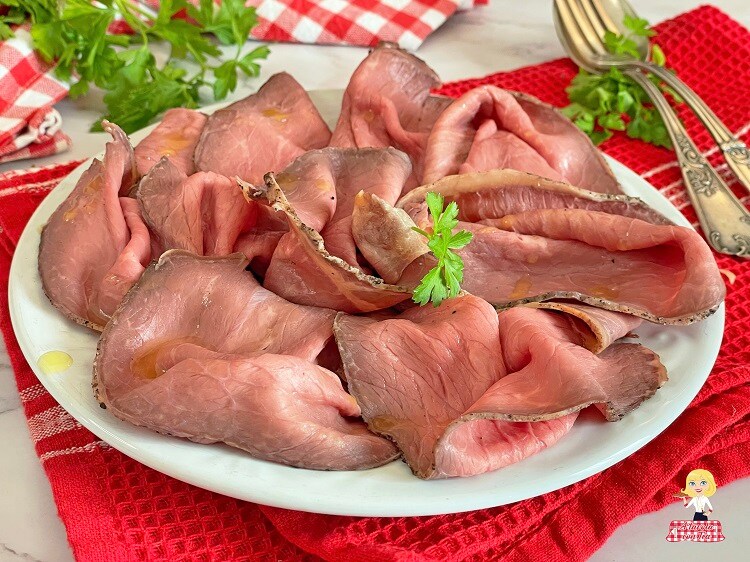
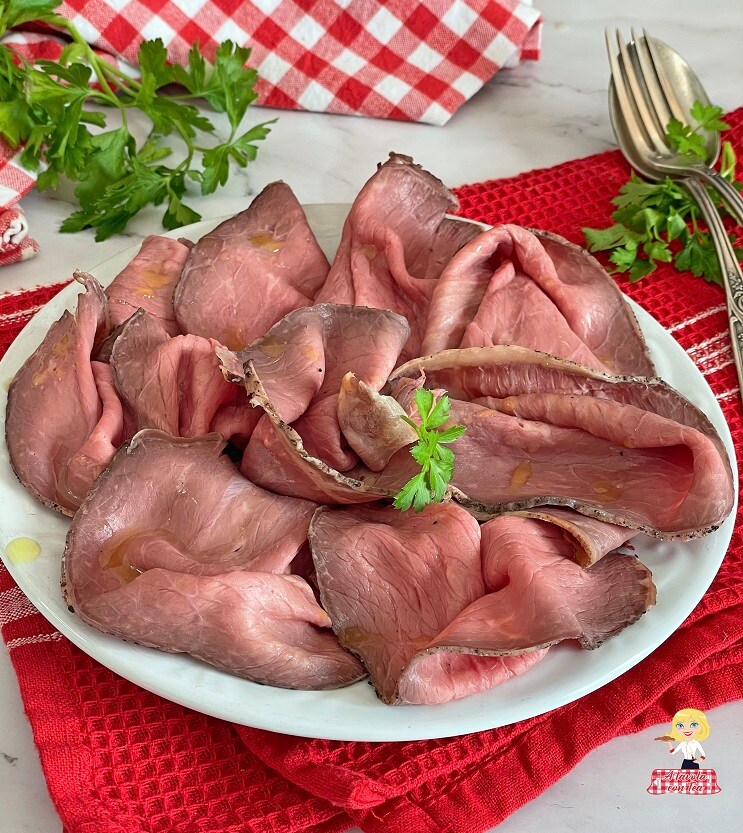
Secrets for a Perfect Roast Beef in a Pan
Cooking roast beef on the stovetop requires a few tricks different from the oven. Here’s what to pay attention to:
Sealing: The Key Step
The secret of a good roast beef in a pan is the Maillard reaction. You must brown the meat over high heat in a base of oil and butter (or aromatics) on all sides, “sealing” the juices inside. Don’t rush: the dark brown crust is what gives all the flavor!
Gentle Cooking and the Pan Juices
After searing, continue cooking over medium-low heat. You can deglaze with white wine or vegetable stock to keep the environment humid and create a base for your pan juices.
Cooking Times in a Pan (per 2.2 lb of meat)
Note: Times may vary depending on the shape of the cut. Using a thermometer remains the safest method.
Desired Result Approx. Cooking Time Internal Temperature
Rare 20-22 minutes 126-131°F
Medium 25-28 minutes 133-140°F
Well Done 30+ minutes > 149°F (Not recommended)
Perfect Roast Beef: Best Cuts for Roast Beef
Tips on the Cut: Secrets for a Tender Roast Beef
One of the most common mistakes is choosing a cut that is too lean or not suitable for quick cooking. For a roast beef that stays tender and doesn’t dry out, it’s essential to opt for cuts from the back or the hindquarter with good marbling (intramuscular fat) or an external fat cap that protects the meat. The prime cut is undoubtedly the striploin (or sirloin), which guarantees juiciness and intense flavor. Other great alternatives are the rump or the topside (noce): they are leaner cuts but equally tender, provided you carefully monitor the internal temperature and ensure it does not exceed 126–131°F (rare) to avoid drying the fibers. Always ask your butcher for a piece of uniform shape, at least 2.2 lb, to guarantee even cooking.
NOTES
WHICH TYPE OF MEAT TO CHOOSE The perfect cuts for Roast Beef are: striploin, rump or sirloin — parts of the beef with more fat; avoid choosing a piece that is excessively lean.
WHICH PAN TO USE The ideal pan for this type of preparation, which involves cooking mainly with fats and almost no liquids, must be able to retain heat and distribute it evenly, so heavy materials like earthenware or cast iron are perfect.
THE SEARING To obtain a perfect roast beef it is very important to sear the meat in oil and seal it over high heat. As soon as it is browned on all sides you can lower the heat and continue cooking. Hasty or uneven searing could compromise the result.
COOKING TIMES Roast beef is traditionally served “rare”, the center of the piece is not cooked and has a red-pink color. In general, for a piece of meat around 3.3–4.0 lb the cooking times are: 20–25 minutes for rare, 25–30 minutes for medium, up to 40 minutes for well done (which I do not recommend).
STORAGE
Consume roast beef within 2–3 days at most. Store the piece of meat in the refrigerator wrapped in cling film and slice it thinly, only the amount you need for a meal.
FAQ (Questions and Answers)
Difference between Roast Beef and Arrosto (Roast)
First of all the origin: Roast Beef has Anglo-Saxon roots and is mainly prepared with striploin and sirloin, while the Italian “arrosto” belongs to Italian culinary tradition and favors selected pieces such as eye round, topside or rump, which are leaner than those used for Roast Beef.
Which pan is best to use?
The ideal is a heavy-bottomed pan, preferably in cast iron or stainless steel, which distributes heat evenly and maintains a constant temperature during searing.
Will the meat become tough in a pan?
No, if you follow the resting rule! After cooking, always wrap the roast beef in aluminum foil for at least 15–20 minutes before slicing. This allows the fibers to relax and the juices to redistribute.
Can I use the same cut for oven roast beef?
Absolutely yes. Striploin, rump or topside work very well. Just make sure the piece fits comfortably in the pan you chose.
