
RUSSIAN SALAD WITH TUNA
The Russian salad with tuna is an easy-to-prepare dish with a rich flavor, a great classic especially on holiday menus, but perfect as an appetizer for a buffet, for aperitif hour or for any occasion or for Sunday lunch.
As with all traditional recipes, there are many variations; almost every family has its own. The one I present today is a thoroughly tested recipe, let’s say my mother-in-law’s signature dish, which she has been preparing this way for years.
In this Russian salad with tuna I used potatoes, carrots and frozen peas as vegetables, plus, of course, mayonnaise. Compared to the classic Russian salad, in this version tuna in oil and anchovies are added to create a sort of tuna sauce.
Preparing the Russian salad is very easy. You just need to boil the vegetables in salted water, drain them and put them in a bowl and then mix them with the tuna sauce and the hard-boiled eggs. Let it rest in the fridge for a couple of hours to let the flavors meld and make it even more tasty, then you’ll be ready to plate it.
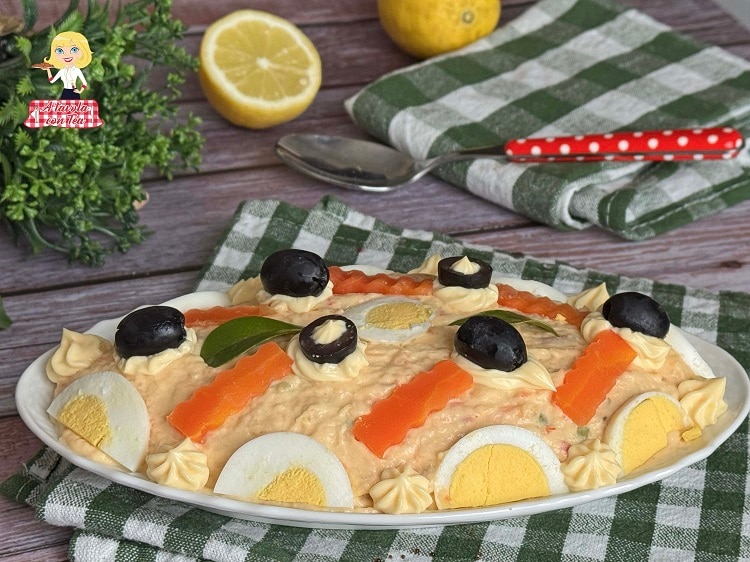
At that point you can decide to create a showy platter by placing the Russian salad on a serving dish and decorating it with hard-boiled eggs, vegetables, gherkins, olives but also shrimp, smoked salmon or trout roe. Decide based on your imagination or simply what you already have available.
Let’s prepare together this super flavorful Russian salad with tuna sauce! And if you’re looking for other appetizer ideas, also check these recipes
- Difficulty: Very easy
- Cost: Budget-friendly
- Rest time: 2 Hours
- Preparation time: 20 Minutes
- Cooking time: 15 Minutes
- Portions: 8
- Cuisine: Italian
- Energy 175.56 (Kcal)
- Carbohydrates 15.95 (g) of which sugars 2.47 (g)
- Proteins 14.77 (g)
- Fat 5.78 (g) of which saturated 1.30 (g)of which unsaturated 2.98 (g)
- Fibers 3.09 (g)
- Sodium 376.13 (mg)
Indicative values for a portion of 75 g processed in an automated way starting from the nutritional information available on the CREA* and FoodData Central** databases. It is not food and / or nutritional advice.
* CREATES Food and Nutrition Research Center: https://www.crea.gov.it/alimenti-e-nutrizione https://www.alimentinutrizione.it ** U.S. Department of Agriculture, Agricultural Research Service. FoodData Central, 2019. https://fdc.nal.usda.gov
What you need to make the Russian salad
For the Russian salad with tuna recipe you can choose to use ready-made mayonnaise or prepare it at home (you can find my recipe HERE). At the end of the instructions you’ll also find how to prepare mayonnaise with the Bimby.
- 2 potatoes (medium)
- 2 carrots (medium)
- 2/3 cup peas (frozen or canned)
- 2 eggs
- 4 pickled gherkins (optional)
- 3/4 cup mayonnaise
- 5 oz tuna in oil (drained)
- 4 fillets anchovies in oil
- to taste salt
- olives (pitted, black or green)
- hard-boiled eggs
- giardiniera (pickled mixed vegetables)
- shrimp (boiled)
- smoked salmon
- parsley
Tools
- Knife
- Pot
- Saucepan
- Blender
HOW TO MAKE RUSSIAN SALAD WITH TUNA
For the Russian salad with tuna recipe you can choose to use ready-made mayonnaise or prepare it at home (you can find my recipe HERE). At the end of the instructions you’ll also find how to prepare mayonnaise with the Bimby.
Clean the carrots: trim, peel and then cut them into very small cubes. Peel the potatoes and then cut them into cubes as well, trying to make them similar in size to the carrots.
Cook the peas in a pot with plenty of salted water. After 4 minutes from when the water is boiling, add the potatoes. You will see the water stop boiling. From when it returns to a boil cook for another 2 minutes. Add the carrots and continue cooking for another 5 minutes. Then drain the vegetables and transfer them to a bowl to cool. If you decided to use pickled gherkins, cut them into very small cubes.
Meanwhile prepare the hard-boiled eggs. Cook them in boiling water for about 9 minutes. After the time has passed, drain them, let them cool slightly and then peel them carefully so as not to break them. Then cut them into small cubes.
To prepare the tuna sauce put the drained tuna in oil, the anchovies and the mayonnaise into the blender, then blend until you obtain a smooth, homogeneous sauce. If you like the flavor you can add some rinsed capers. Make a little extra—you can use it for lots of tasty dishes: see THIS collection.

At this point you’re ready to assemble all the ingredients for the Russian salad. Put the cooked vegetables, the hard-boiled eggs, the gherkins (optional) and the tuna sauce in a large bowl and mix with a spoon until the sauce has completely coated the mixture. Cover with plastic wrap and refrigerate for 1 or 2 hours: it will become much more flavorful!
After the time in the fridge you can plate the Russian salad with tuna. You can choose to arrange it on a serving dish and decorate it with pickles, fresh parsley, hard-boiled eggs or whatever your imagination suggests. Or serve as single portions in glass cups or on individual plates by compacting it with a round cookie cutter. Get creative with the presentation so you’ll serve an appetizer that is not only tasty but also beautiful and refined.
The 3 Essential Tricks for a Perfect Russian Salad
The difference between a run-of-the-mill Russian salad and a buffet masterpiece lies entirely in these three crucial details:
Cutting and “Al Dente” Cooking of the Vegetables
Problem Solved: Vegetables that are overcooked (mushy) or irregularly cut.
The Trick: Cut the potatoes and carrots into very small, uniform cubes (about 5-7 mm). Uniform size ensures even cooking.
Cooking Technique (anti-mushy): Do not cook all the vegetables together! As you do, add them gradually to respect their times:
Start with the peas (the most resilient).
Add the potatoes 4 minutes after the boil.
Add the carrots last (after another 2 minutes).
Timing: This way the vegetables are all al dente at the same time. Drain immediately and let them cool: the thermal shock prevents them from continuing to cook from residual heat.
The Sauce (Tonnato Effect)
Problem Solved: The mixture is dry or the mayonnaise is too heavy.
The Trick: Turn part of the mayonnaise into a homogeneous tuna sauce that coats better.
The Technique: As described in the recipe, adding anchovies and drained tuna blended into the mayonnaise not only gives a richer, more complex flavor (similar to vitello tonnato), but makes the sauce less “pastose” and creamier, ideal for binding the cubes well.
Resting and Serving Temperature
Problem Solved: The Russian salad tastes “flat” if served immediately.
The Trick: Refrigeration is mandatory!
The Technique: Leave the Russian salad in the fridge, covered, for at least 2 hours (but better if overnight). During this time, the potatoes release a little starch and the flavors (anchovies, tuna, mayonnaise) meld together, making the final dish much more harmonious and tasty. Tip: Serve it cold, but not ice-cold, to appreciate all the aromas.
NOTES AND TIPS
VEGETABLES: For this Russian salad with tuna I used potatoes, peas and carrots. You can, however, enrich it by adding for example: blanched green beans, cauliflower, roasted peppers, pickled giardiniera.
TUNA RUSSIAN SALAD VARIANT: Using the same method and substituting the tuna you can prepare Russian salad with smoked salmon or with shrimp. You might also decorate it with trout roe.
MAYONNAISE WITH BIMBY (THERMOMIX) METHOD
Homemade mayonnaise is definitely tastier and making it with the Bimby (Thermomix) is really easy and quick. Here is what you need to prepare the classic mayonnaise recipe:
BIMBY MAYONNAISE INGREDIENTS
About 1 cup + 1 tbsp sunflower oil (250 ml), 1 egg (about 60 g), 2 egg yolks, 1 teaspoon lemon juice or 1 teaspoon vinegar, 1/2 teaspoon salt.
BIMBY MAYONNAISE PROCEDURE
Put the egg, the yolks, the lemon juice and the salt into the bowl. Emulsify: 5 min./speed 4 while slowly pouring the oil onto the lid of the bowl so that it runs in a thin stream. Your Bimby mayonnaise is ready to use or to store in the fridge in a jar.
STORAGE
The Russian salad with tuna can be stored in the refrigerator in an airtight container for a maximum of 2 days. This preparation is not suitable for freezing due to the presence of mayonnaise, which would alter the texture of the dish.
FAQ (Questions & Answers)
Why is it called Russian salad?
It is said that the court chef, on the occasion of the tsar’s visit to Italy at the end of the century, wanted to recreate a dish based on vegetables common in Russia such as potatoes and carrots. The recipe called for a mixture of diced vegetables bound by a creamy sauce meant to recall snow.
What is in Russian salad?
There are many versions of Russian salad. What you often find in almost all recipes are boiled vegetables (diced potatoes, peas, carrots and pickles) and hard-boiled eggs, all dressed with mayonnaise.
How long does Russian salad last in the fridge?
Once prepared, transfer to an airtight container and keep in the refrigerator. Under these conditions it stays fresh for 2-3 days, after which the mayonnaise may begin to separate and the vegetables lose consistency.
When is Russian salad eaten?
Russian salad can be served as an appetizer but also as a side dish. It is a staple for holiday menus such as Christmas, New Year’s and Easter but great all year round at buffets or for a standing aperitif. A classic recipe that never gets boring and is always appreciated by everyone.
What’s the difference between Russian salad and capricciosa salad?
Capricciosa salad differs from the Russian mainly for two reasons: the vegetables are raw and are cut into julienne strips instead of cubes.
How to serve Russian salad?
Some like Russian salad with breadsticks, focaccia or a piece of toast, others love it as filling for rolled cooked ham or even for hard-boiled eggs. You can also fill puff pastry vol-au-vents or cones with Russian salad, or use it to fill toast or sandwiches.
