
Those who know me know I prefer fish to meat — perhaps because I grew up in a family where fish dishes dominated at the expense of others.
By fate, marrying Marco put me, so to speak, in a family of carnivores!
Trying to reconcile the two traditions I often attempted various meat recipes but with poor results: I never got the cooking right — either overcooked and tough as a rock, or too raw. In short, a disaster, and I gave up on further attempts.
One day my son, invited for lunch at my dear friend Federica’s, came home saying he had eaten something delicious… roast beef! He insisted I get the recipe so he could have it again as soon as possible. Needless to say, I told him his mother was hopeless at cooking meat and that if he wanted it again he’d have to get invited back!
Given his insistence I decided to try one last time; after all, she’s not only my best friend but also a very good cook, so I trusted her recipe.
I prepared it and called my little home expert for judgment: the voice of truth who wouldn’t hesitate to tell me: “Aunt Fede’s is better!”
He takes a bite, then another, looks at me, pauses for a moment and opens a huge smile: “Mom, it’s delicious, just like Aunt Fede’s!” He couldn’t have given me a better compliment — hooray, I finally made it!!!!!!!
If you’ve always struggled with cooking meat, try Aunt Fede’s recipe and follow her directions like I did: you’ll get an amazing salt-crusted roast beef — tender, flavorful and juicy — with no added fats.
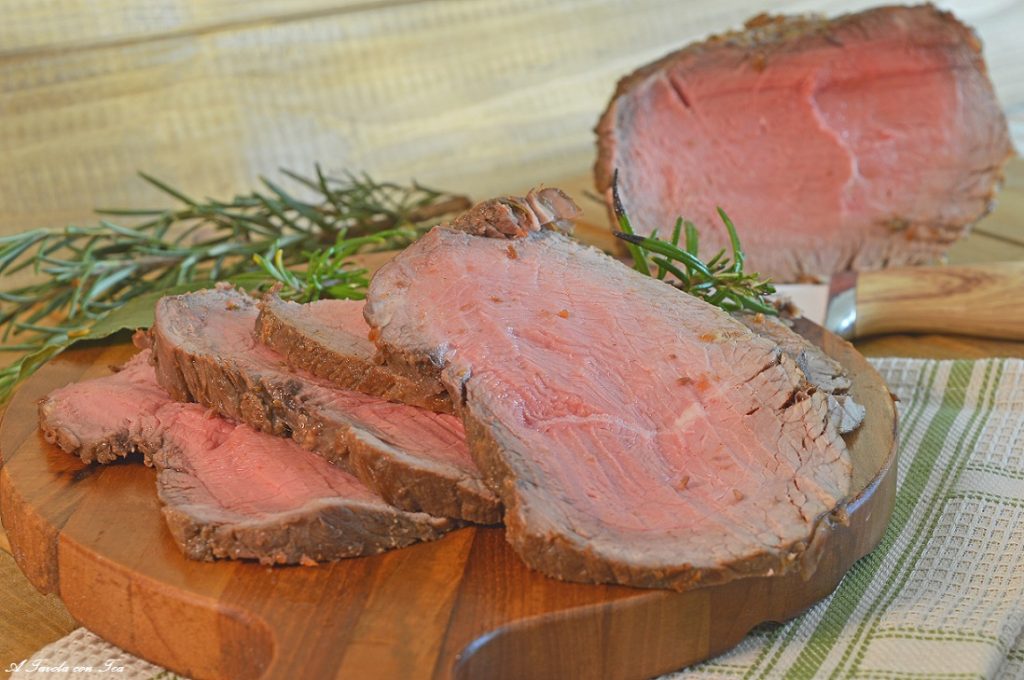
- Difficulty: Very easy
- Cost: Medium
- Preparation time: 10 Minutes
- Cooking time: 20 Minutes
- Portions: 4 servings
- Cuisine: Italian
Ingredients
- 1.3 lb beef (cut for roast beef (600 g))
- 4.4 lb coarse salt (2 kg)
- 2 tbsp water
- 2-3 leaves bay leaves (about 2–3 bay leaves)
- 1 tbsp fresh thyme (or 1 tsp dried (about 5 g))
- 1 tbsp fresh rosemary (or 1 tsp dried (about 5 g))
Preparation
First, preheat the oven to 200°C (392°F) in conventional mode. Wash and dry the aromatic herbs, place them in a food processor and chop finely. With the herb mix, massage the meat, rubbing the surface of the roast beef thoroughly so the herbs adhere well on all sides.
Take a high-sided roasting pan large enough to hold the meat and the salt. Create a layer of coarse salt on the bottom of the dish about 2 cm high (about 3/4 inch), then place the meat on top of it.
Using the remaining salt, completely cover the roast beef so that it is encased in a layer at least 2 cm (about 3/4 inch) thick. Lightly moisten the surface of the salt crust with a little water so that the crust will harden more during cooking.
Bake at 200°C (392°F) in conventional mode for 20 minutes. (Cooking times to achieve the classic rare roast beef are about 20 minutes for every 0.5 kg (1.1 lb) of meat — after the first kilogram (2.2 lb) add 20 minutes more for each additional kilogram. For example, for a 1.5 kg (3.3 lb) roast you will need approximately 40 minutes for rare.)
When the time is up, remove the pan from the oven and let the meat rest at room temperature for 10 minutes. Then, using a spoon and a knife, gently remove all of the salt crust, taking care not to burn yourself.
Place the meat on a cutting board, if necessary scrape off any remaining salt with a knife, then, using a very sharp knife or a slicer if you have one, cut into thin slices and arrange on a serving platter accompanied by a generous salad or roasted potatoes.
Notes
If you prefer the meat more cooked, extend the cooking time. The only difficulty, since you can’t visually check the doneness, is finding your ideal cooking point given the differences between ovens. I recommend doing a few trials to adjust to your needs. For example, at home we don’t like very rare meat, and I leave it 25 minutes.
As I said before, for larger cuts adjust considering that after the first kilogram (2.2 lb) you add 20 minutes for each additional kilogram. If you have leftovers they can be stored in the refrigerator for 2–3 days maximum.
The choice of coarse salt is deliberate: it creates a protective barrier around the roast beef without over-salting the meat. Fine salt would penetrate and risk making the dish too salty.
