
Savory Brezel or Pretzel: The perfect recipe with a baking-soda trick!
There’s an icon of savory comfort food that, as soon as you see it, immediately evokes festivals, European street food and that unmistakable crunch: I’m talking about savory Pretzels or Brezel. These golden knots are not only delicious, they’re a real ritual.
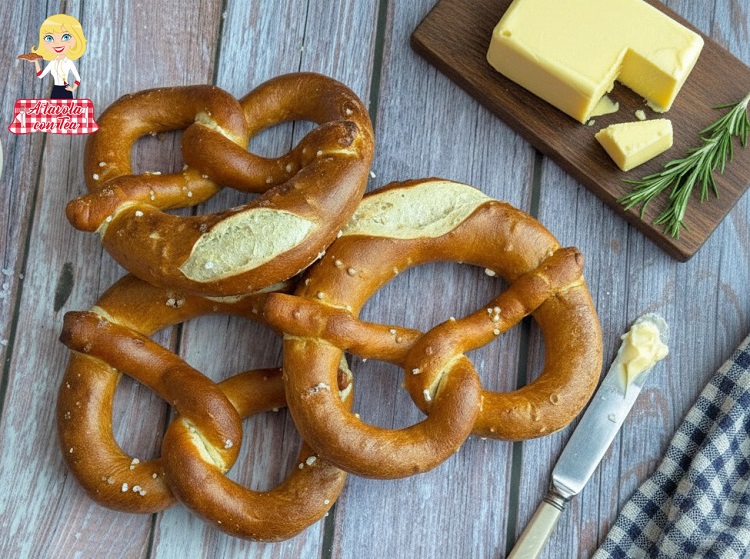
The magic of a perfect pretzel lies in the contrast: a soft, spongy interior wrapped in a thin, glossy crust with the characteristic deep brown-reddish color, studded with coarse salt.
But how do you get that iconic color? The traditional recipe calls for a dip in a lye solution (sodium hydroxide) before baking.
From experience I know that lye is neither easy nor safe to handle in a home kitchen. Safety first!
That’s why I’ve developed this more “accessible” version which, I guarantee, will give you a surprisingly similar result using an ingredient we all have in the pantry: baking soda!
The boiling bath of water and baking soda raises the water’s pH, simulating the effect of lye and accelerating a reaction that gives the dough its color in the oven.
This recipe only requires a bit of patience for the proofing and a pinch of skill for shaping.
Follow the steps for dough consistency and the baking-soda trick, and get ready to bake perfect Brezel. They are ideal warm, perhaps paired with a cold beer!
- Difficulty: Easy
- Cost: Very inexpensive
- Preparation time: 20 Minutes
- Cooking time: 40 Minutes
- Portions: 8
- Cuisine: Italian
Ingredients (Doses for 12/14 Pretzels)
- 4 cups Manitoba flour
- 1 cup milk
- 4 tsp fresh yeast
- 1 tsp granulated sugar
- 1 tsp fine salt
- 1 tbsp extra virgin olive oil
- 2 tbsp baking soda (for the boiling bath)
- coarse salt (for decorating)
Tools
- Kitchen scale
- Bowl
- Small bowl
- Spoon
- Pot
- Parchment paper
- Baking sheet
BREZEL OR PRETZEL PROCEDURE
In a bowl, combine the Manitoba flour, granulated sugar, fine salt and olive oil. Mix with a wooden spoon. In a separate container, dissolve the fresh yeast in the milk slightly warmed. Add the milk with the yeast little by little to the flour mixture and knead.
Transfer the dough to a work surface and knead well for about 10 minutes until you obtain a homogeneous, soft dough — it will feel firm but elastic. Transfer the dough to a bowl covered with plastic wrap and let it rise in a warm place for at least 2 hours, or until doubled in size.After rising time, divide the dough into 12–14 pieces of similar weight. Roll each piece into a rope about 20–24 inches (50–60 cm) long. The secret is to make the central part thicker (about 3/8 in) than the ends, which should be very thin. Shape the classic pretzel: cross the ends and fold them back over the center.
While shaping the pretzels, bring to a boil in a large pot the water with two heaping tablespoons of baking soda per 4 cups (1 L) of water. As soon as the water boils, immerse the pretzels two at a time for about 30–40 seconds (no more!). Transfer the pretzels to a clean towel to drain and dry slightly.
Transfer the pretzels to a baking sheet lined with parchment paper. Quickly brush them with a little milk (this helps the salt stick). Generously sprinkle coarse salt on the thick part. Bake the pretzels in a convection oven at 356°F (180°C) for 35–40 minutes (or at 374°F (190°C) in a conventional oven), until they are nicely browned. Serve warm to enjoy them at their best!
The true German recipe for Laugenbrezel (lye pretzels) uses a dip in a sodium hydroxide (lye) solution before baking. This highly alkaline chemical reacts immediately with the surface starch of the dough, creating the deep brown color and shiny crust very quickly. Warning: lye is corrosive and toxic; it requires gloves, eye protection, and handling in a ventilated environment. For home kitchens, using baking soda (which is safe) in the increased amount described in the recipe is the only safe and recommended alternative!
Ingredient Notes and Substitutions
Manitoba flour: This is essential in this recipe because its high strength holds up well during the long proofing and, above all, resists the boiling in water and baking soda without disintegrating. Do not substitute with weak 00 flour, otherwise the pretzels may break.
Milk: Milk (dairy or plant-based) makes the dough softer and contributes to browning. You can substitute it with water, but the result will be slightly less tender.
Baking soda: Crucial for simulating the effect of lye safely. Do not substitute baking soda with baking powder.
Storage
Pretzels are at their best when eaten hot or warm, right after baking.
They can be stored at room temperature in a paper bag for 1–2 days, but they will tend to lose their crispness.
Freezing: You can freeze the pretzels RAW immediately after the baking-soda bath and slight drying. Freeze them on a baking sheet and then transfer them to a bag. When you want to bake them, put them straight in the oven from frozen (adding about 5–10 minutes to the baking time) and brush and salt them at the last moment.
Iconic Alternatives and Variations
Cinnamon Sweet Pretzels: Omit the coarse salt and the sugar from the original recipe (note: the recipe already contains sugar; for a sweet version remove the coarse-salt topping). Replace 50 g of flour with 50 g of whole-wheat flour (about 3/8 cup or 50 g). After baking, brush with melted butter and sprinkle with a mix of granulated sugar and cinnamon (50 g sugar ≈ 1/4 cup, 1 teaspoon cinnamon).
Cheese Filling: Before boiling, wrap the thicker center of the pretzel with a slice of Edam or mild Provolone. Seal the edges well to prevent the cheese from leaking out.
Seeds Instead of Salt: For a more rustic flavor, replace the coarse salt with a mix of sesame seeds, poppy seeds and flax seeds before baking.
Serving Suggestions and Pairings
Pretzels were made to be paired, and how you serve them makes a difference:
Classic Pairing: Serve with Bavarian sweet mustard or classic mustard.
Dip Sauce: Perfect with a creamy cheese dip (like Cheddar fondue or gorgonzola) or a simple chickpea hummus for a vegan version.
Drink Pairing: Their saltiness is enhanced by a cold pale lager or a Weizen (wheat beer), which balances the dense texture of the leavened dough.
Origins and History of the Recipe
The history of the Pretzel (or Brezel in German) is wrapped in mystery and dates back, according to some sources, as far as 610 A.D. in a monastery in southern France or Bavaria. It is said that a monk invented them to reward children who learned their prayers; the knot shape would represent arms crossed in prayer. It became a symbol in Germany, where it represents the mark of bakers and an indispensable food during Oktoberfest. The salting and boiling, although ancient, have been perfected to turn a simple leavened dough into a crunchy and iconic snack.
FAQ (Questions and Answers)
1. If I don’t use Manitoba flour, will the recipe still work?
Yes, but with reservations. If you use regular 00 or 0 flour, the dough will be less elastic. You should reduce the milk by about 1–2 tablespoons (20–30 ml) and be very gentle when handling the pretzels after boiling, because they will be more fragile.
2. Why did my pretzels come out pale and not brown?
There are two reasons: either the oven temperature was too low, or the baking-soda bath wasn’t effective. Make sure the water is at a rolling boil when you dip the pretzels and don’t bake them at less than 356°F (convection) or 374°F (conventional).
3. Is it normal for the water and baking soda to smell strange?
Yes, that’s absolutely normal! The smell is due to the chemical reaction. For this reason, it’s essential that the pretzel immersion is very quick (max 40 seconds) and, if possible, open a window to ventilate. Do not touch the boiling water with your hands!
